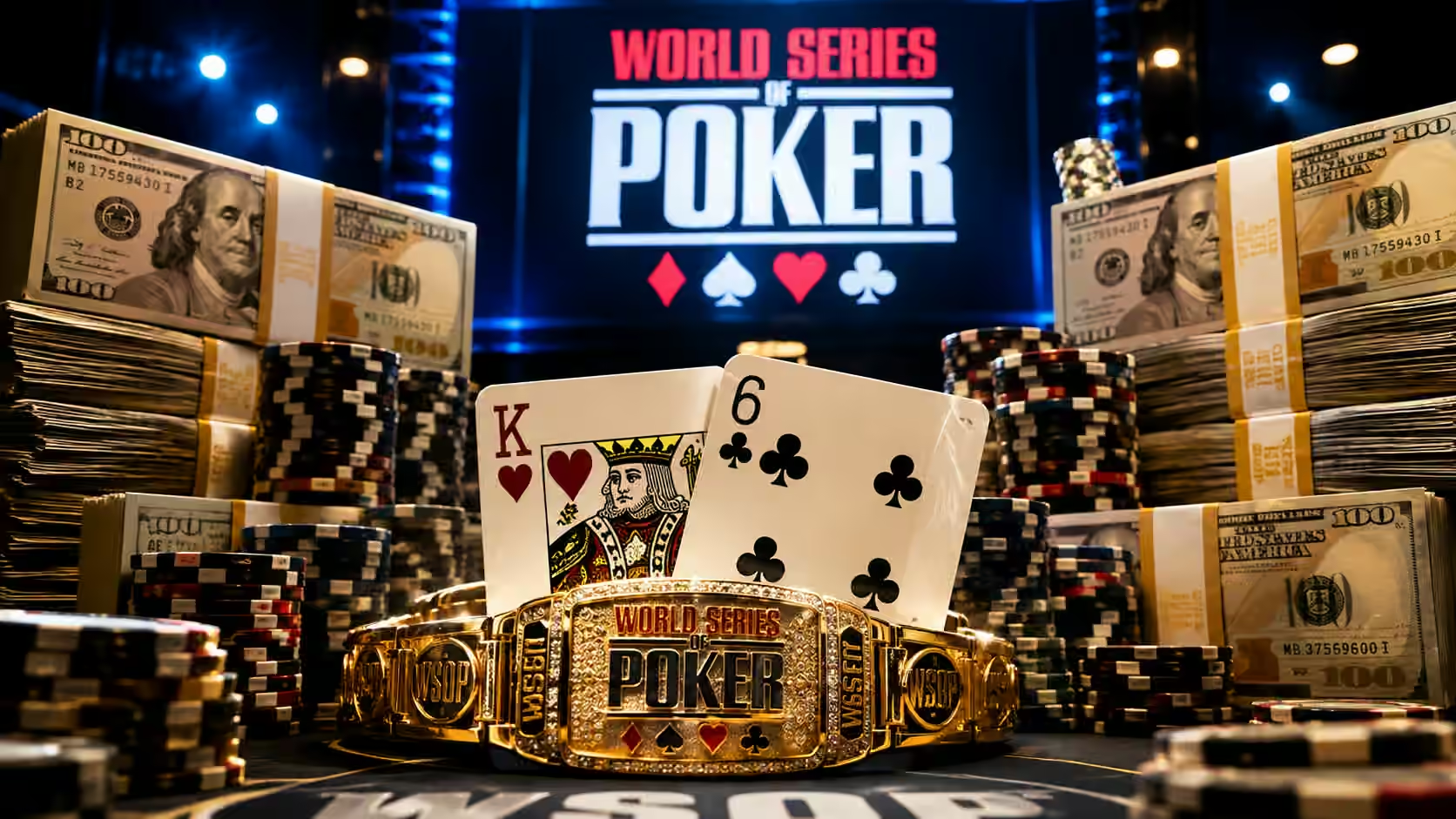
There is a new world champion in poker, and his story almost sounds impossible.
Lucas Jumalon is the 2026 WSOP Main Event winner after defeating a field of 9,208 entries and Finland’s Lauri Saaskilahti heads-up to capture the most prestigious bracelet in poker and a massive $10 million first prize.
But the number that makes his victory truly remarkable is not $10 million.
It is 7,400.
That was the stack Jumalon carried out of Day 1b. He finished the opening flight 758th out of 759 surviving players, sitting near the absolute bottom of the leaderboard with little room for error.
Weeks later, the 22-year-old from Spokane, Washington was standing under the lights in Las Vegas as the World Champion of Poker.
He became the second-youngest Main Event champion in history, held the chip lead for every single hand of the final table, survived one of the most dangerous heads-up momentum swings of the tournament, and then watched one enormous hero call push him within touching distance of the bracelet.
This is how Lucas Jumalon went from 7,400 chips to $10 million, what happened in the hand everyone is still debating, how the final hand played out, and why the 2026 WSOP Main Event may have created poker’s next major star.
For the complete structure, field details and story of the tournament before the final table, read our 2026 WSOP Main Event guide.
Who Won the 2026 WSOP Main Event?
Lucas Jumalon won the 2026 World Series of Poker Main Event for $10,000,000.
The American defeated Lauri Saaskilahti heads-up after the Finnish player finished second for $6 million.
| Place | Player | Country | Prize |
|---|---|---|---|
| 1 | Lucas Jumalon | United States | $10,000,000 |
| 2 | Lauri Saaskilahti | Finland | $6,000,000 |
| 3 | Greg Mueller | Canada | $3,750,000 |
| 4 | Michael Gagliano | United States | $2,750,000 |
| 5 | Han Feng | United States | $2,250,000 |
| 6 | Rami Hammoud | Canada | $1,750,000 |
| 7 | Jamie Shaevel | United States | $1,500,000 |
| 8 | Mario Boos | France | $1,250,000 |
| 9 | Evagoras Evagorou | Cyprus | $1,000,000 |
Every finalist became a millionaire, but the jump from second to first alone was worth $4 million.
Our WSOP Main Event payouts guide covers the complete prize structure from the money bubble through the final table.
Who Is Lucas Jumalon?
Lucas Jumalon is a 22-year-old poker player from Spokane, Washington, and a recent Grand Canyon University graduate.
Before the Main Event made him internationally recognizable, he was far from one of the established superstars expected to dominate the tournament.
That changed quickly.
Jumalon reached the final nine with 194 million chips, more than twice the 79 million held by second-place Rami Hammoud. His stack represented roughly 35% of every chip remaining in the tournament.
More importantly, he converted that enormous advantage.
Main Event chip leaders do not automatically become champions. Players have returned from long final-table breaks with massive stacks only to lose momentum, encounter bad cards or struggle as play becomes short-handed.
Jumalon did the opposite.
He entered the final table first in chips and remained first throughout the entire finale.
That made him the first final-table chip leader to convert the lead into the championship since Koray Aldemir in 2021.
Before the finale began, we analyzed the hands and aggression that created the stack in our Lucas Jumalon poker strategy breakdown.
7,400 Chips: The Number That Makes the Story Incredible
The easiest version of the story is that a huge chip leader reached the final table and finished the job.
The real story started much earlier.
Jumalon ended Day 1b with only 7,400 chips.
He ranked 758th among 759 players who survived that starting flight.
At that stage, there was no 194-million-chip mountain. There was no ESPN final table. There was no $10 million discussion.
There was simply a very short stack and another day of tournament poker.
His progression became extraordinary:
| Stage | Lucas Jumalon Chip Count |
|---|---|
| End of Day 1b | 7,400 |
| End of Day 2 | 146,000 |
| End of Day 3 | 467,000 |
| End of Day 4 | 2,065,000 |
| End of Day 5 | 4,435,000 |
| End of Day 6 | 15,875,000 |
| End of Day 7 | 40,800,000 |
| End of Day 8 | 194,000,000 |
| Champion | $10,000,000 |
This is why his run is more interesting than a simple tournament result.
He did not dominate from the first shuffle. He survived being almost irrelevant on the leaderboard and then increased his stack day after day until the entire tournament revolved around him.
The Final Table Started With One Huge Question
When the final nine were confirmed, everyone could see the same problem.
How do eight players stop a man holding 194 million chips?
Jumalon began with 129 big blinds. Hammoud, his nearest rival, had 53.
The gap allowed Jumalon to put enormous ICM pressure on players who could not afford to fight him carelessly while shorter stacks remained alive.
Our original 2026 WSOP Main Event final table report showed just how extreme the stack distribution was before the long break.
We later compared professional predictions and computer simulations in our article asking who would win the 2026 WSOP Main Event.
The model gave Jumalon approximately a 40% chance of victory.
That made him a heavy favorite by poker standards, but it also meant that even a dominant leader was statistically expected to lose more often than win.
He still had to finish the job.
The Final Nine Begin to Fall
Evagoras Evagorou became the first finalist eliminated, taking home $1 million.
Mario Boos followed in eighth place for $1.25 million, while Jamie Shaevel finished seventh for $1.5 million.
Rami Hammoud, who started second in chips and appeared to be Jumalon’s most obvious threat, eventually exited in sixth for $1.75 million.
Han Feng finished fifth for $2.25 million.
That left two of the most experienced professionals at the table, Michael Gagliano and Greg Mueller, attempting to stop two comparatively less experienced players from reaching heads-up.
Gagliano finished fourth for $2.75 million.
Mueller then took third for $3.75 million.
The final battle was set.
Lucas Jumalon against Lauri Saaskilahti.
A Heads-Up Match Almost Predicted Weeks Earlier
The final pairing had an unusual history.
Jumalon and Saaskilahti had already battled during Day 5 while hundreds of players remained.
After one confrontation, the two joked about potentially meeting heads-up later in the tournament.
That improbable joke became reality.
Saaskilahti entered the last phase as a significant underdog in chips, but he did not simply wait for cards. He fought aggressively and proved capable of pushing back against the tournament leader.
The heads-up match lasted less than two hours, but it contained enough momentum swings to turn what looked like a comfortable Jumalon victory into a genuine battle.
The Double-Up That Nearly Changed Everything
At one point, Saaskilahti found himself all-in with the better ace.
Both players paired the ace on the flop, giving Saaskilahti the stronger kicker and putting him in position to make a major comeback.
Jumalon improved on the turn, but a river card rescued Saaskilahti.
Suddenly the giant chip advantage that Jumalon had protected throughout the final table was under serious pressure.
This was the first moment during the finale when it felt possible that the leader could genuinely lose control.
Then came the hand that changed everything.
The $280 Million Pot Everyone Is Still Talking About
Only minutes after Saaskilahti’s comeback, the two played the hand that has generated the most debate after the final.
Jumalon limped the button with Q♠5♦.
Saaskilahti checked J♦3♦ in the big blind.
The flop came:
A♠ K♠ 4♣
Saaskilahti checked.
Jumalon bet 4 million into 12 million.
Saaskilahti called.
The turn was the J♠.
That gave Saaskilahti a pair of jacks, but Jumalon now held both straight and flush possibilities.
Saaskilahti checked again.
Jumalon fired 40 million into a 20-million pot.
It was a double-pot overbet.
Saaskilahti called again.
The river brought the 6♠.
Jumalon had completed a queen-high flush.
The pot had grown to approximately 100 million chips.
Saaskilahti checked.
Jumalon bet 180 million.
Another enormous overbet.
The Hero Call Worth Almost the Main Event
Saaskilahti had only a pair of jacks.
He also knew that Jumalon was capable of applying extreme pressure.
The Finn entered a long tank and tried to decide whether the 22-year-old champion-in-waiting was firing one final massive bluff.
If Saaskilahti folded, he would still have a fighting chance.
If he called and was correct, the championship could swing dramatically in his direction.
If he called and was wrong, he would be left with only a tiny stack.
He called.
Jumalon showed the flush.
The call left Saaskilahti facing roughly a 12-to-1 chip disadvantage.
The online reaction was immediate. Many viewers described the call as a disaster, but experienced professionals offered a more complicated interpretation. Main Event finalist Ben Lamb was among those who argued that elite players sometimes need to trust a strong read in enormous spots rather than automatically choose the safe option.
The key strategic question is not simply whether one pair looks weak on a four-spade board.
The question is how many value hands Jumalon reaches the river with after limping preflop, betting small on the flop, overbetting the turn, then firing 1.8 times the pot on the river.
Saaskilahti believed the range contained enough bluffs.
This time, it did not.
The hand is exactly why tournament poker cannot be understood from cards alone. Position, ranges, bet sizing, blockers, psychology and millions of dollars in ICM pressure were all involved.
Two Hands Later, It Was Over
Saaskilahti still had one final opportunity.
He moved all-in preflop with A-7.
Jumalon held K-6.
The Finnish player was ahead before the flop.
Then a six appeared.
Another six arrived on the turn.
Jumalon had trip sixes, and Saaskilahti was drawing dead before the river.
After thousands of eliminations, eleven days of Main Event play and a three-night televised final table, the championship was over.
Lucas Jumalon had won $10 million.
Why Jumalon’s Victory Is Historically Significant
The victory produced several milestones.
Second-Youngest WSOP Main Event Champion
Jumalon was 22 years, four months and 27 days old when he won.
Only Joe Cada was younger. Cada was 21 when he won the Main Event in 2009.
First Washington-Born Main Event Champion
Jumalon became the first Main Event winner born in Washington state.
First Final-Table Chip Leader to Win Since 2021
The last player to enter the final table first in chips and convert that advantage into the championship was Koray Aldemir.
Fourth Consecutive American Champion
The Main Event title has now remained with an American player for four consecutive years.
Wire-to-Wire Final Table Leader
Jumalon held the chip lead for every hand of the final table.
That is difficult to appreciate until you consider how quickly tournament stacks can change. One lost race, one cooler or one large bluff can completely reshape a final table.
Jumalon never surrendered the top position.
Patrick Leonard Helped Prepare Him for the Final Table
The unusual break between reaching the final nine and playing the finale gave every finalist time to study.
Jumalon used it.
British high-stakes professional Patrick Leonard helped coach the young chip leader before play resumed.
The coaching likely mattered because the final table required a very different strategy from the earlier Main Event days.
Jumalon was no longer simply another deep-stack tournament player.
He was the player everyone needed to survive.
That creates unique problems. The leader needs to pressure medium stacks without doubling them unnecessarily, attack players constrained by payout jumps, and remain disciplined enough not to mistake a large stack for permission to gamble constantly.
The strategy also became more complex after the WSOP removed the automatic shot clock for the final table. Our article on the WSOP Main Event shot clock controversy explains the rule change and why players criticized its introduction earlier in the tournament.
From Prediction to Reality
Before cards went back in the air, we identified Jumalon as the mathematical favorite.
The reasons were straightforward:
- 194 million chips
- 129 big blinds
- More than one-third of all chips in play
- Enough depth to survive major setbacks
- The ability to apply ICM pressure to every stack
But the path was still uncertain.
Experienced players such as Mueller and Gagliano had stronger resumes.
Hammoud had the second-largest stack.
Saaskilahti eventually proved far more dangerous heads-up than the starting numbers suggested.
The fact that Jumalon won does not mean the prediction was guaranteed. It means he successfully converted the strongest starting position into the only result that mattered.
The Other Big Story: Saaskilahti Leaves With $6 Million
The final hand naturally creates one winner, but Saaskilahti’s run deserves context.
Before this tournament, the Finnish player had nowhere near a $6 million result on his tournament record.
He then outlasted 9,206 players and reached heads-up for the world championship.
His controversial hero call will probably be analyzed for years, but reducing his tournament to that one decision ignores everything required to reach it.
He had already survived a field of more than nine thousand entries, fought back against a historic final-table chip leader and briefly threatened Jumalon’s control of the heads-up match.
Second place paid $6 million.
That is one of the largest runner-up prizes available anywhere in poker.
The 2026 Main Event Also Changed Poker Television
This year’s Main Event returned to ESPN, putting poker’s biggest tournament back in front of a broader television audience.
The broadcast experimented with new production tools, including AI-assisted tell analysis during earlier stages of the event.
That technology created its own debate about whether machines can reliably identify physical behavior associated with bluffing.
Our article on ESPN’s AI poker tells detector explains how the experiment worked and why professional players questioned its accuracy.
The final table itself did not need a gimmick to create drama.
A 22-year-old leader, a $4 million first-to-second-place jump, one enormous hero call and a final hand decided before the river provided enough.
What Happens Next for Lucas Jumalon?
The most obvious change is financial.
A $10 million score gives Jumalon access to nearly any conventional poker tournament in the world.
But winning the Main Event creates another challenge.
Every opponent now knows his name.
Every tournament result will be compared with the $10 million victory.
Invitations, sponsorship opportunities, high rollers and media attention can appear immediately after a Main Event win.
Jumalon indicated after the victory that he did not intend to make any immediate major decision with the money.
That may be one of the smartest statements of the entire tournament.
The Main Event can create a bankroll large enough to support a professional career, but history is full of players who allowed one enormous score to justify playing stakes far beyond the games they were previously prepared to beat.
A bracelet does not eliminate variance.
Ten million dollars does not make every $100,000 tournament a good investment.
2026 WSOP Main Event Winner FAQs
Who won the 2026 WSOP Main Event?
Lucas Jumalon won the 2026 WSOP Main Event and received the $10 million first prize and Main Event bracelet.
How old is Lucas Jumalon?
Jumalon was 22 years, four months and 27 days old when he won the championship.
Is Lucas Jumalon the youngest WSOP Main Event winner?
No. Joe Cada remains the youngest champion after winning in 2009 at age 21. Jumalon is the second-youngest winner.
How much did Lucas Jumalon win?
He won $10,000,000 for first place.
Who finished second in the 2026 WSOP Main Event?
Lauri Saaskilahti of Finland finished runner-up and earned $6,000,000.
How many players entered the 2026 WSOP Main Event?
The tournament attracted 9,208 entries.
How many chips did Jumalon have after Day 1?
He ended Day 1b with only 7,400 chips and ranked 758th of 759 survivors in the flight.
How many chips did Jumalon have at the final table?
He entered the final nine with 194 million chips, more than twice the stack of any opponent.
What happened in the controversial hero-call hand?
Jumalon made a queen-high flush and bet 180 million into a 100-million-chip river pot. Saaskilahti called with one pair and lost, leaving himself with only a small fraction of Jumalon’s stack.
What was the final hand of the WSOP Main Event?
Saaskilahti was all-in with ace-seven against Jumalon’s king-six. Jumalon hit a six on the flop and another on the turn to make trip sixes and secure the championship.
Who coached Lucas Jumalon?
High-stakes professional Patrick Leonard helped Jumalon prepare during the break before the final table.
Did Lucas Jumalon lead the entire final table?
Yes. He entered the final table as chip leader and held the lead throughout every hand of the finale.
Final Thoughts
The headline says Lucas Jumalon won $10 million.
The better story begins with 7,400 chips.
That tiny Day 1 stack could easily have disappeared in the next orbit, leaving Jumalon as one more name among thousands of Main Event eliminations.
Instead, he survived.
He climbed to 146,000, then 467,000, then two million, then fifteen million, then forty million, and eventually 194 million.
He reached the final table with the tournament in his hands and refused to let it go.
Saaskilahti pushed him. The river briefly threatened his lead. One enormous hero call brought the championship within reach. Two hands later, king-six became the hand that ended the biggest tournament of the year.
At 22 years old, Lucas Jumalon is now the 2026 WSOP Main Event winner, a $10 million champion and the newest name permanently attached to poker’s most famous title.
The field started with 9,208 dreams.
Only one survived every hand.