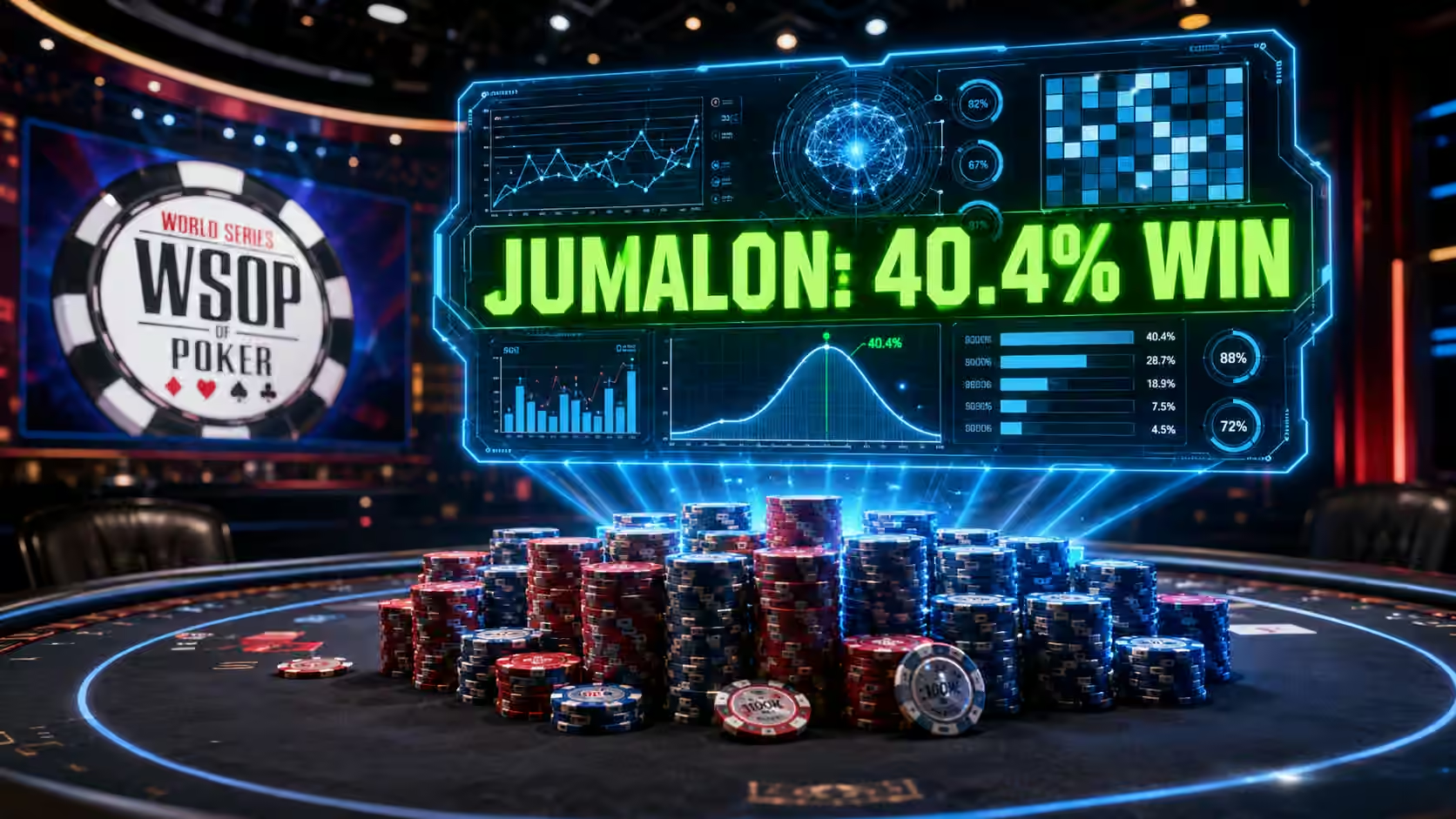
Who will win the 2026 WSOP Main Event? That is the question dominating poker discussion as nine players return to Las Vegas with $10 million, the world championship bracelet and a place in poker history waiting for the winner.
Lucas Jumalon begins with 194 million chips—more than twice the stack of second-place Rami Hammoud—and is the obvious favorite. But the most interesting prediction is not simply “the chip leader will win.” A computer model has now simulated the final table one million times, while established poker professionals have made competing picks based on experience, table position, pressure and playing style.
The numbers favor Jumalon. The simulation gives him a 40.4% chance of winning, but that also means he loses the tournament in nearly six out of every ten runs. Greg Mueller emerges as the model’s strongest value pick, Jamie Shaevel performs better than his raw chip count suggests, and Rami Hammoud faces one of the most uncomfortable seat draws at the table.
This prediction guide compares chip equity, simulation results and professional opinions before making our own final selection. For the complete field history and tournament format, read our WSOP Main Event 2026 guide.
2026 WSOP Main Event Final Table: Chips and Baseline Win Chances
A simple starting point is each player’s share of the chips. If every finalist had identical skill and chips moved randomly, the percentage of chips in play would provide a basic estimate of the chance to finish first.
| Player | Starting Chips | Big Blinds | Share of Chips | AI Win Probability |
|---|---|---|---|---|
| Lucas Jumalon | 194,000,000 | 129 | 35.1% | 40.4% |
| Rami Hammoud | 79,000,000 | 53 | 14.3% | 13.2% |
| Jamie Shaevel | 56,000,000 | 37 | 10.1% | 11.3% |
| Greg Mueller | 48,500,000 | 32 | 8.8% | 10.9% |
| Michael Gagliano | 46,500,000 | 31 | 8.4% | 7.0% |
| Mario Boos | 44,000,000 | 29 | 8.0% | 6.5% |
| Lauri Saaskilahti | 37,500,000 | 25 | 6.8% | 5.2% |
| Han Feng | 25,000,000 | 17 | 4.5% | 3.0% |
| Evagoras Evagorou | 22,500,000 | 15 | 4.1% | 2.5% |
The difference between chip share and simulated win probability is revealing. Jumalon, Shaevel and Mueller outperform the simplest chip-based estimate. Hammoud and the five shortest stacks underperform it. That does not prove the model is correct, but it shows how skill assumptions, seating and ICM pressure can change a prediction.
What the One Million WSOP Simulations Predicted
Advanced Poker Training modeled the entire final table one million times. The system did not merely assign random all-ins based on stack size. Its creator said the bots were adjusted using behavioral characteristics such as aggression, continuation-bet frequency, ICM response and willingness to risk tournament life.
The headline result is clear:
- Lucas Jumalon wins 40.4% of simulations.
- Rami Hammoud finishes first 13.2% of the time.
- Jamie Shaevel wins 11.3%.
- Greg Mueller wins 10.9%.
- No other player reaches an 8% title probability.
The model also produces a reminder that no stack is safe. Jumalon finishes ninth in 1% of simulations despite holding more than one-third of all chips. Evagorou wins 2.5% of the time despite beginning with only 15 big blinds.
Those tails matter. Poker tournaments are not elections where the favorite gradually converts a polling lead into victory. One preflop collision can double a rival, remove a player or completely redistribute the table’s leverage.
Why Lucas Jumalon Is the Clear Favorite
Jumalon’s advantage is larger than the raw number of chips. His 129-big-blind stack gives him several strategic weapons simultaneously.
He Can Pressure Players Without Risking Elimination
Most opponents cannot lose a large confrontation and continue comfortably. Jumalon can. That asymmetry allows him to open more pots, three-bet aggressively and force medium stacks to make decisions while shorter players remain alive.
The pressure is strongest when a 25-to-37-big-blind stack considers fighting the leader while two opponents hold 15 and 17 big blinds. A chip-EV call may become an expensive ICM mistake because losing could cost hundreds of thousands of dollars in immediate pay jumps.
Our ICM in poker guide explains why chips won and chips lost do not have equal cash value at a final table.
He Has Already Shown Multiple Strategic Gears
Jumalon’s route to the final table included short-stack survival, large preflop aggression, a major river value bet and a difficult queen-high bluff catch. He did not reach 194 million chips through one style of play.
That flexibility is analyzed hand by hand in our Lucas Jumalon poker strategy breakdown.
His Opponents Must Beat Him More Than Once
If a 30-big-blind player doubles through Jumalon, the chip leader may still have around 100 big blinds. The challenger improves, but Jumalon remains dangerous. Eliminating him will probably require several successful confrontations rather than one fortunate hand.
The Main Risk: Overusing the Stack
A giant stack can create false confidence. Jumalon does not need to accept every marginal gamble or prove that opponents cannot push him around. His edge is greatest when he wins many small and medium pots without repeatedly exposing 30 or 40 big blinds.
The favorite becomes vulnerable if aggression turns into automatic calling, loose four-bet shoves or unnecessary battles with the second-largest stack.
Why the Computer Is Cautious About Rami Hammoud
Hammoud starts second with 79 million chips and 53 big blinds. In a normal final table preview, that would make him the obvious alternative to the leader. The simulation gives him only a 13.2% chance of winning—slightly below his 14.3% share of the chips.
The biggest concern is table position. Jumalon sits two seats to Hammoud’s left. When Hammoud reaches late position and wants to attack the blinds, the tournament’s largest stack will often be waiting behind or in the blinds with maximum leverage.
This creates several problems:
- Hammoud cannot steal as freely as another second-place stack might.
- His opens can face frequent three-bets from a player who covers him comfortably.
- Calling those three-bets creates large pots against the one opponent capable of damaging him most.
- Folding too often allows Jumalon to control the table without resistance.
Aaron Barone nevertheless selected Hammoud as his winner after reviewing Day 8, praising the variety of ways he applied pressure. Hammoud may be the player best positioned to stop a Jumalon runaway—but he must choose his confrontations carefully.
Greg Mueller: The Best Dark-Horse Prediction
Greg Mueller is the most interesting name in the model. He starts fourth with only 8.8% of the chips but wins 10.9% of the simulations. His simulated average prize is also roughly 12% above his basic ICM value, the largest positive difference in the field.
Why does the model like him?
Experience Under Pressure
Mueller owns three WSOP bracelets and has competed in high-pressure poker environments for years. Before poker, he played professional hockey, so a loud arena and television production are less likely to feel completely unfamiliar.
That does not create extra chips, but it may reduce avoidable errors. Final tables can be lost through rushed decisions, emotional reactions and attempts to create a television moment. Experience helps a player remain process-driven.
A Functional Stack
Thirty-two big blinds is not deep, but it supports opens, three-bet shoves, small three-bets and postflop play. Mueller is not restricted to push-or-fold poker.
He Does Not Need to Fight the Leader Immediately
Mueller can allow the shortest stacks to create volatility while looking for favorable spots against other medium stacks. A double-up would place him close to Hammoud and give him enough chips to challenge Jumalon more directly.
Phil Hellmuth publicly said he is rooting for Mueller, while the simulation expert made Mueller his official upset pick. That makes Mueller the strongest choice for readers seeking a credible challenger rather than simply selecting the favorite.
Jamie Shaevel: The Quiet Contender the Numbers Respect
Shaevel begins third with 56 million chips and a 37-big-blind stack. The simulation gives him an 11.3% chance of winning, higher than his 10.1% chip share.
He has enough chips to survive one moderate loss, apply pressure to the shorter half of the table and play postflop without committing his entire tournament. That flexibility matters because final-table stacks often become awkward when players fall below 25 big blinds.
Shaevel also has repeated Main Event experience and was selected by poker personality Frankie C as the likely champion. He lacks the headline chip count of Jumalon and the bracelet résumé of Mueller, but his combination of stack, experience and lower public attention makes him a serious contender.
Can Michael Gagliano’s Experience Beat the Model?
Michael Gagliano begins with 46.5 million chips and 31 big blinds. The simulation gives him a 7% chance of winning, below his 8.4% chip share.
That appears surprising because Gagliano is one of the most accomplished players at the table. Lexy Gavin-Mather selected him to win based on his long record, technical solidity and experience.
The disagreement highlights a limitation of every prediction model: poker skill is difficult to reduce to a few behavioral settings. A model can estimate how often a player three-bets or calls under ICM pressure, but it cannot perfectly capture preparation completed during a three-week break, live reads or strategic changes designed for specific opponents.
Gagliano’s path is likely to depend on avoiding early damage and reaching six-handed or five-handed play with a competitive stack. As the table shortens, his technical experience may become more valuable and preflop ranges will widen. Readers can follow those adjustments through our poker ranges guide.
Why the Short Stacks Still Matter
Han Feng and Evagoras Evagorou begin with 17 and 15 big blinds. Their simulation title probabilities are only 3% and 2.5%, but neither player is drawing dead.
A single double-up would move either stack into the same region currently occupied by several middle contenders. More importantly, short stacks influence every other player before they even enter a pot.
Suppose a medium stack faces a close all-in decision against Jumalon while Evagorou has 15 big blinds. Folding may preserve the opportunity to move from a $1 million guarantee to $1.25 million or $1.5 million without winning a hand. That pressure gives the chip leader leverage but also gives the short stack indirect survival value.
Evagorou has already shown that he can survive uncomfortable situations. He enters as the first Cypriot to reach a WSOP Main Event final table and has guaranteed a score dramatically larger than his previous tournament results. With nothing to protect except the chance to climb, he may play more freely than opponents expecting him to wait for eliminations.
Our bubble and pay-jump strategy guide explains how survival incentives can reshape otherwise standard decisions.
What Poker Professionals Predicted
The professional picks published immediately before the final table were divided:
- David “ODB” Baker: Lucas Jumalon
- Jamie Gold: Lucas Jumalon, while noting Mueller would be highly dangerous with equal stacks
- Lexy Gavin-Mather: Michael Gagliano
- Aaron Barone: Rami Hammoud
- Frankie C: Jamie Shaevel
- Phil Hellmuth: rooting for Greg Mueller
The split is useful because it shows that there is no hidden consensus against the obvious favorite. Jumalon is the mathematical choice, but respected observers see realistic paths for at least four challengers.
Why Any WSOP Winner Prediction Can Fail
One All-In Can Rewrite the Table
If Hammoud doubles through Jumalon, the gap could close dramatically. If Jumalon eliminates Hammoud, the leader may hold close to half the chips and become even harder to challenge.
The Three-Week Break Creates New Strategies
Players have had time to study broadcast footage, work with coaches and prepare for exact seat positions. The style observed on Day 8 may not be the style used on August 3.
Live Reads Are Not Fully Measurable
Timing, table talk and physical behavior can influence close calls and bluffs. These signals are imperfect, but they remain part of live poker. Our hand-reading techniques guide explains why reads must support range analysis rather than replace it.
The Final Table Starts Without an Automatic Shot Clock
Players will have more freedom to think through major decisions after the WSOP removed the automatic action clock for the finale. That may benefit experienced players in complex ICM situations, but it can also create longer tanks and rhythm changes. The complete background appears in our WSOP shot clock controversy report.
Mental Pressure Cannot Be Simulated Perfectly
Every finalist is guaranteed $1 million, but the difference between first and second is $4 million. Cameras, family rails and the possibility of becoming world champion can change decision-making in ways no model captures precisely.
Our article on the mental game of elite poker players explains how process and emotional control affect high-pressure decisions.
Our 2026 WSOP Main Event Winner Prediction
Best overall pick: Lucas Jumalon.
The correct prediction does not need to be clever. Jumalon has more than one-third of the chips, a 129-big-blind stack and the freedom to pressure every player without risking immediate elimination. The one-million-run model increases his win probability from a raw 35.1% chip share to 40.4%, supporting the idea that his stack can create additional strategic value.
Best dark-horse pick: Greg Mueller.
Mueller combines a playable stack, favorable simulation performance and extensive experience. He is not likely to win more often than Jumalon, but he has the clearest argument among players outside the top two stacks.
Player most capable of changing the tournament quickly: Rami Hammoud.
Hammoud is the only opponent beginning with more than 50 big blinds. If he wins an early major pot, the tournament can transform from one dominant leader into a two-stack battle. His difficult position relative to Jumalon is the reason he is not our upset selection.
How to Watch the Prediction Become Reality
The final table begins on Monday, August 3 at 9:00 p.m. ET on ESPN2 in the United States. That is Tuesday, August 4 at 4:00 a.m. in Cairo. Play continues on August 4 and the champion is scheduled to be crowned on August 5 in Las Vegas.
Our guide to watching the 2026 WSOP Main Event final table includes channels, streaming options and international start times.
2026 WSOP Main Event Prediction FAQs
Who is favored to win the 2026 WSOP Main Event?
Lucas Jumalon is the clear favorite. He begins with 194 million chips and won 40.4% of one million computer simulations.
Who is second in chips?
Rami Hammoud starts second with 79 million chips, equal to 53 big blinds.
What are Lucas Jumalon’s chances of winning?
The simulation estimates a 40.4% win probability. His raw share of all chips is approximately 35.1%.
Who is the best WSOP final-table dark horse?
Greg Mueller is the strongest dark-horse candidate in the simulation. He wins 10.9% of runs despite holding only 8.8% of the chips.
How many simulations were run?
Advanced Poker Training simulated the complete final table one million times using player-specific behavioral settings.
Can the shortest stack still win?
Yes. Evagoras Evagorou begins with 15 big blinds and won 2.5% of simulations. One or two double-ups can rapidly change a tournament stack.
How much does the winner receive?
The champion receives $10 million and the WSOP Main Event bracelet. Every finalist has already secured at least $1 million.
When does the final table start?
Play resumes on August 3, 2026 at 9:00 p.m. Eastern Time, which is August 4 at 4:00 a.m. in Cairo.
Final Verdict
The question “Who will win the 2026 WSOP Main Event?” has one mathematically responsible answer and several compelling alternatives.
Lucas Jumalon should be the favorite. His 194-million stack allows him to pressure opponents, survive setbacks and control the pace of the table. One million simulations give him a 40.4% chance—far ahead of every rival.
But 40.4% is not certainty. Hammoud can create a two-player chip battle, Shaevel has a balanced stack and strong model performance, while Mueller is the most convincing upset selection. Gagliano’s experience also gives him a path that may be difficult for any simulation to measure.
Our final prediction is Jumalon to convert the biggest stack into the bracelet, with Mueller as the player most likely to defeat the numbers. By the end of August 5 in Las Vegas, either the favorite will complete one of the most dominant Main Event runs in recent memory—or one of eight challengers will prove why poker predictions remain dangerous until the final river card.