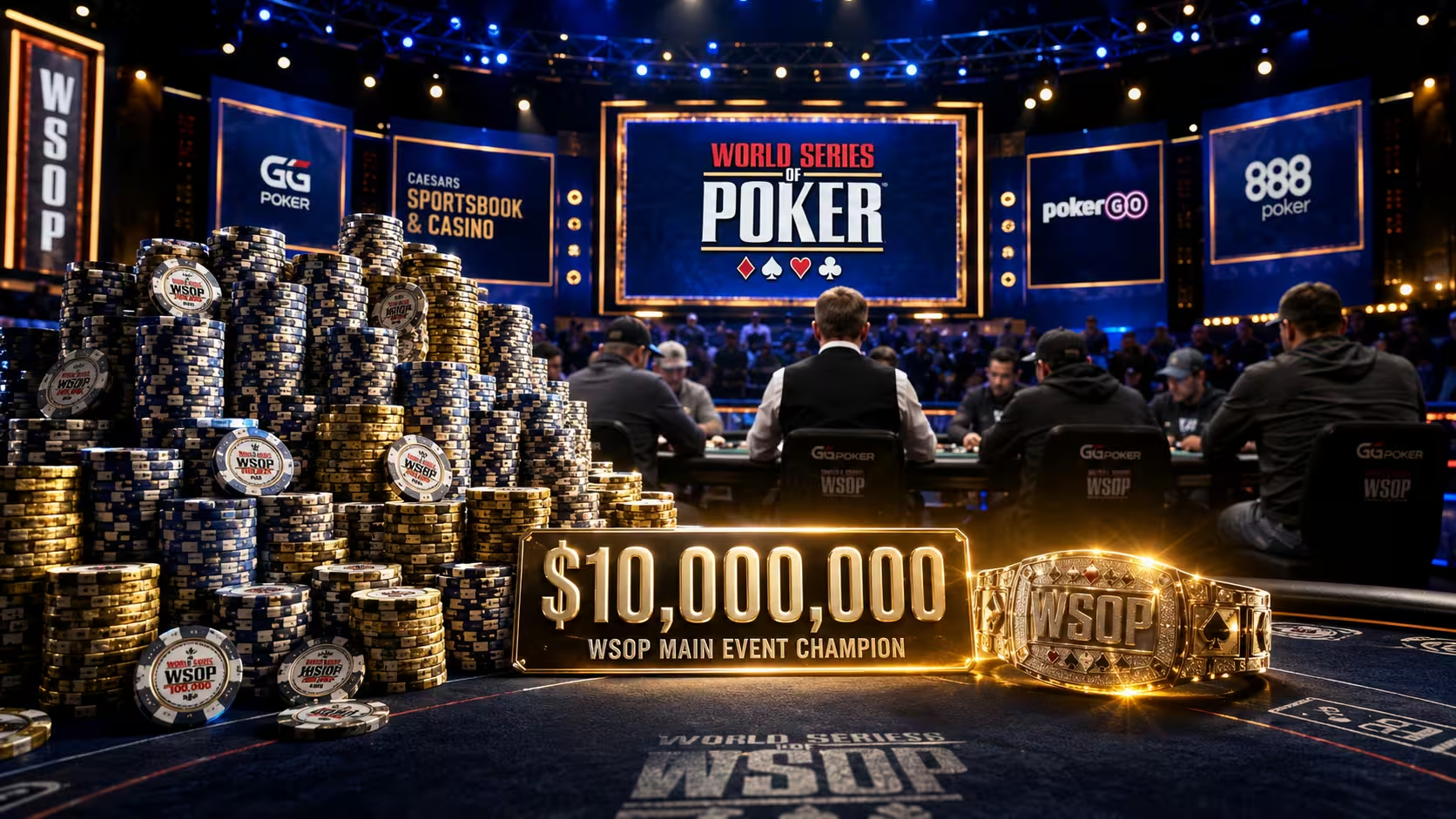
The 2026 WSOP Main Event final table is officially set. Nine players remain from a field of 9,208, every finalist is guaranteed at least $1,000,000, and the winner will receive the world championship bracelet and $10,000,000 when play resumes on August 3.
The biggest headline is 22-year-old Lucas Jumalon. He finished Day 8 with 194,000,000 chips, more than twice the stack of second-place Rami Hammoud and approximately 35.1% of all chips in play. Jumalon began the day third in chips, surged through the final stages, and eliminated Malcolm Trayner in tenth place to stop the tournament and lock the final nine.
This article brings together the information readers are searching for immediately after the final table was confirmed: all nine players, chip counts, big blinds, payouts, player backgrounds, the ESPN schedule, the largest Day 8 storylines, and the practical meaning of the three-week break before the champion is crowned.
For the complete tournament structure and earlier stages, read our WSOP Main Event 2026 guide. This page focuses on the newly confirmed final table and will remain the central reference until play resumes.
2026 WSOP Main Event Final Table: Quick Answer
| Detail | Confirmed Information |
|---|---|
| Final-table dates | August 3-5, 2026 |
| Chip leader | Lucas Jumalon — 194,000,000 |
| Players remaining | 9 |
| Original field | 9,208 entries |
| Prize pool | $85,634,400 |
| Minimum final-table payout | $1,000,000 |
| First prize | $10,000,000 |
| US broadcast | ESPN2 on August 3; ESPN on August 4-5 |
| Main storyline | Jumalon holds 129 big blinds and 2.46 times the stack of his closest challenger |
The official WSOP final-table announcement confirms the nine names, their chip counts and the August broadcast schedule. PokerNews provides the Day 8 action and final-table payouts in its 2026 Main Event final-table report.
2026 WSOP Main Event Final Table Chip Counts
| Rank | Player | Country | Chip Count | Big Blinds |
|---|---|---|---|---|
| 1 | Lucas Jumalon | United States | 194,000,000 | 129 |
| 2 | Rami Hammoud | Canada | 79,000,000 | 53 |
| 3 | Jamie Shaevel | United States | 56,000,000 | 37 |
| 4 | Greg Mueller | Canada | 48,500,000 | 32 |
| 5 | Michael Gagliano | United States | 46,500,000 | 31 |
| 6 | Mario Boos | France | 44,000,000 | 29 |
| 7 | Lauri Saaskilahti | Finland | 37,500,000 | 25 |
| 8 | Han Feng | United States | 25,000,000 | 17 |
| 9 | Evagoras Evagorou | Cyprus | 22,500,000 | 15 |
The final table will return with blinds of 750,000/1,500,000 and a 1,500,000 big-blind ante. That gives Jumalon unusual freedom: he can lose a major pot and still retain a playable stack, while the bottom two players will begin with immediate pressure.
Why This Is the Biggest WSOP Story Today
The final table combines the highest-value search terms of the tournament in one event: “WSOP final table 2026,” “WSOP chip counts,” “who is Lucas Jumalon,” “WSOP Main Event payouts,” “when is the WSOP final table,” and “how to watch the WSOP final table.”
It also resets the Main Event narrative. Former champion Hossein Ensan, defending champion Michael Mizrachi, Shaun Deeb and Todd Brunson generated much of the attention during the middle days. None reached the final nine. The August finale will therefore crown a new world champion from a mix of established professionals, experienced cash players and lesser-known finalists whose careers have already changed.
Readers who want to follow the broadcast can use our WSOP 2026 streaming guide. The final table is scheduled for three nights on ESPN platforms rather than completing immediately after Day 8.
Lucas Jumalon’s Massive Chip Lead Explained
Jumalon’s 194,000,000 chips are not merely a normal first-place stack. The 9,208 entries began with 60,000 chips each, creating 552,480,000 chips in play. Jumalon controls approximately 35.1% of that total.
His lead over Hammoud is 115,000,000 chips. Put another way, Jumalon has roughly 2.46 times the stack of second place and more chips than Hammoud, Shaevel and Evagorou combined.
He entered Day 8 with 40,800,000, meaning he added more than 153 million chips during the day. One turning point came when his pocket jacks improved to a full house against Malcolm Trayner’s pocket queens in a pot worth more than 50 million. Jumalon later eliminated Trayner on the final-table bubble when Trayner’s flopped pair was counterfeited by the runout.
The lead does not guarantee the bracelet. The blinds are large, the payout jumps are extreme and the three-week pause gives every opponent time to prepare. But chip leverage makes Jumalon the clear numerical favorite when play resumes.
Who Is Lucas Jumalon?
Lucas Jumalon is a 22-year-old American player from Spokane, Washington. He recently graduated from Grand Canyon University with a degree in business administration and data analytics. Before this Main Event, his live tournament résumé was modest compared with the established professionals at the table.
That contrast is one reason the story has immediate click appeal. Jumalon entered the tournament without a bracelet and with no previous seven-figure score. He is now guaranteed $1 million and could win ten times that amount.
His WSOP profile shows a growing volume of Circuit and summer-series cashes rather than one previous breakout result. The Main Event has transformed him from a player known mainly within regional and online circles into the central name of poker’s biggest tournament.
Meet Every Player at the 2026 WSOP Main Event Final Table
1. Lucas Jumalon — 194,000,000 Chips
Jumalon has the tournament’s most powerful stack and the most attention. He can pressure medium stacks without putting his own tournament life at risk, and he can absorb a double-up that would eliminate almost any other player. The central question is whether he can use that freedom without forcing action unnecessarily after the break.
2. Rami Hammoud — 79,000,000 Chips
Hammoud is the nearest challenger and the only player besides Jumalon returning with more than 50 big blinds. His recent results show comfort in very large fields, including deep runs in the Gladiators of Poker and SALUTE to Warriors. The gap to first is huge, but 53 big blinds is enough to play complete poker rather than wait for all-in situations.
3. Jamie Shaevel — 56,000,000 Chips
Shaevel brings a different type of experience. He is primarily a cash-game player and has now cashed the WSOP Main Event eight times. His live tournament résumé does not contain many huge scores, but repeated Main Event cashes indicate that he understands long structures, deep stacks and the patience required to survive multiple days.
4. Greg Mueller — 48,500,000 Chips
Greg “FBT” Mueller is one of the two three-time bracelet winners at the table. The former professional hockey player has won major limit and mixed-game championships and owns decades of live experience. With 32 big blinds, he is not deep enough to challenge every pot, but his résumé makes him one of the finalists least likely to be overwhelmed by the stage.
Mueller’s presence also connects the modern final table with poker’s older mixed-game culture. Our Poker Hall of Fame selection analysis explains why longevity and versatility remain important when evaluating tournament careers.
5. Michael Gagliano — 46,500,000 Chips
Michael “Gags30” Gagliano is a three-time bracelet winner, longtime online professional and coach. He may be the most technically established no-limit tournament specialist at the table. His stack is only two million behind Mueller’s, leaving both players in nearly identical positions.
Gagliano’s challenge is structural: he has elite experience, but Jumalon can threaten his tournament life without risking a comparable percentage of his own stack. The long break should allow Gagliano to study every finalist and prepare detailed plans for different stack scenarios.
6. Mario Boos — 44,000,000 Chips
Mario Boos enters with 29 big blinds and a guaranteed payout dramatically larger than his previous career best. His path represents the classic Main Event transformation: a player with solid regional results suddenly competing for poker’s biggest individual prize.
Boos is close enough to Mueller and Gagliano that one early double-up could move him into second place. He is also short enough that a failed three-bet pot could immediately place him under all-in pressure.
7. Lauri Saaskilahti — 37,500,000 Chips
Saaskilahti has already produced the deepest WSOP Main Event run by a Finnish player. He reached the final nine through several high-pressure pots, including a major double with pocket jacks against tens late on Day 8.
At 25 big blinds, he has enough chips to raise-fold and choose spots, but he cannot afford repeated failed attempts against the larger stacks. His final-table appearance is already the biggest result of his recorded live career.
8. Han Feng — 25,000,000 Chips
Feng returns with 17 big blinds and two WSOP Circuit rings. He has experience winning regional tournaments and was recognized as a leading mid-stakes player before reaching this final table. His stack requires urgency, but it is not yet a forced shove-or-fold position.
A single double would place Feng near the middle of the table. That makes him dangerous to larger stacks that open too widely and then face an all-in decision.
9. Evagoras Evagorou — 22,500,000 Chips
Evagorou begins as the shortest stack with 15 big blinds. Before this summer, his recorded tournament results were small compared with the prize he has now guaranteed. He came close to a WSOP final table earlier in the series and converted that momentum into the biggest possible stage.
His task is clear: survive the first orbit without allowing the stack to become too short to generate folds. Because ninth already pays $1 million, he can focus on moves that increase his chance of climbing rather than trying to protect a min-cash that is already locked.
2026 WSOP Main Event Final Table Payouts
| Place | Payout | Jump From Previous Place |
|---|---|---|
| 1st | $10,000,000 | +$4,000,000 |
| 2nd | $6,000,000 | +$2,250,000 |
| 3rd | $3,750,000 | +$1,000,000 |
| 4th | $2,750,000 | +$500,000 |
| 5th | $2,250,000 | +$500,000 |
| 6th | $1,750,000 | +$250,000 |
| 7th | $1,500,000 | +$250,000 |
| 8th | $1,250,000 | +$250,000 |
| 9th | $1,000,000 | — |
The payout structure explains why the final table cannot be evaluated only through chip counts. The difference between first and second is $4 million, while moving from ninth to sixth is worth $750,000. Every decision combines chip value, survival and the possibility of reaching the largest prizes.
Our ICM in poker guide explains why tournament chips do not have a fixed dollar value. The tournament deals and ICM chops guide covers how players evaluate prize equity when payout jumps become life changing. For every paid place below the final nine, see our full 2026 Main Event payouts breakdown.
When Is the 2026 WSOP Main Event Final Table?
The final table resumes on Monday, August 3, 2026 and is scheduled to conclude over three nights:
- August 3: 9:00 PM to midnight ET on ESPN2
- August 4: 9:00 PM to midnight ET on ESPN
- August 5: 10:30 PM to 1:30 AM ET on ESPN
The WSOP says the coverage will be available through ESPN networks in the United States and more than 70 countries, subject to local availability. Edited final-table programs are scheduled to begin on August 10.
For other major live dates during the break, use our global poker tournament calendar.
Why Is There a Three-Week Break?
The 2026 Main Event has returned to a delayed-final-table format. The final nine were confirmed on July 13, but they will not resume until August 3. The pause creates time for ESPN promotion, player interviews, travel, production planning and detailed preparation.
It also changes the competitive environment. Players now have weeks to review streamed hands, study opponents, consult coaches, model stack scenarios and prepare for the exact blind level. The unknown amateurs at the start of the Main Event are no longer unknown.
The break may help shorter stacks because they receive time to prepare precise push, reshove and calling ranges. It may help experienced professionals because they can process more information. It may also increase pressure on Jumalon, who must spend weeks being described as the favorite before playing another hand.
Who Is the Favorite to Win?
By chips, Jumalon is the obvious favorite. A 129-big-blind stack and 35.1% of the chips create a major probability advantage. But “favorite” does not mean “likely to win more than the entire field combined.” Eight opponents remain, all payout jumps are substantial and one large confrontation can reduce the lead quickly.
Hammoud has the healthiest chasing stack. Shaevel has repeated Main Event experience. Mueller and Gagliano have the strongest bracelet résumés. The bottom four players need chips quickly, but each is one double-up away from becoming competitive.
The most accurate conclusion is that Jumalon controls the tournament’s starting position, while the experienced middle stacks may be best equipped to punish mistakes. Readers should avoid treating one chip lead as a guaranteed result.
Big Names Who Missed the Final Table
Day 8 began with several storylines that appeared more likely to dominate the final table:
- Malcolm Trayner: entered Day 8 as chip leader but finished tenth for $750,000 after Jumalon eliminated him on the final-table bubble.
- Hossein Ensan: the 2019 champion finished 13th, ending the possibility of a repeat world champion at the final table.
- Shaun Deeb: the nine-time bracelet winner finished 15th after entering the day among the major names.
- Todd Brunson: made the deepest Main Event run of his career but fell short of joining his father Doyle as a Main Event finalist.
The elimination of Trayner is especially dramatic because he began the day first and missed the final table by one place. That outcome is a reminder that tournament position can change completely in a few large pots, even after eight days of survival.
Players interested in the pressure around the final-table bubble should read our bubble play strategy guide. The concepts apply far beyond ordinary min-cash bubbles when the difference between tenth and ninth is $250,000 and a guaranteed place on ESPN.
What the Final Table Means for the 2026 WSOP
The 2026 Main Event attracted 9,208 entries and created an $85,634,400 prize pool. It did not set a new attendance record, but it remains one of the largest Main Events ever and has delivered a final table with a clear breakout star, multiple bracelet winners and five countries represented.
It also gives ESPN a simple promotional story: an unknown 22-year-old holds a historic lead while experienced professionals chase him for $10 million. That contrast is central to the appeal of the Main Event. The same tournament can place a recent graduate, a cash-game veteran, mixed-game champions and regional winners at one table.
Players who want to understand how people reach the event through smaller buy-ins can read our poker satellites guide. For the financial reality behind taking a $10,000 shot, see how much bankroll poker players need.
What to Watch When Play Resumes
Jumalon’s Opening Frequency
Will the leader immediately attack the medium and short stacks, or use the first orbit to observe how opponents respond after the break? The answer will show whether he intends to maximize chip pressure or reduce variance.
Hammoud’s Position Relative to Jumalon
As the only other player above 50 big blinds, Hammoud can challenge without being automatically committed. His seat position and early confrontations with Jumalon may determine whether the tournament remains one-sided.
How the Three Bracelet Winners Adjust
Mueller and Gagliano know major final tables, but neither begins with a stack that permits endless patience. Their advantage must appear through timing, pressure and opponent-specific choices rather than simply waiting for premium hands.
The Short-Stack Race
Feng and Evagorou begin with 17 and 15 big blinds. If one doubles quickly, the payout ladder changes for everyone. If both lose chips, medium stacks may become more conservative while waiting for an elimination.
Whether the Break Changes Momentum
Jumalon finished Day 8 with extraordinary momentum. August begins as a separate session. The cards, table conditions and emotional rhythm reset, even though the chips remain the same.
Frequently Asked Questions
Who is leading the 2026 WSOP Main Event final table?
Lucas Jumalon leads with 194,000,000 chips, equal to 129 big blinds when play resumes.
Who are the nine players at the 2026 WSOP Main Event final table?
The finalists are Lucas Jumalon, Rami Hammoud, Jamie Shaevel, Greg Mueller, Michael Gagliano, Mario Boos, Lauri Saaskilahti, Han Feng and Evagoras Evagorou.
When does the 2026 WSOP Main Event final table start?
Play resumes on August 3, 2026 and is scheduled to conclude on August 5.
How much does the 2026 WSOP Main Event winner receive?
The champion receives $10,000,000 and the WSOP Main Event bracelet.
How much is ninth place worth?
Every finalist has guaranteed at least $1,000,000.
Where can I watch the final table?
US coverage is scheduled for ESPN2 on August 3 and ESPN on August 4 and 5. Availability outside the United States depends on local broadcast partners.
How large is Lucas Jumalon’s chip lead?
Jumalon has 194 million chips compared with Hammoud’s 79 million. His stack is approximately 2.46 times larger than second place and represents about 35.1% of all chips.
Are any former Main Event champions at the final table?
No. Hossein Ensan was the last former champion remaining and was eliminated in 13th place.
How many bracelet winners are at the final table?
Greg Mueller and Michael Gagliano each have three WSOP bracelets. The other seven finalists are chasing their first bracelet.
Who bubbled the final table?
Malcolm Trayner finished tenth for $750,000 after being eliminated by Lucas Jumalon.
Why is the final table delayed until August?
The delayed format creates a three-week break for broadcast production, promotion and player preparation before the three-night ESPN finale.
Final Verdict
The 2026 WSOP Main Event final table is the strongest WSOP search story today because it combines the final nine, a breakout chip leader, $10 million, seven-figure guarantees and a confirmed ESPN schedule.
Lucas Jumalon enters August with one of the most commanding modern Main Event final-table stacks: 194 million chips, 129 big blinds and approximately 35.1% of all chips in play. Rami Hammoud is the closest challenger, while Jamie Shaevel, Greg Mueller and Michael Gagliano lead a middle group with enough chips and experience to change the tournament quickly.
The field will not produce a repeat champion, and several of the biggest names fell just short. Instead, the Main Event has created what it often creates best: a new star, established professionals under pressure and nine careers already transformed before the final hand is dealt.
Play resumes August 3. Until then, this is the complete snapshot: nine players, $10 million at the top, and one enormous chip lead that the entire poker world will spend three weeks debating.