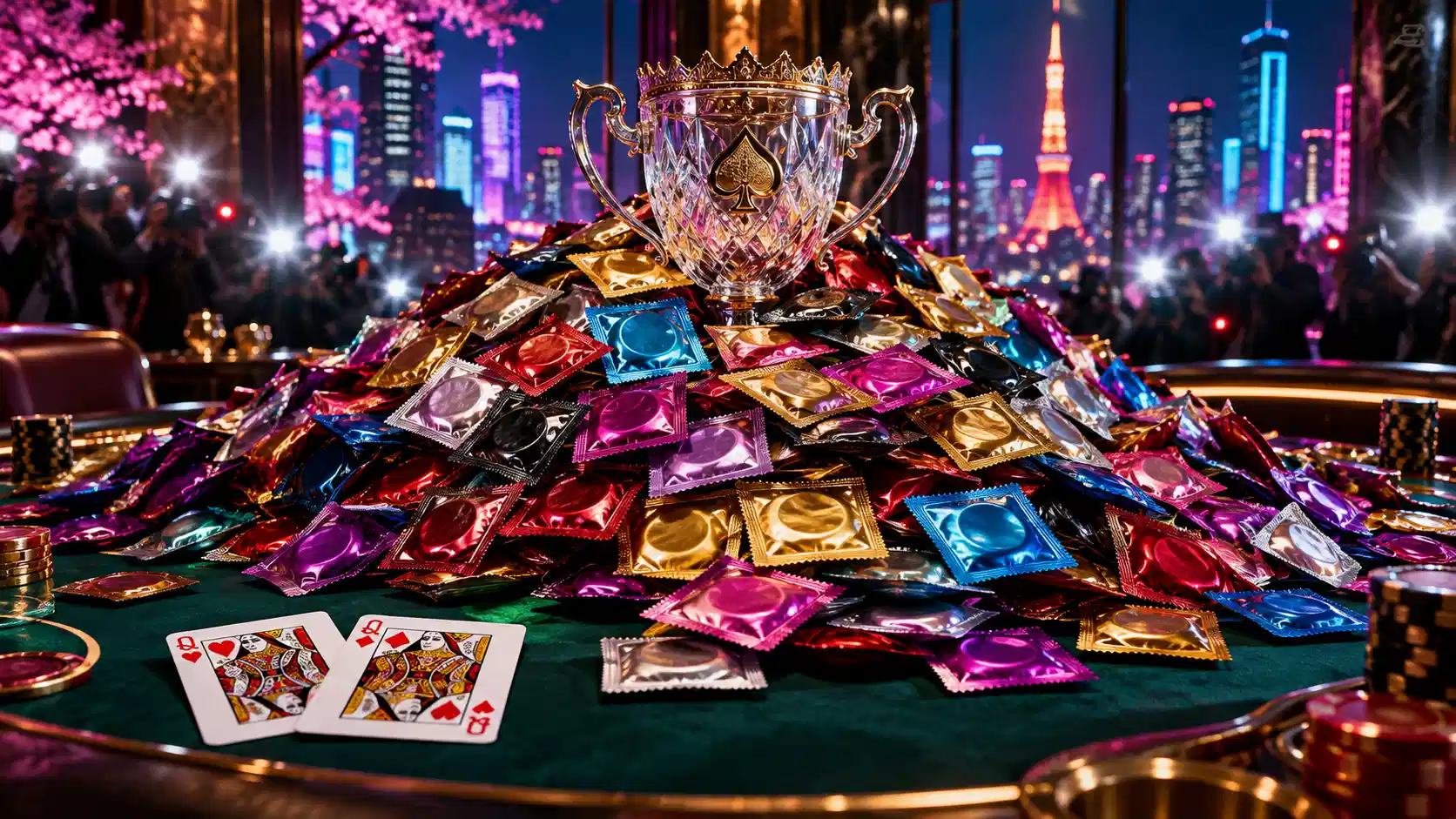
The JOPT Ladies Championship has become the center of a major poker controversy after organizers listed 150 condoms and three bottles of lubricant among the sponsored prizes for the winner of an upcoming women’s tournament in Tokyo.
The unusual prize announcement quickly attracted criticism from poker players and social media users. Many questioned whether the promotion supported women in poker or undermined the competition it was supposed to celebrate.
The Japan Open Poker Tour (JOPT) partnered with Japanese manufacturer Sagami for the October 12 Ladies Championship. However, the promotional campaign has generated attention for reasons neither organization may have anticipated.
Meanwhile, the tournament’s ¥30,000 entry fee, unusual prize structure, and growing online criticism have raised additional questions about how poker events should recognize their female competitors.
Importantly, the controversial products were additional sponsored prizes, not the entire tournament prize pool. The event also offers player contracts and other awards under Japan’s poker tournament rules.
So, what exactly happened? Why are players criticizing the announcement? And what does this controversy reveal about women’s poker in 2026?
Here is everything confirmed as of October 6, 2026.
What Happened at the JOPT Ladies Championship?
The controversy began when the Japan Open Poker Tour announced its partnership with Sagami, a Japanese manufacturer known for condoms and sexual health products.
The company became the title sponsor of Event #72, the NLH Ladies Championship, scheduled for October 12 during JOPT 2026 Tokyo #03.
Initially, the tournament’s published prize information included large quantities of condoms and lubricant for the top three finishers.
According to PokerNews’ October 6 report, the winner’s original sponsored package included 150 condoms and three bottles of water-based lubricant.
The second- and third-place finishers were also listed to receive similar products in smaller quantities.
Consequently, the announcement attracted criticism from people who believed the prizes were inappropriate for a women’s poker championship.
Some players argued that the promotion placed the sponsor’s products ahead of the competitors’ achievements. Others questioned why sexual health products were being awarded specifically to women based on their tournament finishing positions.
The criticism soon spread beyond Japan, drawing attention from international poker media and recognizable figures within the poker community.
JOPT Ladies Championship 2026: Date, Location, Buy-In and Prizes
Despite the controversy, the JOPT Ladies Championship remains listed on the official tournament schedule as of October 6.
The event is part of JOPT 2026 Tokyo #03, which runs from October 8 through October 12.
According to the official Japan Open Poker Tour schedule, the Ladies Championship is a No-Limit Hold’em tournament with a ¥30,000 entry fee.
| Detail | JOPT Ladies Championship 2026 |
|---|---|
| Event | #72 NLH Ladies Championship |
| Organizer | Japan Open Poker Tour (JOPT) |
| Title sponsor | Sagami / Funris |
| Date | October 12, 2026 |
| Starting time | 12:00 PM Japan Standard Time |
| Venue | BelleSalle Takadanobaba, Tokyo |
| Entry fee | ¥30,000, approximately $190 |
| Additional first-entry charge | ¥1,000 drink fee |
| Starting stack | 50,000 chips |
| Provisional total player-contract prizes | $10,817.06 |
| Additional sponsored prizes | Sagami product sets, apparel and other merchandise |
The published total prize figure is provisional and subject to the event’s applicable exchange rate and player-contract rules.
Furthermore, the tournament is one of many events taking place during the five-day Tokyo festival.
For readers following the expanding tournament scene across the region, our guide to major Asian poker events provides additional context about the competitions attracting international players.
What Were the Controversial JOPT Ladies Championship Prizes?
The original sponsored prize list is the main reason the tournament attracted attention.
Rather than simply awarding branded clothing or accessories, the promotion included substantial quantities of products supplied by Sagami.
The reported breakdown was as follows:
| Finishing Position | Condoms | Lubricant |
|---|---|---|
| 1st place | 150 | 3 bottles |
| 2nd place | 80 | 3 bottles |
| 3rd place | 40 | 1 bottle |
The winner’s package reportedly contained 120 regular Sagami Original condoms and 30 larger-sized versions.
Additionally, the top finishers were offered sponsor merchandise, including clothing and accessories. Other promotional prizes included jewelry.
However, the large number of condoms became the defining detail of the announcement.
For many observers, the issue was not simply that a sexual health manufacturer sponsored a poker event.
Instead, the criticism focused on distributing intimate products as ranked prizes to women competing in a tournament.
That distinction matters because sponsorship itself is a normal part of tournament poker.
Companies frequently support events through merchandise, branded prizes, promotional experiences, and additional player benefits.
Nevertheless, the way organizers connect those products to a competition can significantly influence public perception.
Why Are Female Poker Players Criticizing the JOPT Prizes?
The JOPT Ladies Championship controversy gained momentum after social media users questioned whether the promotion respected women as serious poker competitors.
One prominent critic, posting under the account name whitezexy, argued that a tournament designed to encourage female participation should recognize players for their achievements rather than associate their finishing positions with sexual products.
The criticism was widely circulated and subsequently covered by major poker publications.
According to Poker.org’s reporting on October 6, some women publicly expressed discomfort with the announcement.
Notably, a previous JOPT Ladies Championship winner also criticized the promotion and indicated that she would not participate in the upcoming event.
Another prospective participant reportedly said she had rearranged her schedule to play but no longer intended to enter.
These reactions are significant because the event was intended to attract and support female players.
However, the available social media responses do not establish how the entire Japanese poker community feels about the promotion.
The criticism does show that at least some of the tournament’s intended participants found the announced prizes discouraging.
Should Women’s Poker Achievements Be Recognized Differently?
Women’s poker events are designed, in part, to create welcoming competitive environments and encourage more women to participate.
For many players, these tournaments provide an opportunity to gain experience, develop confidence, and compete for meaningful recognition.
Therefore, organizers need to consider how prize announcements affect the tournament’s image.
At the same time, female players are not a single group with identical preferences.
Some may appreciate unusual promotional gifts. Others may prefer tournament tickets, coaching opportunities, trophies, or traditional merchandise.
The controversy suggests that tournament organizers should listen to their intended audience before designing highly visible sponsorship campaigns.
Our feature on women in poker and their growing influence on the game explores why visibility and professional recognition matter.
What Did JOPT and Sponsor Sagami Say?
Sagami announced its partnership with the Japan Open Poker Tour on October 6 through an official press release.
The company presented the sponsorship as an initiative intended to encourage female participation and promote respect through poker.
Its announcement also highlighted Sagami’s history as a Japanese manufacturer of sexual health products.
According to the official Sagami sponsorship announcement, the company planned to distribute product samples and operate a promotional booth during the festival.
The collaboration also included branded clothing and additional gifts for the top three finishers.
Furthermore, Sagami introduced an audience participation activity called “Respect Your Hand.”
Under the promotion, festival visitors could select their favorite two-card poker starting hand and receive a sample package.
The activity was scheduled for October 10 through October 12.
On its own, a promotion connecting poker hands with a sponsor’s products is not particularly unusual.
However, the decision to award large quantities of intimate products according to women’s finishing positions generated a different reaction.
Why Did the Original Prize Details Disappear?
As the controversy developed, reports indicated that the detailed product quantities had disappeared from the public prize listing.
Instead, the revised descriptions referred to generic Sagami gift sets.
The sponsor’s October 6 press release identified three product packages:
- First place: Sagami Gift Set A, a hoodie, a T-shirt and socks.
- Second place: Sagami Gift Set B, a T-shirt and socks.
- Third place: Sagami Gift Set C and a T-shirt.
However, describing the items as gift sets does not establish whether the underlying products had changed.
As of October 6, the publicly available information did not establish a final resolution to the criticism.
Consequently, readers should distinguish between changes to the published descriptions and changes to the actual prizes.
Are 150 Condoms the Only Prize for Winning the JOPT Ladies Championship?
No. The condoms and lubricant were additional sponsored products, not the entire championship prize.
This is one of the most important details in the story.
Some reactions focused exclusively on the condoms, creating confusion about whether the tournament offered any other meaningful awards.
In reality, the event’s official information lists a provisional total prize value of $10,817.06.
However, that amount does not represent an ordinary cash prize pool paid directly to the winners.
Japan’s restrictions on gambling affect how organizers structure poker tournaments and their awards.
As a result, JOPT uses arrangements known as player contracts to support participation in approved poker competitions.
These contracts can cover qualifying tournament-related expenses under the organizer’s rules.
For example, such support may help players participate in larger poker events rather than providing unrestricted cash winnings.
The distinction is particularly relevant because poker satellites and tournament qualification packages already provide alternative routes into major championships.
Nevertheless, sponsored merchandise and tournament support remain separate categories of awards.
Therefore, it would be misleading to suggest that the JOPT Ladies Championship winner receives only condoms and lubricant.
Why Does Japan Use Player Contracts Instead of Standard Cash Prizes?
Japan has a distinctive poker tournament environment because gambling restrictions limit how organizers can distribute awards.
Unlike many international poker festivals, JOPT cannot simply operate every event using conventional cash payouts.
Instead, the tour has established player-contract arrangements that support participation in designated tournaments.
According to the JOPT explanation of its player contracts, eligible participants may receive tournament-related support subject to contractual conditions.
These arrangements can involve buy-ins, travel, and related qualifying expenses.
However, they are not equivalent to unrestricted cash prizes.
The contracts also have specific requirements, and recipients must understand their obligations before accepting an award.
For international readers, that structure may initially seem unfamiliar.
Nevertheless, it helps explain why sponsored goods and promotional benefits play a visible role in Japanese poker tournaments.
Does Japan’s Prize Structure Explain the Controversy?
Partly, but not completely.
The unusual regulatory environment explains why JOPT uses player contracts and supplementary sponsor prizes.
However, it does not require organizers to choose any particular type of promotional product.
That decision remains a sponsorship and event-management issue.
In other words, the controversy is not primarily about whether Japan can award cash prizes.
Instead, it concerns whether the selected merchandise was suitable for this particular competition.
Understanding that difference makes the debate more accurate and productive.
Who Is Sagami, the Sponsor Behind the Controversial Prizes?
Sagami is an established Japanese manufacturer of condoms and sexual health products.
The company traces its history to 1934 and has developed products associated with sexual health and personal protection.
Its involvement in the JOPT Ladies Championship was presented as part of an effort to promote female participation and respectful competition.
Additionally, the company planned promotional activities for visitors attending the Tokyo festival.
These activities included merchandise, product samples, and the poker-hand voting campaign.
However, the original tournament prize announcement connected those products directly to competitive rankings.
That choice transformed an ordinary sponsorship announcement into a subject of international debate.
From a marketing perspective, the situation demonstrates how an unusual promotional concept can attract attention while simultaneously alienating its intended audience.
Still, the existence of controversy does not automatically establish that the sponsor intended to disrespect participants.
The more relevant issue is whether the promotion appropriately reflected the tournament’s stated purpose.
Why the JOPT Ladies Championship Controversy Matters for Women’s Poker
Women’s participation has become an increasingly visible part of the international poker scene.
Major tours now regularly feature female competitors, ambassadors, commentators, and tournament champions.
Meanwhile, Japan has produced internationally recognized players who have helped raise the country’s profile.
One prominent example is Shiina Okamoto, whose back-to-back WSOP Ladies Championship victories in 2024 and 2025 demonstrated the country’s growing presence in women’s tournament poker.
Achievements like these show why recognition matters.
A strong tournament identity helps players associate competitions with skill, achievement, and memorable performances.
However, a controversial prize announcement can shift attention away from those qualities.
Instead of discussing tournament structures, potential champions, or strategic competition, audiences may focus entirely on the sponsor’s products.
Our article featuring inspiring women in poker and their experiences explores the broader importance of competitive opportunities and representation.
Furthermore, poker’s international audience continues to grow through digital media and livestream coverage.
That visibility means organizers must consider how promotional decisions will be interpreted beyond their immediate local markets.
Is This Controversy a Sponsorship Failure or a Cultural Misunderstanding?
The answer depends partly on how people interpret the purpose of the promotion.
From one perspective, Sagami is a legitimate company promoting established consumer products through a sporting event.
Sexual health products are not inherently inappropriate. Indeed, education and access to protective products can serve useful public health purposes.
However, critics are questioning something more specific.
They argue that presenting large quantities of intimate products as rewards for female tournament performance creates an unnecessary association between women’s achievements and their private lives.
That concern differs from opposition to sexual health education itself.
Moreover, the quantities attracted particular attention.
A small informational sample provided to willing festival visitors would create a different impression from awarding 150 condoms to the winner of a women’s championship.
The context, presentation, and intended audience all matter.
Could the Promotion Have Been Handled Differently?
Several alternative approaches might have avoided the same controversy while preserving the sponsorship.
- Optional promotional gifts: Allow participants to choose whether they want sponsor products.
- Equal access to samples: Offer products to interested attendees rather than tying quantities to tournament rankings.
- Poker-focused awards: Emphasize trophies, tournament entries, coaching opportunities, or relevant merchandise.
- Player consultation: Gather feedback from potential participants before announcing unusual prize packages.
- Clear prize explanations: Separate player contracts, sponsored merchandise, and promotional samples in public announcements.
These are possible alternatives, not changes announced by JOPT.
Nevertheless, they demonstrate that a sponsorship can promote its products without making those products the defining feature of a championship.
For additional perspective, our guide to poker ethics and the game’s unwritten rules examines why respect extends beyond the technical rules of competition.
How Social Media Turned the JOPT Prize List Into International Poker News
The controversy also illustrates how quickly poker stories can move from local communities to international audiences.
Initially, the disputed announcement concerned a tournament in Tokyo and products supplied by a Japanese company.
However, screenshots and reactions circulated on X, attracting attention from players outside Japan.
Poker commentators subsequently discussed the announcement, while established publications began reporting the story.
As a result, a local sponsorship decision became part of the wider conversation surrounding women in poker.
This pattern is increasingly common in modern poker media.
Instead of waiting for a major championship result, audiences can follow controversy, player reactions, and behind-the-scenes developments in real time.
Our analysis of poker content creators and the influence of social media examines how digital platforms are changing which stories attract attention.
Nevertheless, rapid circulation creates an important responsibility for readers and publishers.
Viral headlines can simplify complicated stories.
Therefore, accurate coverage must distinguish the additional sponsor products from the tournament’s separate player-contract prize structure.
What Does the Controversy Mean for Poker’s Growth in Asia?
Asian tournament poker has expanded significantly in visibility, with major festivals attracting players from different countries.
Japan is an important part of that development, although its regulatory environment differs from many neighboring markets.
The Japan Open Poker Tour has helped introduce players to organized poker competition while developing connections with international tournaments.
Meanwhile, major festivals elsewhere in Asia continue to attract international attention.
For example, the APT Jeju 2026 festival illustrates the scale of tournament poker activity across the region.
However, expansion creates additional expectations for event organizers.
Players increasingly compare prize structures, tournament rules, promotional campaigns, and the overall competitive experience across international events.
Consequently, local marketing decisions can influence how a tournament brand is perceived globally.
The JOPT controversy does not establish that Japanese poker is facing a wider crisis.
Instead, it highlights the importance of clear communication as tournaments reach more diverse audiences.
Japan’s development also reflects a broader regional conversation about poker’s identity. Our coverage of Thailand’s recognition of poker as a sport in 2025 provides another example of how the game’s status varies across Asian countries.
What Should Poker Tournament Organizers Learn From This?
The JOPT Ladies Championship provides several lessons about tournament marketing and player expectations.
First, a sponsor’s products should complement the competition rather than overshadow its purpose.
Second, organizers should explain prize structures clearly, especially when conventional cash payouts are unavailable.
Third, competitions intended to support particular player communities should consider feedback from those participants.
Furthermore, promotional campaigns need to account for how a broader audience may interpret them.
A campaign can attract substantial attention without strengthening the tournament’s reputation.
That distinction is important because visibility alone does not guarantee successful marketing.
In addition, tournament organizers must maintain clear standards of player treatment.
Our complete guide to poker etiquette explores the importance of respect and professional conduct throughout the game.
Although sponsorship decisions differ from table behavior, both contribute to the experience players associate with an event.
Ultimately, a successful tournament should leave participants remembering the quality of the competition, not only the controversy surrounding its marketing.
Will the JOPT Ladies Championship Change Its Prizes Before October 12?
As of October 6, it remains unclear whether the organizers will make substantive changes to the sponsored prizes.
The detailed quantities have reportedly been replaced by generic gift-set descriptions in public-facing materials.
However, that does not establish whether the contents of those packages have changed.
Therefore, several questions remain unanswered.
- Will JOPT clarify the contents of the sponsored gift sets?
- Will Sagami modify how products are distributed to competitors?
- Could the negative reaction affect tournament participation?
- Will organizers introduce additional player-focused awards?
- How will the controversy influence future sponsorship partnerships?
These questions may become clearer as the October 12 event approaches.
For now, the championship remains on the published schedule.
Readers who want to follow other upcoming competitions can also consult our global poker tournament calendar for broader tournament information.
Frequently Asked Questions About the JOPT Ladies Championship
What is the JOPT Ladies Championship controversy?
The controversy concerns additional sponsored prizes listed for the October 2026 JOPT Ladies Championship in Tokyo. The original prize details included 150 condoms and three bottles of lubricant for the winner. Critics questioned whether those awards were appropriate for a women’s poker tournament.
Did JOPT really offer 150 condoms to the winner?
Yes. Poker publications reported that the original sponsored prize list included 150 condoms for first place, alongside lubricant and other merchandise. The public descriptions were subsequently changed to generic Sagami gift sets. The event had not yet taken place as of October 6.
How many condoms were offered to second and third place?
According to the reported original prize list, second place was assigned 80 condoms and three bottles of lubricant. Third place was assigned 40 condoms and one bottle.
When is the JOPT Ladies Championship 2026?
The tournament is scheduled for Monday, October 12, 2026, starting at 12:00 PM Japan Standard Time. It forms part of JOPT 2026 Tokyo #03, running October 8 through October 12.
How much does the JOPT Ladies Championship cost to enter?
The published entry fee is ¥30,000, approximately $190. According to the event’s official sponsorship information, a separate ¥1,000 drink fee applies on first entry.
Does the JOPT Ladies Championship award cash prizes?
The event uses Japan’s player-contract prize structure rather than ordinary unrestricted cash payouts. Its official information lists a provisional total prize value of $10,817.06. The contracts are separate from sponsored merchandise and have their own conditions.
Who sponsors the JOPT Ladies Championship?
Sagami, a Japanese manufacturer of condoms and sexual health products, is the title sponsor. The partnership also involves its Funris promotional branding.
Has the JOPT Ladies Championship been canceled?
No cancellation had been confirmed as of October 6, 2026. The event remained listed on the official tournament schedule for October 12.
Why are players criticizing the sponsored prizes?
Some players believe the intimate products are inappropriate as ranked awards in a women’s tournament. Their concerns focus on player recognition, competitive respect, and whether the promotion supports the event’s stated goals.
Final Thoughts: The JOPT Controversy Is Bigger Than 150 Condoms
The JOPT Ladies Championship has unexpectedly become one of the most controversial poker stories of October 6, 2026.
What began as a sponsorship announcement has developed into a debate about marketing, competitive respect, and the recognition of women in poker.
However, the discussion should remain grounded in the facts.
The original sponsored prize list included 150 condoms and lubricant for the winner. Those products were additional promotional awards, not the tournament’s entire prize pool.
Moreover, the event uses player contracts because of Japan’s distinctive poker prize structure.
Nevertheless, the criticism raises a legitimate question: should an event designed to celebrate female poker players make intimate products a prominent reward for competitive success?
Different observers may answer that question differently.
Ultimately, the most meaningful test will be how organizers respond to feedback and whether the tournament delivers a respectful, rewarding experience for its competitors.
As of October 6, the JOPT Ladies Championship remains scheduled for October 12 in Tokyo. Whether its sponsored prizes will change remains to be seen.
Bluffing Monkeys will continue following significant developments in this story and the wider international poker scene.