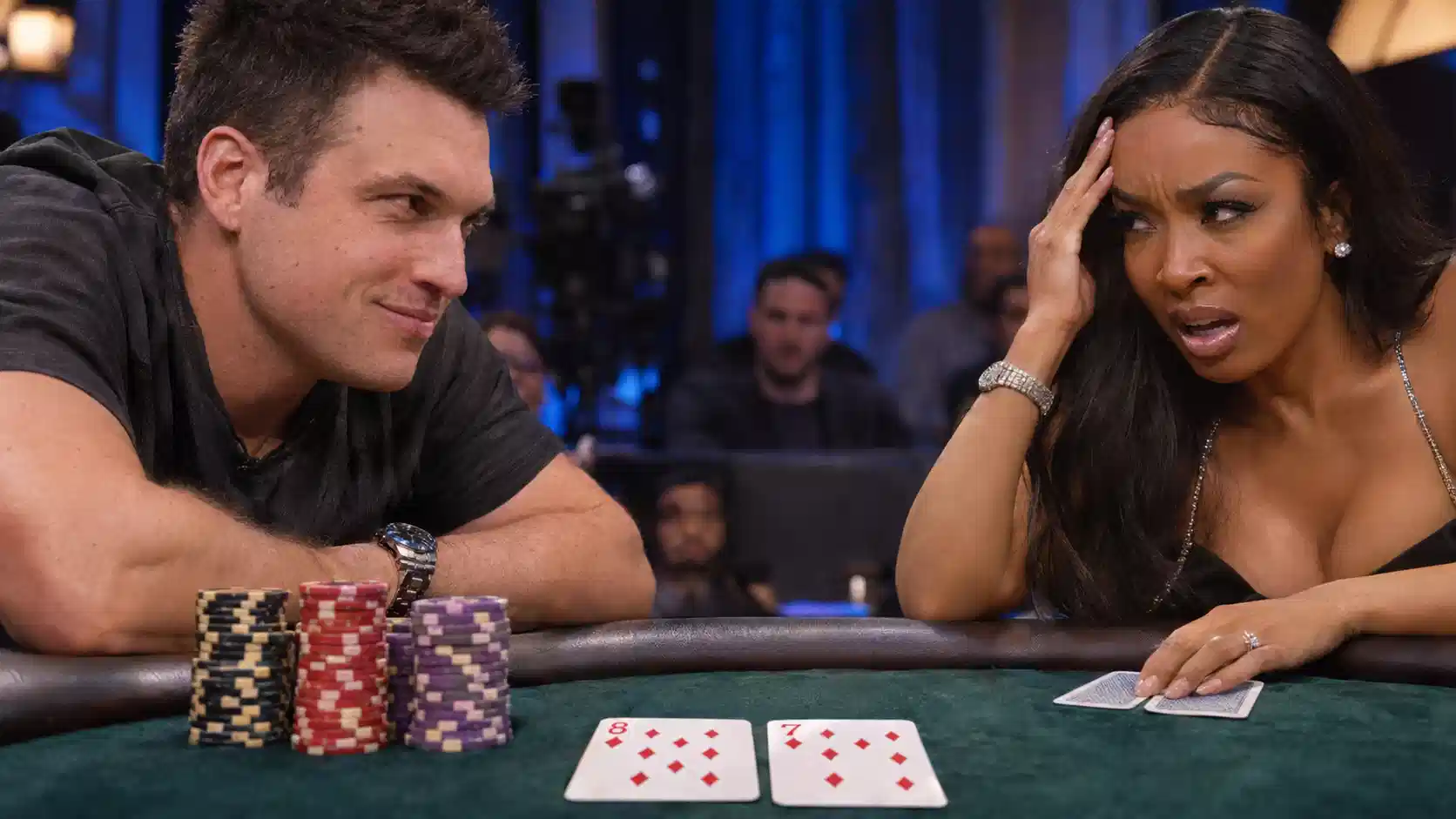
Doug Polk vs Princess Love produced one of the wildest poker showdowns of the latest PokerStars Big Game on Tour episode. A $42,000 bluff forced Love to fold a full house. Later, she answered with a fearless $29,100 call that helped her capture a $65,800 pot.
The two hands told completely different stories. First, Polk used aggression to win with eight-high. However, his next major confrontation ended with Love refusing to fold a modest pair against another huge bet.
Meanwhile, comedian Tony Hinchcliffe stunned Antonio Esfandiari in a separate $108,000 pot. Together, these moments made the show’s return a fascinating example of how quickly a high-stakes poker session can change.
So, was Polk’s aggression justified? Did Princess Love make the right decisions? And what can ordinary players learn from two completely different outcomes?
Doug Polk vs Princess Love: What Happened on The Big Game on Tour?
PokerStars brought back The Big Game on Tour with a new six-player lineup featuring professional poker stars, entertainers, and one aspiring player competing as the show’s Loose Cannon.
The action took place at $100/$200 no-limit Texas Hold’em stakes. Polk and Antonio Esfandiari each entered with $100,000, while the other players started with $50,000.
The table featured:
- Doug Polk, the high-stakes specialist and poker content creator.
- Princess Love, the television personality and poker enthusiast.
- Antonio Esfandiari, the legendary high-stakes tournament player.
- Esther Taylor, a respected mixed-game professional.
- Tony Hinchcliffe, the comedian and host of Kill Tony.
- Scott Gaughan, the Canadian aspiring comedian playing as the Loose Cannon.
The episode covered just 20 hands. Nevertheless, those hands produced enormous pots, difficult decisions, and several memorable confrontations.
For viewers who enjoy televised poker action, our guide to high-stakes poker in 2026 explores why major cash games continue attracting attention.
Hand One: Doug Polk Bluffs Princess Love Off a Full House
The opening hand immediately established Polk’s aggressive approach.
With a $400 straddle in play, Princess Love entered the pot holding pocket deuces. Polk looked down at 8♦7♦ and raised to $1,600. Love called, setting up a heads-up confrontation.
The Flop: 6-4-4
The dealer revealed a paired flop of 6-4-4.
Love still held pocket deuces, giving her two pair when combined with the board. Polk, meanwhile, had eight-high and no completed hand.
Despite having little showdown value, Polk continued betting for $1,200.
Love called.
At this point, Polk’s play reflected an important feature of aggressive poker. He did not need the strongest hand to win the pot. Instead, he needed his opponent to fold often enough for the pressure to become profitable.
Our poker straddle strategy guide explains how an additional blind changes preflop decisions and pot sizes.
The Turn: Another Four Changes Everything
The turn brought the third four.
Suddenly, Princess Love had a full house: fours full of deuces.
That sounds like an unbeatable situation. However, the strength of a full house depends on the board and the possible hands an opponent can hold.
Anyone holding a four would have four of a kind. In addition, a pocket pair higher than deuces could make a stronger full house.
Polk continued applying pressure with a $5,000 bet. Love called again.
Her decision kept Polk’s bluffs in the pot. Nevertheless, it also allowed him to tell a convincing story about holding a powerful hand.
The River: A $42,000 All-In With Eight-High
A queen arrived on the river, completing the board at 6-4-4-4-Q.
Love checked.
Polk responded by moving all-in for approximately $42,000.
He still held only eight-high.
After facing the enormous wager, Princess Love folded her full house. Polk then revealed his cards, showing that the winning bet had been a pure bluff.
The hand became an immediate example of how psychological pressure can overcome raw hand strength.
However, labeling Love’s fold an automatic mistake would oversimplify the situation. The bet was unusually large, and she could lose to multiple stronger full houses or quads.
The real question was whether Polk could hold enough bluffs to justify calling.
For a deeper explanation, see our guide to when you should bluff in poker.
Was Princess Love Wrong to Fold Her Full House?
At first glance, folding a full house to an eight-high bluff looks disastrous. Yet poker decisions must be judged using the information available before the cards are revealed.
Love could not see Polk’s hand when he shoved.
Instead, she had to estimate his range based on the previous betting action, the board, and his playing style.
Why the Fold Was Difficult
Polk’s river wager represented enormous strength. An opponent betting almost three times the approximate pot is applying extreme pressure.
Still, the paired board created several important possibilities.
- A player holding the remaining four would have quads.
- Pocket threes or another higher pocket pair could make a stronger full house than Love’s deuces.
- A weaker hand might attempt to represent those holdings through an aggressive bluff.
Consequently, Love needed to decide how frequently Polk would bluff compared with the number of strong hands he could realistically hold.
This is where understanding poker ranges becomes more useful than concentrating on one possible hand.
Why the Bet Size Matters
Consider a simplified calculation using an approximate $15,600 pot before Polk’s $42,000 river shove.
If Love called, she would need to risk another $42,000 to contest a final pot of roughly $99,600.
That means she would require approximately 42.2% equity to justify the call based on immediate pot odds.
Against a polarized range consisting of hands that beat her and hands she beats, the important question becomes how often Polk is bluffing.
Against a player who rarely makes huge bluffs, folding may be reasonable. Against someone who frequently applies extreme pressure with weak holdings, calling becomes more attractive.
Therefore, the fact that Polk was bluffing does not prove the original fold was irrational.
Our guide to fold equity in poker explains the relationship between bet sizing, pressure, and an opponent’s likelihood of folding.
Hand Two: Princess Love Gets Her $65,800 Payback
The final hand of the episode delivered a dramatic reversal.
After folding to Polk’s earlier bluff, Princess Love faced another large bet from the same opponent. This time, she refused to surrender.
Preflop: Polk Raises With Queen-Jack
Tony Hinchcliffe limped with queen-five. Princess Love followed with nine-eight from the small blind.
Polk held queen-jack and raised to $1,000.
Both opponents called.
The situation gave Polk an opportunity to build a pot against two players who had entered without raising. However, his opponents were not ready to release their hands.
The Flop: Polk Finds a Powerful Draw
The flop came 10-9-4.
Love connected with middle pair, holding nine-eight.
Polk had an open-ended straight draw, with additional flush-draw potential from his suited cards and the board.
He continued for $2,200.
Hinchcliffe folded, while Love called with her pair of nines.
Polk had plenty of possible improving cards. Nevertheless, his hand was still a draw rather than a completed straight or flush.
The Turn: A Massive $29,100 Shove
The turn brought a three, which did not improve either player’s main hand.
With approximately $7,600 in the pot, Polk moved all-in for Love’s remaining $29,100.
That represented an overbet of approximately 3.8 times the pot.
However, Princess Love responded almost immediately.
She called with just one pair.
This was the defining moment of the confrontation. Unlike the earlier hand, Love decided that her modest holding was strong enough against Polk’s betting range.
Importantly, Polk’s all-in occurred on the turn, not the river. The players subsequently agreed to deal the river twice.
Two Rivers, One $65,800 Pot
The players agreed to run the river twice, splitting the pot into two portions that would be determined by separate river cards.
The first river was a six. Polk missed his draw, and Love secured the first half.
The second river was a nine, improving Love to three of a kind.
She won that runout as well.
As a result, Princess Love collected the entire $65,800 pot.
The turnaround was remarkable. Earlier, she had folded a full house against a bluff. Now, she had successfully called a huge wager with only middle pair.
The hand illustrates why a player’s actual cards are only one part of a poker decision.
Was Princess Love’s $29,100 Hero Call Correct?
Love’s call was bold, but its quality requires more analysis than simply celebrating the winning result.
At the time of the decision, she held one pair on a board containing straight and flush possibilities.
However, Polk’s aggressive line could represent both strong made hands and powerful draws.
The Pot Odds Behind the Call
The pot was approximately $7,600 before Polk shoved $29,100.
After accounting for his bet and Love’s matching call, the final pot would reach $65,800.
The required equity was therefore:
$29,100 ÷ $65,800 = approximately 44.2%.
In other words, Love needed to win often enough to justify risking her remaining chips.
Against the exact hand Polk held, she was ahead when the money went in. Nevertheless, his straight and flush possibilities gave him meaningful chances to improve.
Her decision also had to account for stronger hands that Polk might play in the same aggressive manner.
For additional examples, our pot odds guide explains how to calculate profitable calls without overcomplicating the math.
Why Aggressive Players Can Be Easier to Call
Players who bet frequently may include more bluffs in their ranges than cautious opponents.
As a result, opponents sometimes need to defend weaker hands to avoid folding too often.
However, aggression alone does not justify every hero call. The board, bet size, previous action, and likely hand combinations all matter.
Against an extremely tight player, a $29,100 turn shove could represent overwhelming strength.
Against someone known for relentless pressure, the same bet may include more draws and bluffs.
Love’s decision reflected a willingness to challenge Polk rather than assume every large bet meant a monster hand.
Our guide to hand reading techniques in poker covers how to interpret betting patterns and narrow an opponent’s likely holdings.
Doug Polk’s Bluffing Strategy: Brilliant or Too Aggressive?
The two confrontations reveal a fascinating contrast in Polk’s approach.
His first enormous bluff succeeded. His second major all-in failed.
However, poker strategy cannot be evaluated by whether an individual hand wins or loses.
Why the First Bluff Worked
On the first hand, Polk represented an exceptionally strong range by betting aggressively across several streets.
He used the board texture and a huge river wager to create a difficult decision.
Moreover, his opponent could lose to several hands stronger than her full house.
The result showed the effectiveness of a well-timed bluff against a player who believed the betting line.
Why the Second Bluff Failed
In the later hand, Polk held a powerful draw rather than complete air.
His shove could win immediately if Love folded. Alternatively, he could improve to a straight or flush when called.
This type of play combines fold equity with the possibility of winning at showdown.
Nevertheless, Love’s decision to call removed the immediate fold-equity benefit.
Polk then needed one of his improving cards. Neither river produced the result he wanted.
Therefore, his loss does not automatically prove that the shove was strategically incorrect. A complete evaluation would require estimating both players’ ranges and their likely responses.
The broader lesson is that thin value betting and large bluffs serve different purposes. Successful players need to understand when each approach makes sense.
Tony Hinchcliffe Wins a $108,000 Pot Against Antonio Esfandiari
The Polk and Love showdown was not the only major moment.
Comedian Tony Hinchcliffe also won a remarkable confrontation against Antonio Esfandiari.
Esfandiari entered the hand with pocket sevens. Hinchcliffe held six-four and connected with two pair on a 6-4-5 flop.
Esfandiari had an overpair and an open-ended straight draw, creating a situation where both players had reasons to invest heavily.
After a series of raises, the players committed their stacks.
The pot reached approximately $108,000.
A four on the turn improved Hinchcliffe to a full house. Esfandiari still had limited chances to make a stronger full house, but the river did not rescue him.
Hinchcliffe collected the six-figure pot.
For a comedian facing accomplished poker professionals, it was an extraordinary result. More importantly, it demonstrated how quickly a strong drawing hand can become a major liability when another player improves.
Big Game on Tour Results: Who Won and Lost?
After the opening 20-hand session, Tony Hinchcliffe finished as the biggest winner.
Princess Love also ended in profit, while Polk and Esfandiari suffered losses despite their experience.
| Player | Session Profit/Loss |
|---|---|
| Tony Hinchcliffe | +$59,800 |
| Princess Love | +$15,800 |
| Scott Gaughan | -$100 |
| Doug Polk | -$12,600 |
| Antonio Esfandiari | -$30,800 |
| Esther Taylor | -$32,100 |
These results underline an important distinction between short-term outcomes and long-term poker skill.
A 20-hand sample is far too small to establish who has the strongest overall strategy.
Even elite professionals can experience large losses when opponents make successful calls or strong hands collide.
Similarly, a recreational player can win a substantial amount during a short session without becoming the favorite in a longer game.
The challenge is separating decision quality from immediate financial results.
What Is the Loose Cannon Format?
The Big Game on Tour uses a special format that adds another layer of excitement.
One participant, known as the Loose Cannon, receives a $50,000 stake from PokerStars to compete against established players.
The player must survive a scheduled series of 150 hands and can keep any profit above the starting amount.
Scott Gaughan occupies that seat during the current lineup.
His opening session included a difficult decision with pocket kings against Doug Polk.
On a dangerous river containing four cards to a straight, Polk made a $15,000 bet with pocket nines.
Gaughan eventually folded the stronger hand.
The decision protected him from a potentially expensive call against a possible straight. However, Polk’s actual cards showed that his kings would have won.
Despite the confrontation, Gaughan finished the opening session down only $100.
Consequently, his overall Loose Cannon challenge remained largely intact after the first 20 hands.
Five Poker Lessons From Doug Polk vs Princess Love
The episode offered several lessons that apply beyond televised high-stakes games.
1. Strong Hands Are Not Always Automatic Calls
A full house looks impressive, but its relative strength matters more than its name.
Board texture and opponent ranges determine whether calling is profitable.
2. Large Bets Create Pressure, Not Certainty
An oversized wager can represent a powerful hand. However, it can also be an attempt to force an opponent to fold.
Therefore, players should consider the opponent’s likely range rather than treating every massive bet as proof of strength.
3. Previous Hands Influence Future Decisions
Polk showed Love a successful bluff early in the episode.
That information could affect how she interpreted later aggression. Still, adjusting to one revealed bluff should not replace careful hand analysis.
The psychological side of this adjustment connects to our guide on emotional control and the poker face.
4. Winning a Hand Does Not Prove the Decision Was Perfect
Love won the $65,800 pot, but a full strategic assessment must consider her equity against Polk’s entire possible range.
Likewise, Polk’s failed shove could still have reasonable strategic foundations.
Strong poker decisions focus on expected value, not the emotional satisfaction of one result.
5. Reviewing Hands Builds Better Instincts
The most useful approach is to reconstruct the action and ask what each player could realistically hold.
Players should compare bet sizes, board changes, stack depths, and possible bluffs.
Our poker hand review guide provides a structured method for turning memorable hands into practical improvements.
When Is the Next Big Game on Tour Episode?
The second half of Season 3 features five weekly episodes on the PokerStars YouTube channel.
The confirmed schedule is:
- Episode 6: November 8, 2026
- Episode 7: November 15, 2026
- Episode 8: November 22, 2026
- Episode 9: November 29, 2026
- Episode 10: December 6, 2026
Viewers can follow the remaining sessions to see whether Polk recovers, Hinchcliffe protects his early lead, and Gaughan finishes his Loose Cannon challenge in profit.
The episodes are available through the official PokerStars YouTube channel.
Frequently Asked Questions
Did Doug Polk Bluff Princess Love Off a Full House?
Yes. Polk moved all-in for approximately $42,000 with eight-high on a 6-4-4-4-Q board. Princess Love folded her full house, fours full of deuces, before Polk revealed the bluff.
How Much Did Princess Love Win Against Doug Polk?
Princess Love won a $65,800 pot after calling Polk’s $29,100 turn shove with middle pair. The players ran the river twice, and Love won both runouts.
What Hand Did Doug Polk Have in the $65,800 Pot?
Polk held queen-jack on a 10-9-4-3 board. His straight and flush drawing possibilities failed to improve, while Princess Love held nine-eight.
Who Won the Most Money on Big Game on Tour Episode 6?
Tony Hinchcliffe finished as the biggest winner with a $59,800 profit. Princess Love finished second with a $15,800 profit.
How Much Did Doug Polk Lose?
Polk ended the opening 20-hand session down $12,600, despite winning several pots through aggressive bluffing.
What Stakes Are Played on The Big Game on Tour?
The featured cash game uses $100/$200 no-limit Texas Hold’em stakes, with additional straddles possible during play.
Final Thoughts: Aggression Meets a Fearless Call
The Doug Polk vs Princess Love confrontation captured the unpredictable nature of high-stakes poker.
Polk began by forcing a full house to fold with an extraordinary $42,000 bluff. Later, Love changed the story by calling his $29,100 shove and winning a $65,800 pot.
Meanwhile, Tony Hinchcliffe delivered another memorable moment by defeating Antonio Esfandiari in a $108,000 confrontation.
These hands remind players that aggression can be powerful, but it is never guaranteed to succeed.
Ultimately, great poker requires more than courage. Players must understand ranges, calculate risks, adapt to opponents, and recognize when a large bet deserves respect.
Princess Love demonstrated that sometimes the most important decision in poker is knowing when to stop folding.