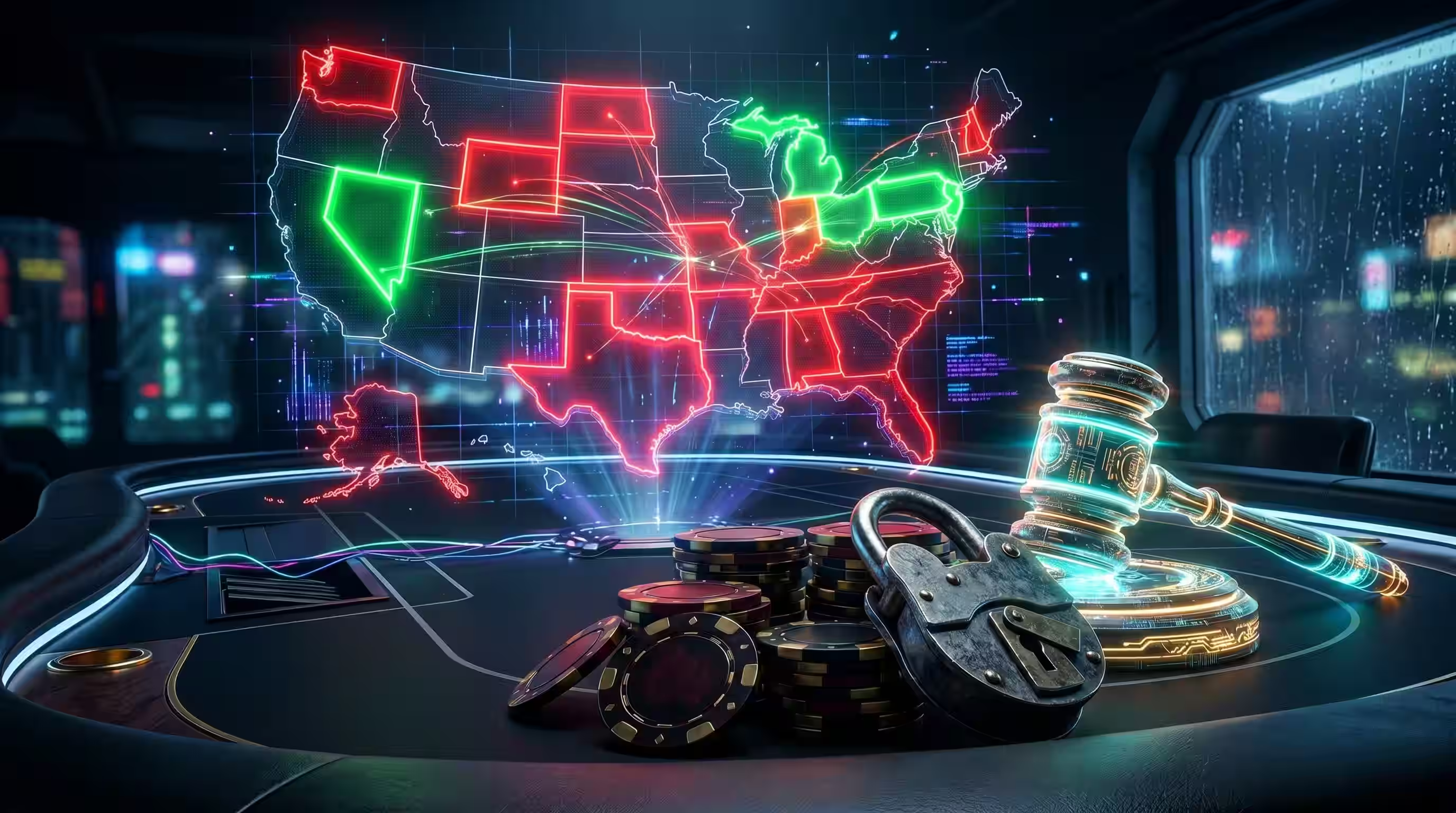
Is Online Poker Legal in 2026? The Real State-by-State Poker Guide Players Need
Is online poker legal in 2026? That is one of the biggest questions players are asking right now.
And the answer is not as simple as most people want it to be.
Some players think online poker is legal everywhere. Others think it is banned everywhere. Some confuse regulated poker sites with offshore rooms. Others mix up sweepstakes poker, club apps, social poker, and real-money online poker as if they are all the same thing.
它们不是。
The truth is that online poker in 2026 depends heavily on where you are physically located, which model you are using, and whether the platform is licensed, sweepstakes-based, offshore, social, or club-based.
That is why this guide matters.
This is not legal advice. It is a practical poker guide for players who want to understand the current online poker landscape before choosing where, how, or whether to play.
Why Online Poker Legality Is So Confusing
Online poker legality is confusing because players use one phrase — “online poker” — to describe several different models.
Those models can include:
- regulated real-money online poker
- offshore online poker sites
- sweepstakes poker platforms
- 社交扑克应用
- private poker club apps
- play-money poker rooms
- subscription-based poker products
Each model works differently.
That means the question “Is online poker legal?” is incomplete.
The better question is:
Which type of online poker are you talking about, and where is the player physically located?
That one question clears up most of the confusion.
Is Online Poker Legal in the United States in 2026?
In the United States, online poker is not regulated by one simple national poker license.
Instead, the U.S. market is mostly state-by-state.
Some states have legalized and launched regulated online poker. Some have legalized it but do not have live poker operators yet. Some allow online casino but not poker in practice. Many states have not created a regulated real-money online poker market at all.
This is why players often get conflicting answers online.
One article may say “online poker is legal in six states.” Another may say “eight states.” Another may say “nine states.” They may all be using different definitions:
- states where regulated online poker is live
- states where online poker has been authorized by law
- states that joined shared-liquidity agreements
- states where operators are licensed and active
- states where online poker is legal on paper but unavailable
That distinction is extremely important.
Legalized vs Live: The Difference Players Miss
This is the biggest mistake in online poker legality discussions.
A state can legalize online poker without having a live poker site available.
That means players may see headlines saying online poker is legal in a state, but still not be able to sit down and play on a regulated platform.
The reasons can include:
- no operator has launched yet
- regulations are still being written
- licensed casinos have not partnered with poker operators
- the state has not joined shared liquidity
- the market is too small to support a standalone poker pool
This is why “legal” and “available” are not always the same thing.
If you remember one concept from this article, remember that.
Why Maine Became a Big Online Poker Story in 2026
Maine became one of the biggest online poker legality stories of 2026 because it joined the group of states that have authorized online poker.
The move matters because any new state legalization creates attention around the broader U.S. online poker map.
But players should not misunderstand what that means.
Legalization does not instantly create a mature poker market. Maine still has to deal with operator launches, regulation, market size, and whether shared liquidity becomes part of the future.
That last point matters a lot.
Online poker works better when there are enough players. A small state can legalize poker, but if the player pool is isolated, games may be limited unless the state can connect with larger shared-liquidity networks.
What Is Shared Liquidity in Online Poker?
Shared liquidity means players from different states can play in the same online poker player pool, if the states and operators are approved to do so.
This matters more in poker than in casino games.
A slot game does not need other players. A blackjack table can run with a small number of users. But poker depends on player traffic.
More shared liquidity can mean:
- more cash games running
- bigger tournament prize pools
- more game formats
- less waiting for tables
- healthier player pools
This is one reason multi-state online poker is so important in 2026.
When states share player pools, online poker becomes much more viable.
Why the Multi-State Internet Gaming Agreement Matters
The Multi-State Internet Gaming Agreement, often called MSIGA, is one of the most important structures in regulated U.S. online poker.
It allows participating states to combine online poker liquidity under approved conditions.
That matters because poker needs volume.
Without shared liquidity, smaller states can struggle. With shared liquidity, a legal market can become more attractive to operators and players.
This is why Michigan, Pennsylvania, New Jersey, Nevada, Delaware, and West Virginia are often discussed together in online poker regulation conversations.
In 2026, Michigan’s approval of FanDuel/PokerStars for multi-state poker with Michigan, Pennsylvania, and New Jersey showed how important this model has become.
Why Connecticut Shows the Problem Clearly
Connecticut is one of the best examples of why online poker legality is confusing.
The state authorized online poker, but regulated real-money online poker still has not launched there.
That means a casual player may search “is online poker legal in Connecticut?” and get a confusing answer.
Technically, the law may allow online poker. Practically, there may be no live licensed poker platform available to players.
That is exactly why this guide separates three ideas:
- legalized: the state has passed law allowing online poker
- launched: operators are actually live
- liquid: the player pool is large enough or shared enough to support strong games
Players need all three concepts, not just one.
Why Regulated Online Poker Is Different from Offshore Poker
Regulated online poker means the platform is licensed under a specific state or national regulatory framework.
That usually means there are rules around:
- geolocation
- identity verification
- responsible gaming
- game integrity
- segregated player funds or financial controls
- dispute processes
- operator reporting
Offshore poker sites may serve players in places where regulated poker is not available, but they usually operate outside the player’s local regulated system.
That creates a different risk profile.
The question is not only “Can I access the site?”
The better question is:
Who regulates the site, who protects the player, and what happens if something goes wrong?
That is the real difference.
Online Poker vs Sweepstakes Poker
Sweepstakes poker became a major online poker trend because it offers a different model from regulated real-money poker.
Instead of direct cash balances and traditional poker licensing, sweepstakes poker usually uses virtual currencies and promotional credits that may be redeemable under specific rules.
That model can make poker-style games available in places where regulated real-money online poker is limited.
But it is not the same thing as a normal real-money poker room.
This is why players should not confuse these two searches:
- is online poker legal
- is sweepstakes poker legal
They are related, but they are not identical.
If you want the full breakdown of that model, read our guide to sweepstakes poker in 2026.
Online Poker vs Club-Based Poker Apps
Club-based poker apps are another reason the word “poker” gets confusing in 2026.
Some players are not looking for regulated online poker rooms. They are looking for private clubs, poker apps, or club-based communities.
That is a different model.
A club-based app may depend heavily on the specific club, route, support, rules, and local eligibility. The app itself is only part of the experience. The club environment matters just as much.
This is why we built a dedicated 俱乐部名单 for players comparing poker club environments.
And if you are specifically researching ClubGG, our Complete ClubGG Guide 2026 explains how that ecosystem differs from traditional online poker.
Why Online Poker Is Not Legal Nationwide in the U.S.
Many players ask why online poker is not simply legal across the whole United States.
The answer is mostly about state-level gambling law.
Gambling regulation in the U.S. is heavily state-driven. That means each state can choose whether to authorize, regulate, restrict, or avoid online poker.
This creates a patchwork market.
From a player perspective, that feels inefficient. From a regulatory perspective, it allows each state to control licensing, taxation, consumer protection, and enforcement.
The result is a market where your online poker options can change dramatically based on your physical location.
Why Physical Location Matters More Than Residency
In regulated U.S. online poker, physical location usually matters more than residency.
That means you may not need to be a resident of a state to play on its regulated poker sites, but you usually must be physically located inside that state when playing.
This is why geolocation is so important.
Licensed poker platforms must confirm that players are inside the approved jurisdiction before allowing real-money play.
That is also why VPN use can be dangerous.
If a player tries to bypass geolocation rules, they may risk account closure, fund issues, or regulatory problems.
Why Online Poker Needs More States to Work Better
Online poker is different from online casino because poker is player-versus-player.
A casino game can run against the house with one player. Poker needs active tables, enough opponents, and enough tournament entries.
That is why state-by-state regulation creates a unique problem for poker.
If one state has a small population and cannot share liquidity, it may struggle to support a healthy online poker market even if the law allows it.
More states joining shared liquidity could improve:
- cash game traffic
- sit-and-go availability
- tournament guarantees
- 游戏种类
- operator interest
- player retention
This is why online poker legalization is not only about legal permission.
It is about market structure.
The Problem with Small Isolated Poker Markets
A small isolated poker market can become frustrating quickly.
Players may find:
- limited stakes
- few tournaments
- repeated opponents
- low off-peak traffic
- weak game variety
- operator hesitation
That is why shared liquidity is so important.
If a new state legalizes online poker but does not join a shared player pool, the law may look exciting on paper while the actual games remain limited.
This is one of the most important realities for players to understand in 2026.
Why Legal Online Poker Is Still Growing Slowly
Online poker grows more slowly than online sports betting and online casino for several reasons.
First, poker produces less predictable revenue than casino games.
Second, poker requires player liquidity.
Third, poker has more game-integrity concerns because players compete against each other.
Fourth, operators often prioritize products with higher margins.
That is why some states move quickly on sports betting but slowly on poker.
From the player perspective, that is frustrating.
From the operator perspective, poker is more complex to run profitably.
Why 2026 Is Still a Big Year for Online Poker
Even though growth is slow, 2026 is still important for online poker.
Several things are happening at once:
- more states are discussing online gaming
- Maine added new legalization momentum
- multi-state poker continues expanding
- sweepstakes poker is under pressure and evolving
- players are more aware of regulation and safety
- club-based poker apps continue attracting attention
That combination makes online poker legality one of the most important poker topics of the year.
It is not just a legal question.
It is a market question, a player-safety question, and a future-of-poker question.
How to Check If Online Poker Is Legal Where You Are
Before playing online poker, use a careful process.
- Check your state or country law: Do not rely only on old forum comments.
- Check whether regulated operators are live: Legalized does not always mean available.
- Check the platform’s restricted regions: Good sites publish where they operate.
- Check licensing: A regulated site should clearly show its license and operator details.
- Check geolocation rules: Physical location usually matters.
- Check payment and withdrawal rules: Legal access means little if money movement is unclear.
- Check responsible gaming tools: Serious operators should provide them clearly.
This process is not exciting.
But it can protect you from bad assumptions.
Red Flags When Choosing an Online Poker Site
Be careful if a poker site:
- does not clearly explain who operates it
- does not show licensing information
- makes unrealistic guarantees
- avoids questions about withdrawals
- does not explain country or state restrictions
- has repeated unresolved complaints
- encourages VPN use to bypass rules
One red flag does not automatically prove a site is bad.
But several red flags together should make you slow down.
In 2026, poker site selection is not only about soft games.
It is about trust.
What About Offshore Poker Sites?
Offshore poker sites exist because many players do not have access to regulated online poker where they live.
Some players use them. Some avoid them. Some see them as the only practical option.
The important thing is to understand the tradeoff.
Offshore poker may offer more access, but often with less local regulatory protection. If there is a dispute, delayed withdrawal, account closure, or game-integrity issue, your options may be different from a regulated state-licensed platform.
That does not mean every offshore site is the same.
It means players should judge risk honestly instead of pretending access equals safety.
How Bots, RTA, and Game Integrity Fit Into Legal Poker
Legal status is not the only thing that matters.
A legal site still needs strong game integrity.
Players should care about:
- 机器人检测
- RTA policies
- collusion monitoring
- multi-accounting controls
- hand history review
- support response
- fund protection
This is why our article on poker bots and RTA in 2026 connects naturally to online poker legality.
A poker market is not healthy just because it exists.
It has to be fair enough for players to trust it.
Why Online Poker Legalization Helps Recreational Players
Regulated online poker can help recreational players because it usually provides clearer rules, stronger oversight, and more transparent payment systems.
That does not mean regulated poker is easy.
Strong players still exist. Variance still hurts. Rake still matters. Game selection still matters.
But a regulated environment can make basic player protections easier to understand.
That matters for new players who want to play poker without needing to decode offshore risks, sketchy payment methods, or unclear support structures.
Why Online Poker Legalization Helps Serious Players
Serious players care about legality too, but for different reasons.
They need:
- stable traffic
- reliable withdrawals
- clear rules
- shared liquidity
- long-term platform stability
- reduced game-integrity risk
For a high-volume player, uncertainty is expensive.
A platform that may suddenly restrict access, change payment rules, or face legal pressure can damage bankroll planning.
That is why serious players should treat legal structure as part of game selection.
Why Rake Still Matters in Legal Online Poker
Even if a poker site is legal and regulated, rake still matters.
A safe platform with terrible rake can still be hard to beat.
Players should always compare:
- cash game rake
- tournament fees
- rake caps
- rewards programs
- traffic quality
- game softness
If you want to understand your real cost, use the 扑克返水计算器 to compare how rake and rewards affect your actual value over time.
Online Poker Strategy in Legal Markets
Legal online poker markets can play differently from offshore or club-based environments.
Some regulated markets have smaller player pools. Some have more recreational traffic. Some have tighter regular-heavy pools because traffic is limited. Some have better tournament structures because shared liquidity improves guarantees.
Your strategy should adjust to the actual pool.
Useful habits include:
- track your sessions instead of relying on feelings
- study common pool tendencies
- avoid assuming every legal market is soft
- watch rake carefully
- review hands after sessions
- separate legal safety from strategic profitability
这 扑克对局追踪器 can help you monitor whether a specific poker environment is actually working for you.
What Players Should Not Do
Players make several common mistakes when researching online poker legality.
- Do not rely on old information: laws and platform availability change.
- Do not confuse legal with live: authorized poker may not be available yet.
- Do not use VPNs to bypass rules: this can create serious account problems.
- Do not assume all poker apps are the same: regulated rooms, sweepstakes sites, and club apps are different.
- Do not ignore withdrawal rules: playing is only half the question.
- Do not choose only by bonus: safety, traffic, and rules matter more.
Why This Topic Can Rank for Poker Searches
This topic is powerful because it targets several high-demand search clusters at once:
- is online poker legal
- online poker legal 2026
- legal online poker USA
- where is online poker legal
- legal poker sites
- online poker states
- real money online poker legal
- online poker regulation
- poker sites for US players
It also supports broader authority around the word 扑克 because it answers a question that affects almost every online poker player before strategy even begins.
Players cannot choose the best poker site if they do not understand which type of poker site they are looking at.
The Future of Online Poker Legality
The future of online poker will probably not move in one straight line.
We are likely to see several models continue at the same time:
- regulated state-licensed online poker
- multi-state shared liquidity
- sweepstakes poker models
- club-based poker apps
- offshore poker rooms
- social poker products
The question is not which model exists.
The question is which model players trust.
In 2026 and beyond, trust may become the biggest competitive advantage in online poker.
如果你只记住一件事
Online poker legality in 2026 is not one simple yes-or-no answer. It depends on the player’s physical location, the platform model, whether regulated operators are actually live, and whether the player pool is strong enough to support real games.
That is the real lesson.
Do not confuse legalized with launched.
Do not confuse sweepstakes poker with traditional real-money poker.
Do not confuse club apps with regulated poker rooms.
And do not assume access means safety.
The smartest online poker players in 2026 are not just asking where they can play.
They are asking where they can play safely, legally, profitably, and with enough trust to keep coming back.
FAQ: Is Online Poker Legal in 2026?
Is online poker legal in 2026?
Online poker legality depends on where you are physically located and which platform model you are using. Some states and countries have regulated online poker, while others do not.
Is online poker legal everywhere in the United States?
No. Online poker in the U.S. is mostly regulated state by state, so availability depends on state law, operator licensing, and geolocation.
What is the difference between legal and live online poker?
Legal means a state has authorized online poker by law. Live means licensed operators are actually available and running games for players.
Why does shared liquidity matter in online poker?
Shared liquidity lets players from multiple approved states or regions play in the same poker pool, which can create more games and bigger tournaments.
Can I play online poker from a legal state if I live somewhere else?
In many regulated U.S. markets, physical location matters more than residency. You usually need to be physically located inside the approved state while playing.
Is offshore poker the same as regulated online poker?
No. Offshore poker sites usually operate outside the player’s local regulated system, while regulated poker sites are licensed under a specific state or country framework.
Is sweepstakes poker the same as online poker?
No. Sweepstakes poker may offer poker-style games, but it usually uses virtual currencies and promotional redemption rules rather than a traditional real-money poker structure.
Are club-based poker apps legal online poker?
Club-based poker apps are a separate model from regulated online poker rooms. Their structure depends on the app, club, route, local rules, and eligibility.
Why is online poker not legal nationwide in the U.S.?
Gambling law in the U.S. is heavily state-driven, so each state decides whether to authorize and regulate online poker.
What should I check before playing online poker?
Check your local rules, platform licensing, restricted regions, geolocation requirements, withdrawal rules, game integrity policies, and support quality before playing.
在 BluffingMonkeys ,我们不仅仅分享扑克策略、评论和指南。我们帮助玩家与最佳游戏、最新更新和最大机会保持联系。请务必关注我们所有的社交媒体频道,这样您就不会错过重要的公告、奖金、促销活动、特别活动和新优惠。继续探索我们的内容,当您准备好加入行动时,请使用我们主页上的实时聊天按钮与我们联系或发送消息 @bluffingmonkeys24_7 在 Telegram 应用上。