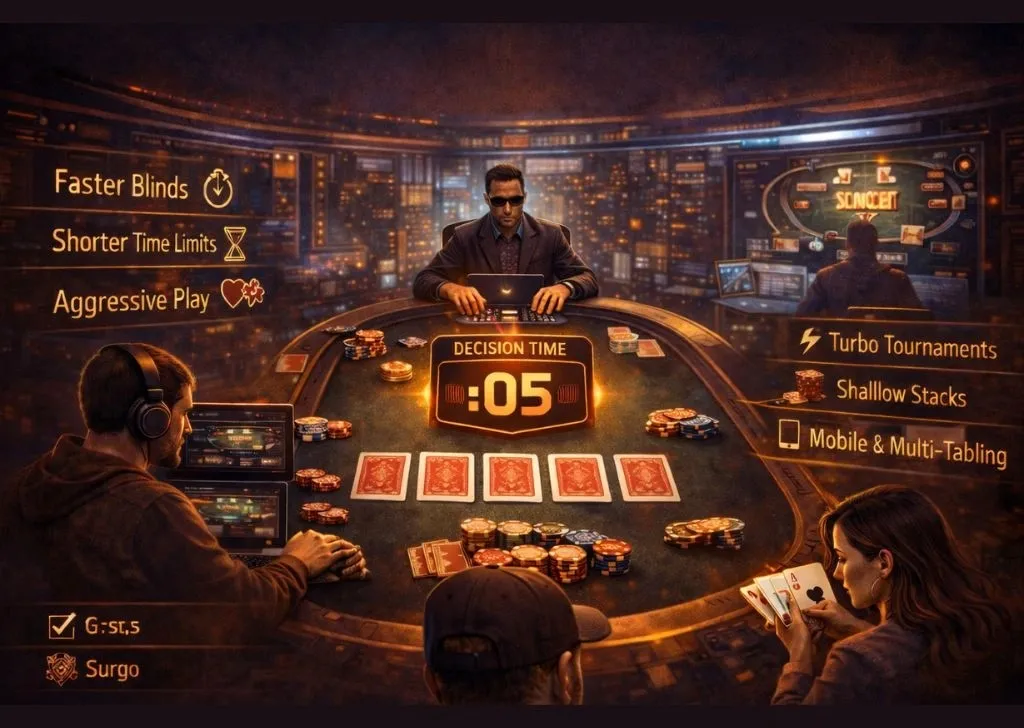
Are poker games getting shorter as we move into 2026, or does it only feel that way because attention spans are shrinking everywhere else? Spend even a short time at an online table, and the answer becomes obvious. Hands move rapidly, blinds climb sooner, and decision clocks leave little room for hesitation. Sessions that once stretched for hours now wrap up in a fraction of the time.
This shift isn’t accidental. Poker has adapted to modern habits, technology, and competition. Understanding why games are shorter and how that affects different types of players is now just as important as knowing hand ranges or pot odds.
Are Poker Games Getting Shorter in 2026? What’s Actually Happening
Yes, poker games are undeniably shorter in 2026, especially online. This doesn’t mean fewer hands are played overall. Instead, more hands are compressed into tighter time frames, making sessions feel intense and relentless.
Tournament structures feature faster blind increases, while cash games enforce quicker decisions through reduced time banks. The result is a game that demands readiness from the first hand and offers little forgiveness for slow starts.
Why Poker Games Getting Shorter Is Changing Poker Strategy
Shorter games reshape poker from the ground up. The way players approach risk, aggression, and patience has shifted dramatically.
- Early decisions carry greater long-term impact: With fewer hands before blinds escalate, mistakes made early often can’t be undone later.
- Waiting for premium spots becomes costly: Folding too much leads to being blinded down faster than before.
- Pressure replaces patience as the dominant force: Players must actively fight for pots rather than waiting for ideal situations.
This is poker compressed into a tighter decision window, not simplified.
The Structural and Economic Forces Behind Faster Poker
Poker platforms benefit directly from faster games, and that incentive shapes design choices.
- Increased hands per hour boost rake efficiency: Faster gameplay allows rooms to earn more without increasing player volume.
- Shorter sessions suit modern schedules: Players are more likely to play frequently if they can finish a session quickly.
- Reduced stalling improves overall table experience: Strict timers prevent frustration caused by excessive tanking.
These changes favor consistency and engagement over marathon sessions.
The Rise of Faster Decision Cycles
One of the most noticeable changes is how little time players now have to act. Faster poker decision-making has become a core mechanic rather than a courtesy.
- Short action timers force pre-planned thinking: Players must know their responses before the cards are dealt.
- Limited-time banks increase pressure in key spots: Saving time for critical decisions becomes a strategic skill.
- Automatic actions reward familiarity with ranges: Players who rely on preparation outperform those relying on improvisation.
Poker has become a game of preparation first, execution second.
Online Poker Trends That Are Accelerating the Pace
Poker games getting shorter online is closely tied to platform design and player behavior.
- Turbo-style formats dominate tournament schedules: Faster structures attract players seeking quick results and higher volume.
- Mobile play encourages shorter, sharper sessions: Games are designed for play during breaks, not long sittings.
- Multi-tabling favors speed over contemplation: Players handling multiple tables must act quickly to remain efficient.
- Software discourages slow play by default: Timers and auto-fold systems actively penalize indecision.
Online poker now rewards efficiency as much as skill.
Short-Handed Tables and Reduced Stack Sizes
Common Misunderstandings About Faster Poker
Many players misunderstand what shorter games really mean.
- Luck may feel more visible in shorter formats, but it isn’t more powerful. Variance simply compresses time. Swings happen faster, bad beats feel louder, and results fluctuate more frequently, yet the underlying math doesn’t change. Players with long-term edges still have them; they just need enough volume and emotional control to let those edges surface.
- Experience continues to separate winners from losers, perhaps more than ever. In faster structures, there’s little room to “figure things out” mid-game. Familiarity with standard shove-fold spots, blind-vs-blind dynamics, and short-stack play becomes invaluable. Players who’ve seen these scenarios hundreds of times react correctly almost on autopilot, while inexperienced players hesitate or misapply pressure.
- Ultimately, shorter games act like a spotlight. They expose leaks quickly—poor discipline, emotional mistakes, and weak fundamentals don’t hide for long. At the same time, they reward consistency, preparation, and repeatable decision-making, turning solid fundamentals into a reliable long-term advantage.
Shorter games reveal weaknesses quickly but reward consistency.
How Recreational Players Experience Shorter Games
Recreational players often feel the effects of shorter games more intensely than seasoned grinders. For many casual players, poker has traditionally been about relaxation and gradual learning. Faster formats disrupt that expectation.
- Games feel exciting but overwhelming
Rapid action creates adrenaline, but it can also leave players feeling rushed and uncertain.
- Mistakes are punished immediately
With fewer hands to recover, a single error can define an entire session.
- There’s less time to observe and adjust
Recreational players lose valuable learning moments that slower games once provided.
- Sessions end before confidence builds
Players may exit games before settling into a rhythm, reducing enjoyment.
- Losses feel sharper, even if smaller
Quick defeats can feel emotionally heavier than longer, drawn-out sessions.
While some recreational players enjoy the intensity, others quietly disengage, finding the pace stressful rather than entertaining.
Are Shorter Poker Games More Profitable?
Profitability in shorter poker games depends heavily on preparation, discipline, and emotional control.
- Skilled players benefit from increased volume
Faster games allow strong players to realize their edge over more hands per hour.
- Edges materialize faster but fluctuate more
Variance increases, meaning swings happen quickly in both directions.
- Unprepared players lose money at a faster rate
Speed exposes strategic leaks repeatedly in a short time frame.
- Hourly profits may rise while session profits shrink
Players can earn more over time but feel less satisfied per individual session.
- Bankroll management becomes more critical
Short stacks and fast structures amplify risk, making discipline essential.
Shorter games are neither inherently better nor worse for profit, they simply punish mistakes faster and reward preparation sooner.
Live Poker vs Online Poker in 2026
Despite some modernization, live poker remains noticeably slower.
- Live games allow more physical and social interaction
Table talk and manual dealing naturally slow the pace.
- Online games enforce speed mechanically
Software eliminates delays and ensures a consistent tempo.
- Strategies must adjust between formats
What works online doesn’t always translate smoothly to live play.
Understanding these differences gives adaptable players a clear edge.
How Players Can Adapt to Shorter Poker Games
Thriving in modern poker requires intentional adjustment.
- Study away from the table
Preparation reduces in-game decision stress.
- Create default responses for common situations
Familiar patterns lead to quicker, more confident actions.
- Limit table count when necessary
Fewer tables improve decision quality under time pressure.
- Choose formats that fit personal comfort levels
Not all players thrive in hyper-fast environments.
Adaptation isn’t optional, it’s the price of staying competitive.
FAQs
Are poker games really getting shorter in 2026?
Yes, particularly online, where faster structures and strict timers dominate.
Do faster games favor aggressive players?
Generally, yes, because pressure and initiative matter more in shorter formats.
Is online poker faster than live poker now?
Online poker is significantly faster due to automation and enforced decision clocks.
Can recreational players still enjoy poker in 2026?
Yes, but many prefer slower formats or lower-pressure environments.
Will poker keep getting faster after 2026?
The trend likely continues, though balance between speed and enjoyment will influence future designs.
Conclusion
So, are poker games getting shorter in 2026? Without question. Poker hasn’t lost its depth, it’s simply condensed it. Faster games demand sharper preparation, quicker thinking, and stronger emotional control.
For players willing to adapt, modern poker remains rich with opportunity. For those expecting the game to slow down, the pace may feel unforgiving. Either way, the message is clear: poker is still the same battle of skill and psychology, it just moves faster now.
At BluffingMonkeys, we do more than just share poker strategy, reviews, and guides. We help players stay connected to the best games, latest updates, and biggest opportunities. Be sure to follow all of our social media channels so you never miss important announcements, bonuses, promotions, special events, and new offers. Keep exploring our content, and when you’re ready to join the action, use our live chat button on the homepage to connect with us or message @bluffingmonkeys24_7 on the Telegram App.
 Hindi
Hindi Russian
 Spanish
 Brazilian Portuguese
 Simplified Chinese
 English