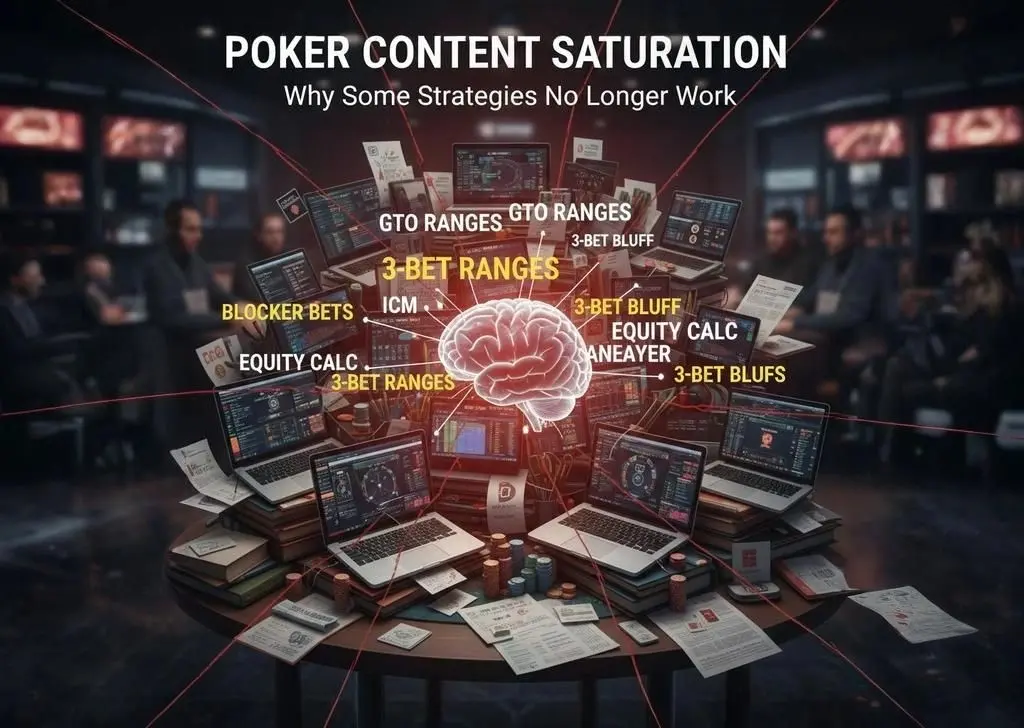
Poker content saturation didn’t arrive overnight. It crept in quietly, one tutorial here, one video there, until suddenly the strategy world felt crowded. Today, almost every concept has been explained, diagrammed, and replayed endlessly. As a result, many approaches that once gave players an edge no longer hit the same way.
This overload helps explain why so many players now ask the same questions: Why is online poker so hard? Why does every decision feel rushed? Why do opponents seem sharper, even at casual levels? The answer isn’t that the game itself changed. It’s that everyone learned the same things at the same time.
In this article, we’ll unpack how saturation changed strategy, why familiar plays stopped working, and how players can stay effective in a crowded information era.
Poker Content Saturation and the Strategy Overload Problem
Poker content saturation describes what happens when strategic knowledge becomes widely available and endlessly repeated. Articles, videos, streams, charts, there’s no shortage of material. The problem isn’t a lack of information anymore. It’s too much of it.
When everyone studies similar material, play styles start to blend together. Ranges tighten in the same spots. Aggression appears at predictable moments. Once-creative lines become expected.
This leads to a strange outcome:
Even weaker players now understand concepts that used to separate strong players from the rest. The strategic gap shrinks, and the game feels tougher across the board.
Instead of outplaying opponents with clever ideas, players often find themselves facing resistance at every turn. Nothing feels surprising anymore.
Poker Content Saturation and Why Old Strategies Fail
The second effect of poker content saturation is brutal honesty: a strategy only works when opponents don’t expect it. Once it becomes popular, it loses power.
Here’s how that plays out:
- Standard aggression patterns are instantly recognized
- Common traps are spotted early
- Textbook lines get neutralized
- Predictable timing gets challenged
In the past, mixing up play styles caused confusion. Today, it often triggers recognition. Instead of opponents freezing, they respond with confidence because they’ve seen the spot before.
Even balance-based approaches suffer. When too many players aim for the same “correct” lines, exploitation becomes harder. The game turns into a mirror match of shared knowledge.
This doesn’t mean strategy is useless. It means blindly copying popular strategy is.
Why Is Online Poker So Hard?
The difficulty spike players feel today isn’t imagined. Several forces stack together to make online environments more demanding.
Higher baseline knowledge
Many players study at least some strategy content. Even casual participants often understand fundamentals that used to be advanced.
Faster correction of mistakes
Errors get punished quickly. Loose decisions, slow reactions, and poor structure don’t linger long before being exploited.
Technical expectations
Players are expected to think in ranges, probabilities, and long-term outcomes. Poker is hard not because it’s impossible, but because it demands consistent mental discipline.
Fewer obvious weak spots
The days of routinely finding opponents making massive errors are fading. Mistakes still exist, but they’re subtler and harder to identify.
Put simply, online poker feels hard because the average player is better prepared.
Why Is Online Poker So Fast?
Speed plays a huge role in player frustration. Online formats remove nearly all downtime, and decision-making becomes relentless.
Here’s why the pace feels intense:
- More hands are played per hour.
- Transitions between hands are instant.
- Timers push faster decisions.
- Multi-table environments increase cognitive load.
There’s little breathing room. One decision flows into the next, and hesitation gets punished. For newer players, this creates pressure. For experienced players, it demands focus and endurance.
Fast doesn’t always mean chaotic, but it does mean mistakes compound quickly.
The Psychological Impact of Saturation
Beyond mechanics, saturation affects mindset.
When strategies stop working, frustration creeps in. Players feel like they’re “doing everything right” but not getting results. This leads to:
- Over-adjusting
- Forcing creativity
- Chasing complexity
- Abandoning solid fundamentals
Ironically, saturation often pushes players away from simplicity, even though clarity is more valuable than ever.
Poker is hard not just because of strategy, but because confidence erodes when edges feel invisible.
Adapting in a Saturated Strategy Environment
The goal isn’t to find secret knowledge. It’s to use common knowledge better than others.
Here’s how adaptable players stay effective:
Focus on understanding, not memorization
Knowing why a move works matters more than knowing when it’s recommended.
Observe opponents, not charts
Many players apply strategy mechanically. Watching how individuals deviate creates opportunity.
Embrace flexibility
Rigid play breaks easily. Flexible decision-making survives longer.
Simplify under pressure
When speed increases, clarity beats complexity. Clean decision trees reduce errors.
Question popular wisdom
If everyone follows the same advice, the counter-approach may gain value.
The strongest players aren’t chasing novelty, they’re refining execution.
Poker Content Saturation in Poker Media
An overlooked side effect of poker content saturation in poker media is repetition fatigue. Concepts get recycled with new titles but identical substance. Players consume more but learn less.
This creates an illusion of progress without meaningful improvement.
To avoid this trap:
- Limit content intake
- Study one idea deeply
- Apply before moving on
- Review outcomes honestly
Learning slows down when consumption speeds up.
FAQs
Why is online poker so hard?
Because the shared knowledge level has increased. Players encounter fewer obvious errors, faster decisions, and stronger resistance. The game now rewards precision over improvisation.
Why is online poker so fast?
Online formats maximize efficiency. Faster dealing, instant transitions, and time limits push continuous action. This reduces thinking time and increases mental strain.
What does poker content saturation in poker mean?
It refers to the overwhelming amount of strategy material available. When everyone studies similar content, strategies become predictable and less effective.
Why do old strategies stop working?
Once a strategy becomes popular, opponents learn to respond. Effectiveness fades as recognition rises.
Poker is hard; does that mean it’s not worth learning?
Not at all. Difficulty reflects depth. Poker remains rewarding for players who adapt, simplify, and stay curious.
Conclusion
Poker content saturation changed the game quietly but permanently. The flood of strategy material raised the average skill level and flattened traditional advantages. What once felt clever now feels ordinary.
But saturation isn’t the end, it’s a filter. Players who adapt, observe, and think independently still find success. The key isn’t consuming more content. It’s using information with intention.
Poker is hard because it demands evolution. And for those willing to evolve, the game still has plenty to teach.
At BluffingMonkeys, we do more than just share poker strategy, reviews, and guides. We help players stay connected to the best games, latest updates, and biggest opportunities. Be sure to follow all of our social media channels so you never miss important announcements, bonuses, promotions, special events, and new offers. Keep exploring our content, and when you’re ready to join the action, use our live chat button on the homepage to connect with us or message @bluffingmonkeys24_7 on the Telegram App.
 Hindi
Hindi Russian
 Spanish
 Brazilian Portuguese
 Simplified Chinese
 English