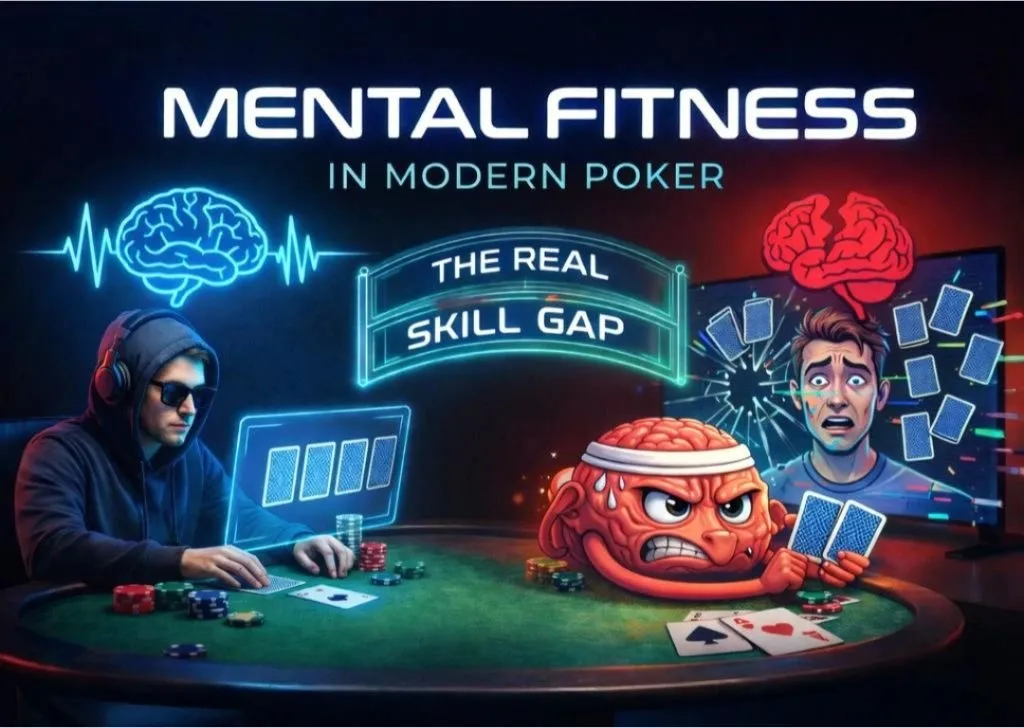
Poker has always been considered a game of skill, strategy, and probability. For many years, players believed that learning advanced strategy, ranges, and theory was the key to success. But the modern poker world has changed.
Today, strategy knowledge is widely available. Players can easily access training content, charts, solvers, and coaching programs. Because of this, many players now have a similar technical understanding of the game.
Yet, some players consistently perform better than others.
The reason is not just strategy, it is mental fitness in modern poker.
In today’s game, the biggest skill gap is no longer technical knowledge. It is mindset, discipline, emotional control, and psychological resilience.
What Is Mental Fitness in Poker?
Mental fitness in poker refers to the psychological and cognitive abilities that help players perform consistently and rationally, even under pressure.
It includes:
- Emotional control during losses and wins
Poker involves constant ups and downs. Emotional control means staying calm after negative outcomes and not becoming overly excited after positive results. Players with strong emotional control avoid impulsive decisions and stick to logical strategy.
- Focus and concentration during long sessions
Poker sessions can be long and mentally exhausting. Focus helps players track opponents, calculate probabilities, and avoid careless mistakes caused by distraction or fatigue.
- Discipline to follow a strategy
Discipline means applying your strategy consistently, even when bored, frustrated, or tempted to deviate. Many players know the right strategy but fail to follow it due to emotional or psychological pressure.
- Confidence without arrogance
Confidence allows players to trust their decisions and avoid fear-based play. However, arrogance leads to overestimating skill and taking unnecessary risks. Mental fitness balances confidence with humility.
- Ability to handle uncertainty and variance
Poker outcomes are unpredictable in the short term. A mentally fit player accepts uncertainty and does not panic or change strategy due to temporary negative results.
- Decision-making under pressure
Poker decisions often involve time pressure, psychological pressure, and uncertainty. Mental fitness allows players to think clearly and logically in stressful situations. Players often develop these skills while exploring different tables and communities listed in our poker club list.
Why Mental Fitness Is Becoming the Real Skill Gap in Poker
Strategy Knowledge Is Becoming Common
In the past, advanced poker knowledge was limited to elite players. Today, anyone can learn:
- Game theory concepts
- Preflop and postflop ranges
- Solver-based strategies
- Professional training content
Because of this, technical skill differences are shrinking.
However, mental discipline is still rare, making it a major competitive edge.
Modern Poker Is Mentally More Demanding
Modern poker is faster and more complex than ever. Players must multi-table, process large amounts of information, and make decisions quickly. This creates mental overload and fatigue.
Without strong mental fitness, even technically skilled players make mistakes simply because their mind cannot handle the pressure.
Variance Is More Intense and Visible
Modern poker formats increase variance due to aggressive strategies and faster structures. Players experience big swings more frequently.
Without a strong variance mindset, players tilt, lose confidence, or change strategy irrationally.
Understanding the Poker Mental Game
Poker psychology focuses on how thoughts and emotions influence decisions. Common psychological challenges include:
- Tilt after bad outcomes
Tilt happens when frustration or anger affects decision-making after negative results.
- Fear of losing
Some players become too cautious and avoid profitable opportunities due to fear.
- Overconfidence after winning
Winning streaks can create false confidence, leading to risky and undisciplined decisions.
- Confirmation bias
Players tend to notice only information that supports their beliefs and ignore evidence that contradicts them.
- Loss aversion
Humans dislike losses more than they enjoy equivalent gains, which can lead to overly conservative play.
Understanding these biases helps players improve decision-making and long-term performance.
The Biggest Mental Leaks in Modern Poker
Tilt and Emotional Decisions
Tilt occurs when emotions override logic. It can be triggered by bad beats, losing streaks, opponent behavior, or fatigue. Tilt often leads to impulsive aggression or passive play that deviates from optimal strategy
Results-Oriented Thinking
Many players judge decisions based on short-term outcomes rather than long-term logic. This leads to frequent strategy changes, loss of confidence, and emotional reactions that harm long-term performance.
Overconfidence After Success
Winning streaks can create a false sense of superiority. Players may stop studying, ignore discipline, and take unnecessary risks, which can erase long-term progress.
Mental Fatigue and Lack of Focus
Long sessions reduce concentration and mental energy. Fatigue causes autopilot decisions, missed details, and poor judgment, which accumulate into significant performance loss over time.
Why Technical Skill Alone Is Not Enough
A player can know perfect strategy and still perform poorly if they cannot control emotions, maintain discipline, or stay focused. Modern poker rewards execution more than knowledge.
Mental fitness determines whether players can consistently apply their strategy in real situations.
How Mental Fitness Creates a Real Competitive Edge
Better Decision-Making Under Pressure
Calm and focused players analyze situations logically instead of emotionally. This reduces impulsive mistakes and improves strategic consistency.
Consistency Over Thousands of Sessions
Poker success is long-term. Mentally disciplined players follow their strategy regardless of short-term results, leading to stable performance.
Faster Learning and Improvement
Mentally strong players accept mistakes without ego. They review sessions objectively and continuously improve their skills.
Longer Career Longevity
Mental burnout is common in poker due to stress and emotional swings. Mental fitness reduces frustration and helps players sustain long-term careers.
Practical Ways to Build Mental Fitness in Poker
Develop Emotional Awareness
Recognize emotional triggers such as frustration or excitement. Awareness helps players pause, reset, and avoid emotional decisions.
Create Structured Sessions
Set session limits, scheduled breaks, and clear goals. Structured routines reduce fatigue and improve mental clarity.
Focus on Process, Not Results
Measure success by quality of decisions rather than short-term outcomes. Process-based goals build discipline and confidence.
Practice Focus Techniques
Meditation, breathing exercises, and distraction-free environments improve concentration and cognitive performance.
Study Poker Psychology
Learning about cognitive biases and emotional regulation gives players a psychological edge and improves decision-making.
The Future of Poker: Mental Skills vs Technical Skills
As training tools become more accessible, technical knowledge differences will continue to shrink. The future top players will be those who master emotional control, discipline, focus, and psychological resilience.
Poker is evolving into a mental performance game, where mindset is as important as strategy.
FAQs: Mental Fitness in Modern Poker
Why is mental fitness important in modern poker?
Mental fitness is important because most players today have access to similar strategy knowledge. The real difference in performance comes from mindset, emotional control, discipline, and psychological resilience, which determine how well players execute their strategy.
How does poker psychology affect performance?
Poker psychology affects how players react to wins, losses, and uncertainty. Emotional reactions like tilt, fear, or overconfidence can lead to poor decisions. A strong psychological mindset helps players stay consistent and make logical choices.
What is tilt in poker and how can it be controlled?
Tilt is an emotional state where frustration or anger leads to irrational decisions. It can be controlled by taking breaks, practicing emotional awareness, focusing on long-term strategy, and using mental training techniques like breathing exercises or mindfulness.
Is mindset more important than strategy in poker?
Both mindset and strategy are important, but in modern poker, many players have similar technical knowledge. Mindset often becomes the deciding factor because it affects discipline, focus, and long-term consistency.
How can players improve their mental game in poker?
Players can improve their mental game by setting structured sessions, reviewing decisions objectively, practicing focus techniques, learning poker psychology, and focusing on process-based goals instead of short-term results.
Conclusion
Mental fitness in modern poker is becoming the real skill gap because technical knowledge is now widely available, but psychological discipline is not.
Players who master poker psychology, emotional control, focus, and decision-making under pressure will consistently outperform others, even with similar technical skills.
In modern poker, your strategy tells you what to do.
Your mind decides whether you actually do it.
At BluffingMonkeys, we do more than just share poker strategy, reviews, and guides. We help players stay connected to the best games, latest updates, and biggest opportunities. Be sure to follow all of our social media channels so you never miss important announcements, bonuses, promotions, special events, and new offers. Keep exploring our content, and when you’re ready to join the action, use our live chat button on the homepage to connect with us or message @bluffingmonkeys24_7 on the Telegram App.
 Hindi
Hindi Russian
 Spanish
 Brazilian Portuguese
 Simplified Chinese
 English