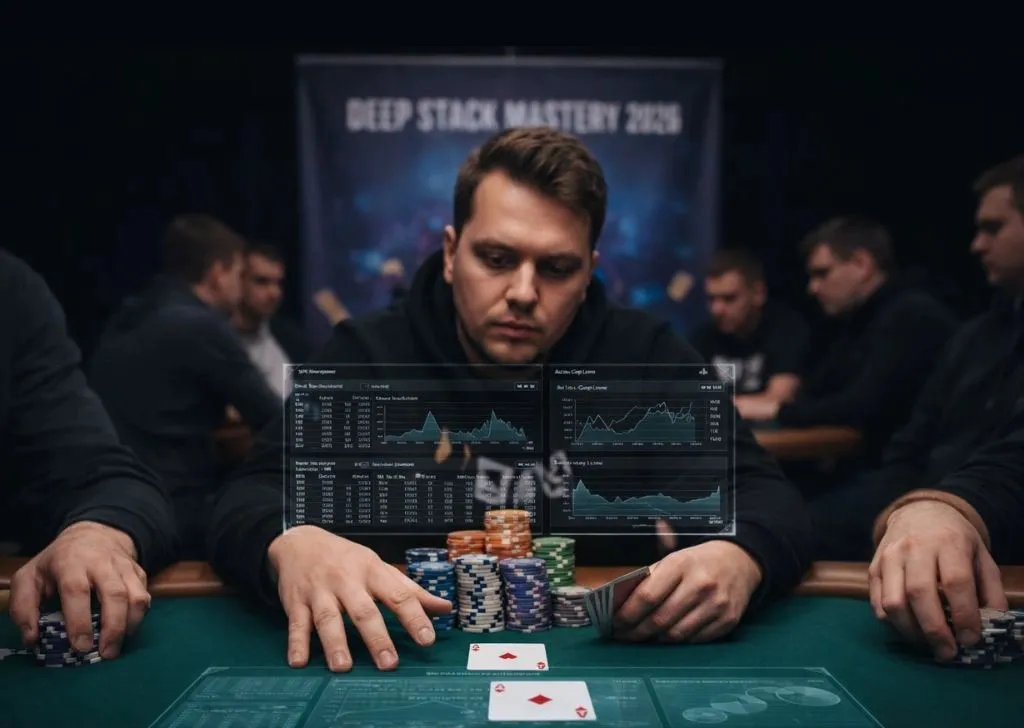
Deep stack poker strategy isn’t simply regular poker stretched out over more chips. That shortcut idea sounds convenient, sure, but it’s also misleading. When stacks are deep, every decision carries future weight. Actions taken early don’t vanish; they linger, shaping later possibilities. One loose choice can echo for hours, while one disciplined adjustment can quietly tilt the entire table dynamic in your favor.
This is where poker stops being reactive and starts becoming architectural. You’re no longer just responding to what’s in front of you, you’re shaping what’s allowed to happen next. And that shift is exactly why deep play demands a different mindset, not just sharper mechanics.
Deep Stack Poker Strategy: Why Extra Depth Changes the Game Entirely
Deep stack poker strategy forces players to zoom out. Instead of focusing on single streets, you’re planning sequences. Instead of asking what’s strong right now, you’re asking what stays strong if pressure increases later.
When stacks are deep:
- Decisions become layered, meaning early actions are chosen specifically to influence later streets rather than to resolve the hand immediately.
- Mistakes grow more costly over time, because depth allows opponents to apply pressure repeatedly instead of all at once.
- Patience turns into an edge, as rushed lines often collapse under long-form resistance.
In short, depth magnifies skill expression. It also magnifies errors, which is why many players feel uncomfortable when stacks run long.
Deep Stack Poker Strategy: Understanding SPR and Long-Term Commitment
Stack-to-Pot Ratio (SPR) quietly governs deep play, even when players don’t consciously think about it. High SPR environments mean that no single action forces full commitment, which sounds liberating, but actually increases responsibility.
In high SPR situations:
- One-pair holdings lose automatic strength because opponents have room to represent stronger ranges later.
- Drawing hands gain value due to increased implied future pressure.
- Pot growth must be managed intentionally to avoid awkward commitment thresholds.
SPR awareness helps players decide not just what to do, but how far a situation should be allowed to develop. That awareness is a cornerstone of advanced poker strategy.
When navigating long-stack situations, having quick access to poker cheat sheets can help reinforce correct SPR-based decisions under pressure.
Deep Stack Meaning in Practical Terms
Deep stack meaning isn’t defined by a fixed number of chips. It’s contextual, fluid, and shaped by interaction.
A stack behaves as “deep” when:
- The pot is still small relative to remaining chips.
- Multiple rounds of pressure are realistically possible.
- Neither player is forced into full commitment by a single action.
In some scenarios, a visually large stack plays shallow because the pot has already ballooned. In others, modest stacks feel deep because action stays controlled. Strong players read depth dynamically, adjusting in real time rather than relying on static assumptions.
Preflop Planning When Stacks Are Deep
Depth changes the value of starting hands, not by making everything playable, but by rewarding hands that can evolve across multiple streets without revealing their strength too early.
Effective preflop adjustments include:
- Expanding suited and connected holdings in position, as they can develop into strong concealed structures later.
- Avoiding dominated offsuit combinations that struggle to improve cleanly when pressure escalates.
- Prioritizing position more heavily than raw card value, since positional control becomes more powerful as stacks deepen.
The goal here isn’t aggression for its own sake. It’s optionality, the ability to pivot smoothly as the hand unfolds.
Postflop Decision Making: Where Depth Exposes Gaps
Deep stack decision making reveals who’s thinking ahead and who’s just reacting.
In long-stack situations:
- Medium-strength hands benefit from controlled pot growth rather than immediate escalation.
- Strong holdings are more valuable when they’re allowed to extract value gradually instead of all at once.
- Delayed pressure often outperforms automatic continuation lines, especially on evolving board textures.
Every action should serve a future purpose. If a move doesn’t improve your options later, it’s often doing more harm than good.
Bluff Versus Value Distribution in Deep Play
Depth reshapes how bluffs function. They’re no longer about immediate success; they’re about credibility over time.
Well-structured deep bluffs:
- Represent ranges that naturally improve on later streets.
- Apply pressure in stages instead of all at once.
- Maintain consistency with earlier actions.
Value extraction, meanwhile, becomes more subtle. Instead of large early commitments, strong players build value patiently, allowing opponents to continue with weaker portions of their range longer.
Balance isn’t about equal frequency, it’s about believable storytelling.
Bet-Cap Lines and Controlled Pressure (Conceptual Framework)
In deep play, experienced players intuitively recognize informal ceilings, points where pushing further no longer improves outcomes.
These conceptual “caps” help players:
- Avoid inflating pots unnecessarily with medium-strength holdings.
- Keep opponent ranges wider for longer, increasing long-term extraction potential.
- Preserve maneuverability on later streets.
Controlled pressure keeps decisions reversible. And reversibility is powerful when stacks allow extended play.
Deep Stack Poker Tournament Dynamics
A deep stack poker tournament introduces changing depth conditions rather than static ones. Early stages often feature long stacks across the field, but depth compresses gradually.
During early phases:
- Selective engagement preserves flexibility.
- Avoiding unnecessary confrontations maintains long-term leverage.
As the event progresses:
- Stack depth relative to structure changes decision thresholds.
- Players who plan ahead adjust more smoothly.
Depth-aware players don’t panic as conditions shift, 111111they adapt because they anticipated the transition.
Advanced Poker Strategy: Ranges Over Individual Hands
Deep play punishes hand-focused thinking. The question isn’t “Is my hand strong?” but “How does my range behave if pressure increases later?”
Advanced poker strategy in deep environments prioritizes:
- Range advantage instead of isolated card strength.
- Board interaction patterns over immediate outcomes.
- Future leverage rather than short-term resolution.
When stacks are deep, restraint often creates more pressure than force.
Psychological Load and Long-Stack Play
Depth doesn’t just test strategy, it tests patience.
Common psychological challenges include:
- Hesitation caused by fear of large future decisions.
- Overconfidence after early success in deep confrontations.
- Mental fatigue from tracking extended action sequences.
Strong players pace themselves. They treat deep stacks as a long conversation, not a shouting match.
Common Errors in Deep Stack Scenarios
Even experienced players fall into traps when depth increases.
Frequent mistakes include:
- Overvaluing single-pair holdings as if depth didn’t exist.
- Escalating pressure too early without a range advantage.
- Forcing action instead of allowing opponents to make mistakes organically.
Each error chips away at long-term edge, not immediately, but persistently.
FAQs
What does deep stack mean in poker contexts?
It refers to situations where chip depth allows multiple future decisions without immediate forced commitment.
Is deep-stack play more complex than shallow play?
Yes, because it requires layered planning, emotional control, and range-based thinking.
Do bluffing approaches change with depth?
They become more selective and more focused on long-term credibility.
Why is SPR so important in long-stack scenarios?
It defines how much freedom exists before commitment becomes unavoidable.
Can charts really help with deep stack decision-making?
They provide structure, but adaptability remains essential.
Conclusion
Deep stack poker strategy rewards players who think in chapters instead of sentences. It favors patience over impulse, structure over force, and foresight over reaction. When stacks are deep, the game slows down, but only for those who know how to let it.
By understanding SPR, managing pressure carefully, and balancing bluff and value lines with intention, deep play stops feeling intimidating. It becomes expressive, strategic, and quietly powerful. And that’s where long-term mastery lives, right beneath the surface, waiting for players disciplined enough to reach it.
At BluffingMonkeys, we do more than just share poker strategy, reviews, and guides. We help players stay connected to the best games, latest updates, and biggest opportunities. Be sure to follow all of our social media channels so you never miss important announcements, bonuses, promotions, special events, and new offers. Keep exploring our content, and when you’re ready to join the action, use our live chat button on the homepage to connect with us or message @bluffingmonkeys24_7 on the Telegram App.
 Hindi
Hindi Russian
 Spanish
 Brazilian Portuguese
 Simplified Chinese
 English