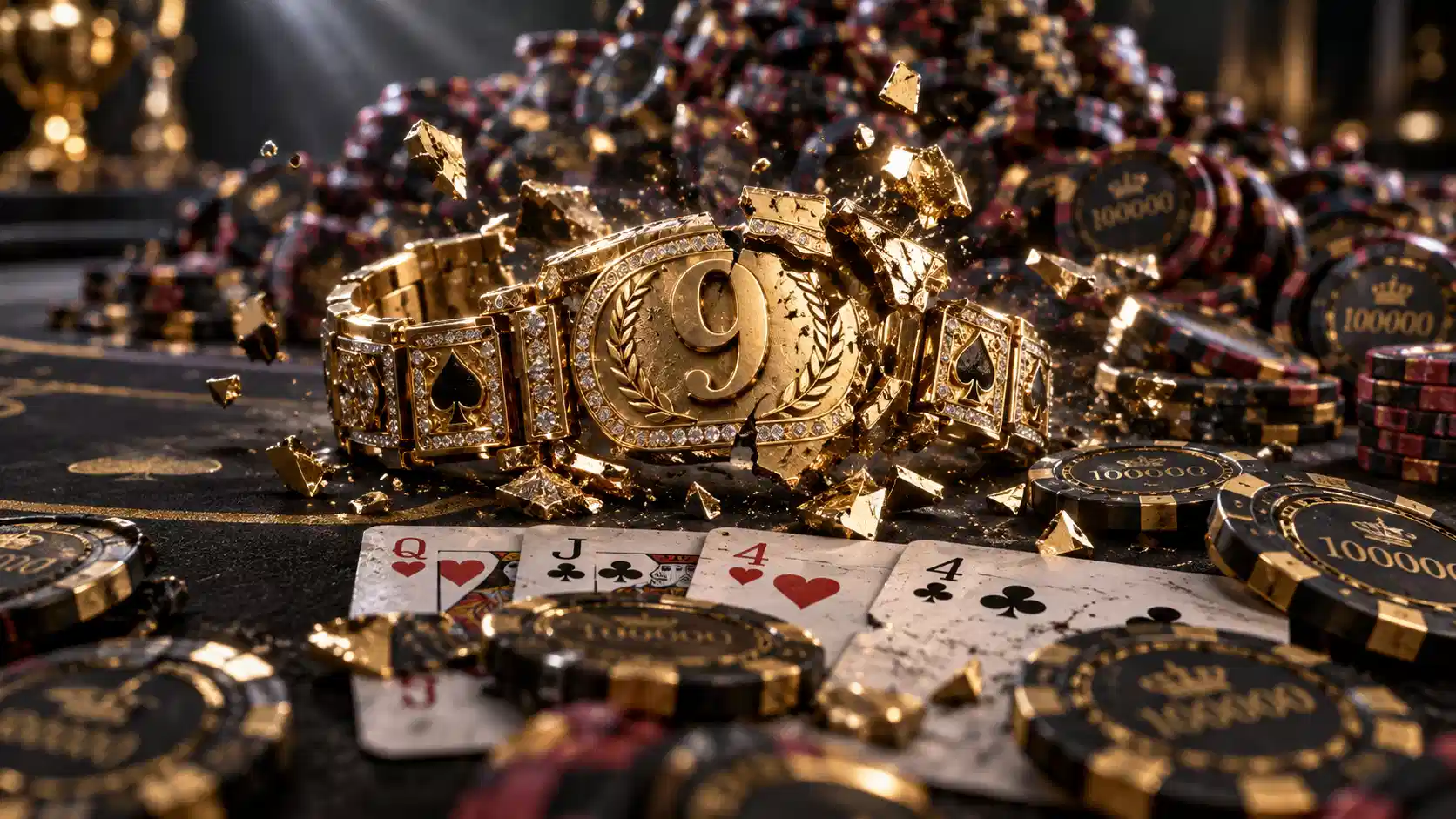
Daniel Negreanu looked only a few hours away from a realistic shot at his ninth WSOP bracelet.
Instead, his tournament changed in one enormous Pot-Limit Omaha hand.
Negreanu entered the final table of the $10,000 WSOP Online GGMillion$ PLO Championship with the second-largest stack.
He had 92.1 big blinds.
Only Andreas Freund had more.
Then Negreanu won a few early pots and moved into the chip lead.
For a moment, bracelet number nine looked very possible.
However, less than 20 minutes into the final table, Negreanu became involved in a pot worth almost 200 big blinds against Freund.
The turn produced exactly the type of PLO situation that can destroy even a massive tournament stack.
Negreanu had two flush draws, key blockers and a hand he believed was strong enough to apply extreme ICM pressure.
Freund had turned a set and held the higher club draw.
The river completed clubs for both players.
Freund’s flush was bigger.
Negreanu dropped from chip leader to fewer than seven big blinds and was eliminated soon afterward.
Just like that, the Daniel Negreanu ninth bracelet chase was over.
Daniel Negreanu WSOP Online PLO Result: Quick Facts
| Category | Details |
|---|---|
| Player | Daniel Negreanu |
| Event | WSOP Online $10K GGMillion$ PLO |
| Platform | GGPoker |
| Buy-In | $10,000 |
| Total Entries | 228 |
| Prize Pool | $2,211,600 |
| Players Paid | 33 |
| Final Table Starting Position | 2nd in chips |
| Starting Stack | 6.45M, approximately 92.1 BB |
| Final Finish | 7th |
| Prize | $71,409 |
| Current WSOP Bracelets | 8 |
| Winner | Andreas Freund |
| Winner Prize | $428,456 |
Why Daniel Negreanu Was So Close to Bracelet Number Nine
This was not a situation where Negreanu barely reached the final table with a short stack.
Quite the opposite.
The tournament attracted 228 entries, yet only seven players remained when final-table play began.
Freund started first with approximately 123.8 big blinds.
Negreanu was next with 92.1 big blinds.
Meanwhile, third-place Samuli Sipila had fewer than 50 big blinds.
Therefore, the top two stacks controlled a huge percentage of the chips.
That created an ideal situation for Negreanu.
He had enough chips to pressure medium stacks while still avoiding unnecessary risk against Freund.
More importantly, he had already proven that PLO remains one of his strongest formats.
Only a few months earlier, Negreanu won the $100,000 PLO High Roller at the live WSOP for $2,257,718 and his eighth bracelet.
So this was not simply a famous player making another final table.
He was chasing his second PLO bracelet of 2026.
Negreanu Had Already Won Bracelet Number Eight in PLO
The timing made the September run especially interesting.
On July 2, Negreanu defeated an elite 83-entry field in the $100,000 Pot-Limit Omaha High Roller in Las Vegas.
That tournament created a $7.968 million prize pool.
Negreanu beat Artur Martirosian heads-up and collected more than $2.25 million.
Most importantly, the victory gave him WSOP bracelet number eight.
Therefore, entering another PLO final table only a few months later immediately created a new storyline.
Could he win number nine before 2026 ended?
Our WSOP Online 2026 guide covers the full bracelet schedule and explains why the online series has become such an important extension of the summer WSOP.
Negreanu Briefly Took the Chip Lead
The final table began well.
Negreanu won several early pots.
One of them came directly against Freund.
As a result, Negreanu moved from second place into the outright chip lead.
At that stage, the situation looked extremely favorable.
Several opponents had fewer than 20 big blinds.
In contrast, Negreanu and Freund both controlled deep stacks.
That meant one of them could potentially dominate the table while the shorter players waited for elimination spots.
Then the two biggest stacks collided.
The Hand That Destroyed Negreanu’s Bracelet Run
Freund opened from under the gun.
Negreanu defended his big blind.
The hands were:
Daniel Negreanu: Q♥ J♣ 4♥ 4♣
Andreas Freund: Q♣ 10♠ 8♦ 8♣
The flop came:
A♥ 3♣ 2♣
Both players checked.
At this point, the pot was still manageable.
However, the turn completely changed the hand.
The 8♥ Was the Disaster Card
The turn was the 8♥.
For Negreanu, the card looked extremely powerful.
He now had two flush draws.
In addition, his pair of fours blocked combinations of 4-5, which would make the nut straight.
Freund, meanwhile, had improved to a set of eights.
More importantly, he also held the Q♣.
That meant one of Negreanu’s flush draws was dominated.
The card created exactly the type of overlapping equity situation that makes PLO so dangerous.
If you are new to four-card poker, our Pot-Limit Omaha Poker 2026 guide explains why made hands and draws interact very differently from Hold’em.
Negreanu Bet 8 Big Blinds
Negreanu led the turn for approximately eight big blinds.
Freund responded by raising pot to roughly 25.8 big blinds.
Now the hand became much more serious.
Negreanu had to decide what Freund’s pot-sized raise represented.
From his perspective, the strongest natural hand was 4-5 for the nut straight.
However, Negreanu held two fours.
Therefore, some 4-5 combinations were blocked.
He also held multiple draws if Freund had a strong made hand.
Negreanu later explained that he believed Freund should rarely raise the turn in this ICM situation without a very strong hand.
At the same time, that made the spot attractive for possible bluffs.
Negreanu Repotted
Instead of calling, Negreanu increased the pressure.
He repotted.
Freund moved all in.
Negreanu called.
Suddenly, nearly 200 big blinds were in the middle.
This was not simply a large poker pot.
It was a tournament pot between the two biggest stacks at a seven-handed WSOP final table.
The winner would gain an overwhelming lead.
The loser would see their bracelet chances collapse.
Why ICM Made the Hand So Important
Final-table chips do not have the same value as ordinary cash-game chips.
That is because tournament payouts increase as players are eliminated.
For example, preserving a large stack can sometimes be more valuable than taking a marginal gamble against the only opponent who can seriously damage you.
Meanwhile, big stacks can use that pressure to attack players who want to avoid busting.
Negreanu understood this.
That was part of his reasoning for applying pressure on the turn.
However, PLO equity often runs close.
Even strong blockers do not guarantee that the opponent is bluffing.
This is one reason our deep-run tournament strategy guide emphasizes stack relationships rather than looking only at absolute hand strength.
Negreanu Had Only About 17.5% to Scoop
Once the cards were exposed, the problem became clear.
Freund’s set was ahead.
In addition, his Q♣ dominated Negreanu’s club draw.
According to contemporary analysis of the hand, Negreanu had only about 17.5% equity to scoop the entire pot.
He still had outs.
However, he needed the river to cooperate.
It did not.
The 5♣ River Gave Both Players a Flush
The river was the 5♣.
At first glance, the club looked like a card that could help Negreanu.
He completed a flush.
Unfortunately, Freund completed a better one.
Freund’s higher club took the entire pot.
Negreanu fell from tournament chip leader to a stack of fewer than seven big blinds.
In one hand, his position changed completely.
This is the brutal side of poker variance.
Even elite players can move from commanding positions to near elimination within a few minutes.
Negreanu Called It the “Sickest Turn”
After the tournament, Negreanu analyzed the hand publicly.
His focus was not primarily on the river.
Instead, he pointed to the 8♥ turn.
That single card improved Freund to a set while simultaneously giving Negreanu two flush draws and important blockers.
In other words, it gave both players enough reason to continue aggressively.
Negreanu described the spot as an unusual collision of ranges and ICM pressure.
He also made his tournament objective clear.
He was playing to win.
That mindset helps explain why he was willing to take such a large spot instead of protecting his stack and waiting for shorter players to bust.
Could Negreanu Have Played More Carefully?
This is where the hand becomes strategically interesting.
From a pure survival perspective, avoiding a giant confrontation against the only other massive stack has obvious value.
Several players were much shorter.
Therefore, folding or taking a lower-variance line could have preserved Negreanu’s excellent final-table position.
However, tournaments are not won by survival alone.
If Negreanu believed Freund was capable of raising the turn as a bluff, then his blockers made aggressive play more attractive.
Furthermore, winning the pot would have created a huge chip lead.
That could significantly increase his chance of winning the bracelet.
So the correct lesson is not simply “never play a big pot against another big stack.”
Instead, players need to understand ranges, blockers, equity and payout pressure at the same time.
PLO Blockers Can Be Powerful and Dangerous
Negreanu’s two fours mattered because they reduced the number of 4-5 combinations available to Freund.
That is a classic blocker concept.
If you hold cards that your opponent needs to make a certain strong hand, that hand becomes statistically less likely.
However, blockers are only part of the decision.
Freund did not need 4-5.
He had turned a set and held additional flush equity.
Therefore, a useful blocker did not mean Negreanu’s opponent had to be bluffing.
Our Poker Ranges Explained guide covers why strong players think in combinations instead of trying to guess one exact hand.
Negreanu Was Not Eliminated Immediately
The giant pot left Negreanu with only a little more than six big blinds.
Still, the tournament was not officially over.
He managed to almost triple his short stack on the following hand.
That briefly gave him another chance.
However, another all-in followed soon afterward.
This time, the river ended his tournament.
Negreanu finished in seventh place.
His payout was $71,409.
WSOP Online $10K PLO Final Table Results
| Place | Player | Prize |
|---|---|---|
| 1 | Andreas Freund | $428,456 |
| 2 | Vito Jhonny Recchimurzo | $317,844 |
| 3 | Samuli Sipila | $235,788 |
| 4 | Biao Ding | $174,916 |
| 5 | Dirk Gerritse | $129,759 |
| 6 | Chris Nguyen | $96,260 |
| 7 | Daniel Negreanu | $71,409 |
Andreas Freund Turned the Pot Into His First Bracelet
The huge hand did more than eliminate Negreanu.
It gave Freund an enormous stack.
From there, he applied pressure to the rest of the final table.
The entire final table lasted only a little more than an hour.
Eventually, Freund reached heads-up play against Vito Jhonny Recchimurzo.
The match was not completely one-sided.
Recchimurzo doubled several times and managed to reduce Freund’s advantage.
Still, Freund recovered.
He eventually won the tournament for $428,456 and his first WSOP bracelet.
The victory also came with a WSOP Paradise Super Pass.
The Tournament Had 228 Entries and a $2.21M Prize Pool
The $10,000 event attracted 228 entries.
That created a prize pool of approximately $2.21 million.
Thirty-three players reached the money.
Interestingly, Lex Veldhuis came extremely close but finished 34th on the bubble.
That field size shows how strong online high-stakes PLO has become.
A $10,000 four-card tournament drawing more than 200 entries is not a casual event.
It contains experienced online specialists and high-stakes professionals from around the world.
Our High Stakes Poker 2026 guide looks at the wider growth in nosebleed tournaments and streamed high-stakes poker.
Why Negreanu Had to Play From Canada
There was another unusual element to the story.
Negreanu lives in Las Vegas.
However, the international GGPoker client is not available to him for this bracelet series from Nevada.
As a result, he traveled to Canada to compete online.
The situation creates a strange contrast.
Negreanu can play live WSOP bracelet events in Las Vegas.
Yet to chase certain online WSOP bracelets on GGPoker, he needs to play from an eligible jurisdiction.
This was one reason his online run attracted extra attention before the final table even began.
WSOP Online Is Becoming More Important
Online bracelet events are no longer a small side schedule.
The 2026 international series includes 33 bracelets and several multimillion-dollar guarantees.
For example, the $5,000 Main Event carries a $25 million guarantee.
That means the same series can attract recreational qualifiers, established online grinders and players such as Negreanu.
This wider accessibility is helping online WSOP events create storylines that once existed almost entirely in Las Vegas.
What Can Regular Players Learn From Negreanu’s Hand?
1. Big Stack Does Not Mean Safe Stack
Negreanu entered with more than 90 big blinds.
Twenty minutes later, he was almost out.
A deep tournament stack can disappear quickly when two large stacks collide.
2. Blockers Are Not the Same as Proof
Holding two fours made 4-5 less likely.
However, Freund had another strong value hand.
Use blockers to refine ranges, not to convince yourself that an opponent must be bluffing.
3. ICM Changes Aggression
At a final table, stack preservation has real financial value.
Nevertheless, strong players can also use that pressure aggressively.
4. PLO Equity Runs Close
Four-card poker creates many overlapping draws.
A hand that looks powerful can still be heavily dominated.
5. One Hand Should Not Define Your Strategy
Results are noisy.
Good decisions can lose, while poor decisions sometimes win.
That is why serious players should review large samples rather than one dramatic river.
Tools listed in our Free Poker Calculators 2026 guide can help players study equity and ranges away from the table.
Why Bankroll Management Still Matters at High Stakes
Seeing professionals enter $10K and $100K tournaments can distort how normal players think about money.
Do not copy their stakes.
Professional high rollers may sell action, swap percentages or use backing agreements.
In addition, their bankrolls and income can be completely different from yours.
Therefore, a $10,000 tournament appearing normal on a livestream does not make it a sensible buy-in for the average player.
Our Poker Bankroll Management guide explains how to choose stakes based on risk rather than spectacle.
Negreanu Still Has Eight Bracelets
The loss did not change Negreanu’s place in the WSOP record books.
He remains an eight-time bracelet winner.
His most recent victory came only months earlier.
More importantly, he continues reaching final tables in the formats where many of the world’s strongest players compete.
That makes bracelet number nine a continuing storyline rather than a closed chapter.
Bluffing Monkeys also recently covered his broader 2026 activity in our Daniel Negreanu 2026 feature.
Daniel Negreanu Ninth Bracelet FAQ
Did Daniel Negreanu win his ninth WSOP bracelet?
No. Negreanu finished seventh in the $10,000 WSOP Online GGMillion$ PLO event on September 21, 2026.
How many WSOP bracelets does Daniel Negreanu have?
Negreanu has eight WSOP bracelets as of September 2026.
How much did Daniel Negreanu win in the WSOP Online PLO event?
He earned $71,409 for seventh place.
How many players entered the tournament?
The $10K GGMillion$ PLO event drew 228 entries.
What was the prize pool?
The tournament generated approximately $2.21 million in prize money.
Who won the tournament?
Austria’s Andreas Freund won his first WSOP bracelet and $428,456.
What happened in Negreanu’s big final-table hand?
Negreanu and Freund played a pot worth nearly 200 big blinds. Negreanu held Q-J-4-4 double-suited, while Freund held Q-10-8-8. Freund turned a set and also held the higher club draw. The river completed clubs for both players, but Freund’s flush was higher.
Was Negreanu chip leader before the hand?
Yes. He began the final table second in chips and moved into first place shortly before the massive confrontation with Freund.
When did Negreanu win his eighth bracelet?
He won bracelet number eight in July 2026 by taking down the $100,000 PLO High Roller at the live WSOP for $2,257,718.
Why was Negreanu playing from Canada?
He traveled to an eligible jurisdiction to compete in the international GGPoker WSOP Online series.
Final Thoughts: Bracelet Number Nine Disappeared in One PLO Pot
Daniel Negreanu began the final table in almost perfect shape.
He had 92 big blinds.
He was second in chips.
Then he moved into the lead.
Several opponents were short.
And another WSOP bracelet looked genuinely possible.
However, PLO can change everything with one card.
The 8♥ gave Negreanu two flush draws and valuable blockers.
It also gave Andreas Freund a set and a stronger club draw.
Both players had reasons to continue.
The pot grew to almost 200 big blinds.
Then the 5♣ river completed both flushes.
Freund had the better one.
Within minutes, Negreanu went from chip leader to short stack and then seventh-place finisher.
That is why this final table became such a compelling poker story.
It was not simply another tournament bust.
It was an eight-time bracelet winner, already fresh from a major PLO victory, getting extremely close to number nine before one enormous hand changed everything.
The ninth bracelet will have to wait.
But considering how often Negreanu is still reaching high-stakes final tables, the chase is far from over.