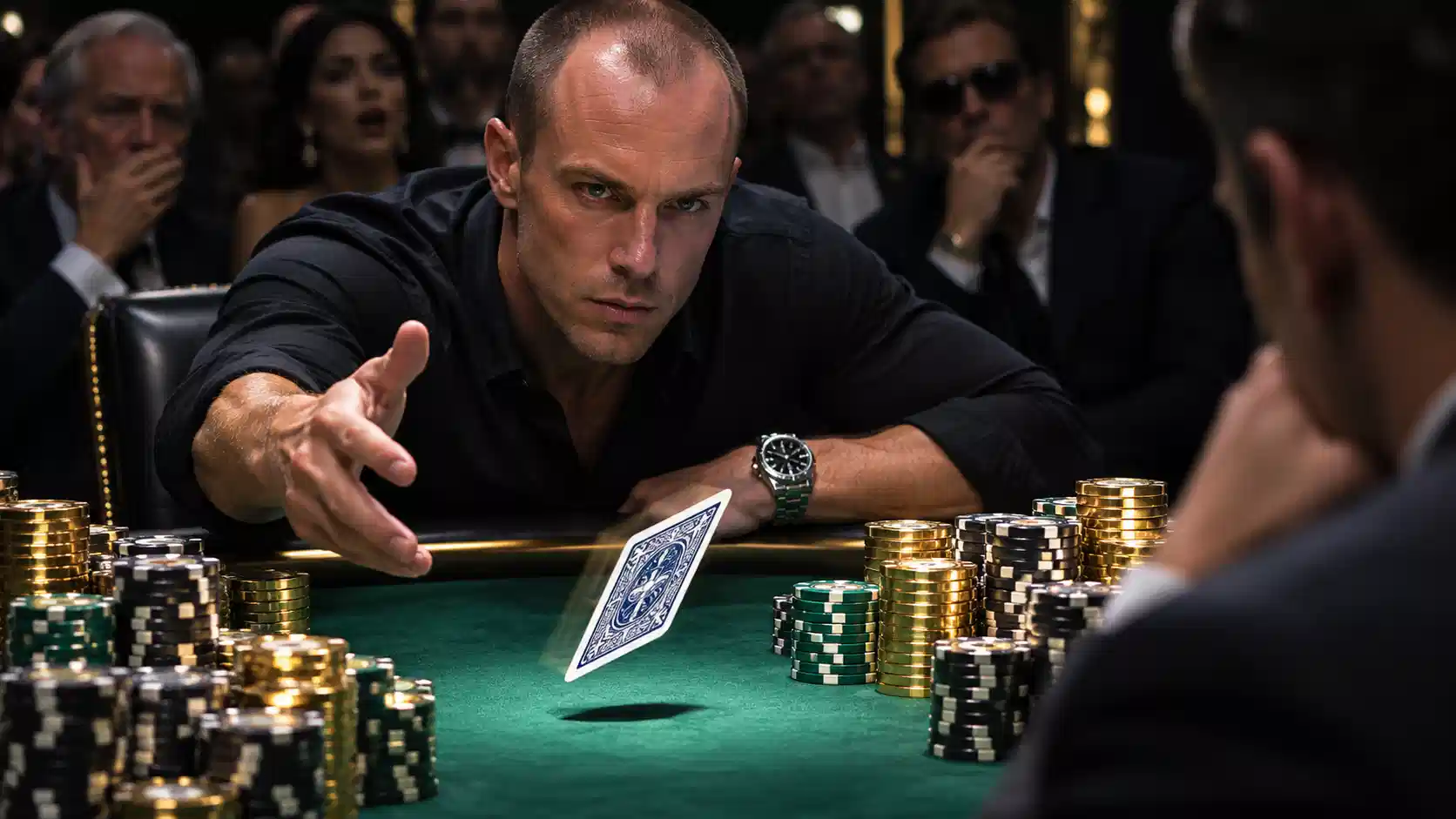
The Andrew Robl $1.24 million pot became one of the most talked-about hands of High Stakes Poker Live after the high-stakes professional left a $340,000 river decision to another player at the table. Robl was facing an all-in bet from Eric Wasserson when he asked Sameh Elamawy to turn over one of his two hole cards.
The rules of his unusual decision were simple: if Elamawy revealed Robl’s ace, he would call. If he revealed the seven, Robl would fold.
However, the situation became even stranger when Wasserson exposed his pocket nines, revealing that he had flopped a set. Robl now knew his pair of aces was beaten, but Elamawy turned over the ace and Robl followed through with the call.
The result was a $1,241,000 pot for Wasserson and another memorable confrontation between two players with a history of enormous televised poker battles.
The hand took place on November 24, 2026, during the third day of High Stakes Poker Live at the PokerGO Studio in Las Vegas. Coverage continued on November 25 as poker fans debated the decision.
Here is the complete hand history, the pot-odds calculation, and why this call was so different from an ordinary hero call.
Andrew Robl $1.24 Million Pot: What Happened?
Andrew Robl and Eric Wasserson were competing in a high-stakes No-Limit Hold’em cash game featuring blinds of $1,000/$2,000 and a $10,000 big blind ante.
Both players had substantial stacks when the confrontation began.
Robl started the hand with approximately $880,000, while Wasserson held around $612,000.
According to the documented hand history, Robl opened the action with ace-seven suited and received calls from Wasserson and Jason Koon.
The hand eventually became a heads-up confrontation between Robl and Wasserson.
Key Details of the $1,241,000 Hand
| Detail | Confirmed Information |
|---|---|
| Broadcast | High Stakes Poker Live, Day 3 |
| Hand played | November 24, 2026 |
| Location | PokerGO Studio, Las Vegas |
| Game | No-Limit Hold’em |
| Blinds | $1,000/$2,000 |
| Big blind ante | $10,000 |
| Andrew Robl’s hand | A♥ 7♥ |
| Eric Wasserson’s hand | 9♠ 9♥ |
| Jason Koon’s hand | K♥ 8♠ |
| River all-in | $340,000 |
| Final pot | $1,241,000 |
| Winner | Eric Wasserson |
Importantly, the $1,241,000 figure is the total pot. It does not mean Robl personally lost $1,241,000 in this hand.
His individual contribution was approximately $612,000, while the final pot also included Wasserson’s chips and Jason Koon’s earlier contribution.
Full Hand Breakdown: Robl’s Ace-Seven vs Wasserson’s Pocket Nines
The hand is especially interesting because both players had legitimate reasons to continue betting during the earlier streets.
However, the river completely changed the situation.
Preflop: Robl Opens With A♥7♥
Robl raised to $7,000 from under the gun with A♥7♥.
Wasserson called from the small blind with 9♠9♥.
Meanwhile, Jason Koon called from the big blind holding K♥8♠.
Other players folded, leaving three competitors in the pot.
After including the blinds and ante, the pot reached $31,000.
At this stage, Wasserson held the strongest made hand with pocket nines.
Nevertheless, Robl’s suited ace had opportunities to improve through pairs, straights, or a flush.
Flop: 10♥ 2♥ 9♣
The dealer revealed:
10♥ 2♥ 9♣
Wasserson immediately made a set of nines, one of the strongest possible hands on the board.
However, Robl also picked up a powerful draw.
With A♥7♥ and two hearts on the flop, he held the nut flush draw.
Wasserson and Koon checked.
Robl continued with a $15,000 bet.
Wasserson called with his set, while Koon folded.
Consequently, the pot reached $61,000 and the confrontation became heads-up.
Turn: 3♦
The turn brought the 3♦.
That card did not complete Robl’s flush.
Wasserson checked again, giving Robl another opportunity to bet.
This time, Robl fired $80,000 into the $61,000 pot.
However, Wasserson responded with a substantial check-raise to $250,000 total.
Robl faced an additional $170,000 to continue.
He eventually called with his nut flush draw.
After the action, the pot had grown to $561,000.
At this point, Robl was still drawing to improve against Wasserson’s actual set.
Nevertheless, the final card had not yet appeared.
River: A♦
The final board was:
10♥ 2♥ 9♣ 3♦ A♦
The river ace gave Robl top pair.
However, it did not complete his heart flush.
Wasserson still held three nines, comfortably beating Robl’s pair of aces.
With $561,000 already in the pot, Wasserson moved all-in for his remaining $340,000.
The pot now stood at $901,000, and Robl needed to call another $340,000 to reach showdown.
That created the extraordinary decision that made the hand famous.
Complete Betting Action
| Street | Action | Pot After Action |
|---|---|---|
| Preflop | Robl raises to $7K; Wasserson and Koon call | $31,000 |
| Flop | Robl bets $15K; Wasserson calls; Koon folds | $61,000 |
| Turn | Robl bets $80K; Wasserson raises to $250K; Robl calls | $561,000 |
| River | Wasserson shoves $340K | $901,000 |
| Showdown | Robl calls $340K | $1,241,000 |
The action is documented in the hand breakdown and matches the reporting published by PokerNews.
Why Did Andrew Robl Let Sameh Elamawy Decide?
Robl spent more than five minutes considering Wasserson’s river shove.
He had made top pair on the river, but the earlier betting action suggested that Wasserson could hold a very strong hand.
However, Wasserson could also theoretically have arrived at the river with certain missed draws.
That uncertainty created a difficult bluff-catching decision.
Instead of selecting call or fold directly, Robl turned to fellow player Sameh Elamawy.
The Ace-or-Seven Rule
Robl offered his two cards to Elamawy and established a simple randomizing procedure.
- If Elamawy exposed the ace, Robl would call.
- If Elamawy exposed the seven, Robl would fold.
Assuming an unbiased selection, the method gave each option a 50% probability.
However, this was not a formally calculated poker equilibrium strategy.
It was an improvised decision rule chosen during a live cash game.
Then the situation became even stranger.
Wasserson Reveals His Winning Hand
Before Elamawy completed the selection, Wasserson exposed his pocket nines.
That revealed he had flopped a set.
Robl no longer needed to guess whether his pair of aces was ahead.
He could see that he was beaten.
Nevertheless, Robl remained committed to the randomizing procedure he had proposed.
Elamawy turned over the ace.
Robl called the additional $340,000, and Wasserson collected the $1,241,000 pot.
According to PokerOrg’s November 25 coverage, the bizarre sequence left the table reacting to a call Robl knew would lose.
Did Andrew Robl Know He Was Losing Before Calling?
Yes. That is what makes this hand different from an ordinary poker hero call.
When Robl initially faced the shove, Wasserson’s cards were still hidden.
Therefore, Robl needed to evaluate the possibility of bluffs and stronger value hands.
However, once Wasserson showed his set of nines, the uncertainty about the actual showdown outcome disappeared.
Robl had only a pair of aces and could not beat the set on the completed board.
Consequently, the call could not win or tie the pot.
Was Robl Required to Call?
The coverage describes Robl as following through on his own announced procedure.
However, that should not automatically be interpreted as a formal poker rule requiring him to call after the cards were exposed.
The available reporting does not establish that a tournament director or floor supervisor imposed a binding ruling.
Instead, the moment was presented as an unusual self-imposed commitment during a high-stakes cash game.
Therefore, the most accurate description is that Robl chose to honor the card-flip result.
That distinction matters when discussing live poker etiquette and unusual table behavior.
The $340,000 River Call: What Did the Pot Odds Say?
Before Wasserson revealed his hand, Robl faced a standard mathematical question.
How often would a call need to win to justify risking another $340,000?
The pot was $901,000 after Wasserson’s shove.
Calling would create a final pot of $1,241,000.
Calculating Robl’s Required Equity
The simplified break-even formula is:
Required equity = Call amount ÷ Final pot after calling
For Robl:
$340,000 ÷ $1,241,000 ≈ 27.4%
Therefore, ignoring ties and other complications, Robl needed to win approximately 27.4% of the time against Wasserson’s river betting range for a call to break even.
However, that calculation applies while the opponent’s hand remains unknown.
For a complete explanation, read our pot odds in poker guide.
What Changed After Wasserson Showed Pocket Nines?
Everything important about the immediate showdown became known.
Before the reveal, Robl could reasonably consider the possibility that Wasserson was bluffing.
Afterward, he knew Wasserson held a set.
Because every community card had already been dealt, Robl had no remaining opportunity to improve.
His probability of winning this particular showdown was zero.
Consequently, calling another $340,000 could not be justified by ordinary showdown equity.
Our expected value in poker guide explains the difference between making a decision under uncertainty and knowing the outcome.
Was Andrew Robl Making a Hero Call?
A hero call usually involves calling a significant bet with a relatively weak hand because the player believes the opponent may be bluffing.
For example, a player might call a large river bet with one pair after concluding that the opponent has enough missed draws in their range.
However, Robl’s final call did not fit that ordinary definition.
He knew the opponent’s winning hand before placing the last $340,000 into the pot.
Before the Reveal: A Bluff-Catching Decision
The river ace gave Robl a hand that could beat some missed draws and weaker holdings.
However, Wasserson’s large turn check-raise and river shove represented significant strength.
That created a genuine hand-reading problem.
Robl needed to consider how often Wasserson would use the same betting line with a bluff.
Our advanced river strategy guide explains how value bets and bluffs influence difficult calling decisions.
After the Reveal: A Known Losing Call
Once Wasserson exposed his set, Robl no longer needed to estimate the opponent’s range for the immediate showdown.
The result was already clear.
Therefore, calling became a personal decision to follow the randomizing rule rather than a conventional attempt to catch a bluff.
This distinction is essential when analyzing the hand accurately.
Why Randomization Can Be Useful in Poker
Randomization is not inherently a bad poker concept.
Advanced strategies sometimes mix actions, meaning the same hand can be played differently at different frequencies.
For example, a solver might recommend calling a particular hand some of the time and folding it the rest of the time against a specified opponent strategy.
In those situations, an independent random number can help a player avoid becoming predictable.
However, a random decision is only strategically meaningful when its frequency follows a sound calculation.
A 50/50 Decision Is Not Automatically Correct
Robl’s ace-or-seven procedure created an approximately equal chance of calling or folding.
However, the fact that both outcomes had equal probability does not establish that a 50/50 mix was theoretically justified.
A correct calling frequency depends on the player’s range, the opponent’s range, the pot odds, and the specific game situation.
Therefore, simply choosing a random card does not replace proper strategy.
Our poker decision-making and mental models guide explains how structured thinking can reduce avoidable mistakes.
Randomization Becomes Irrelevant When the Outcome Is Known
This is the central lesson from Robl’s unusual call.
When a player is uncertain about an opponent’s range, randomized strategies can sometimes be useful.
However, once the opponent shows a hand that certainly wins, there is no mathematical reason to randomize between calling and folding for showdown value.
At that point, the result of the hand is known.
Robl’s decision became an entertainment moment and a personal commitment rather than an equity-driven poker choice.
Why Eric Wasserson’s Set Was So Difficult to Read
Wasserson flopped a set of nines on a board containing two hearts.
That gave him an extremely strong made hand, but one that could still be vulnerable to certain future cards.
However, he initially chose to check-call the flop rather than immediately raise.
The Flop Check-Call
By calling Robl’s $15,000 continuation bet, Wasserson allowed the hand to continue without revealing the full strength of his holding.
Nevertheless, a check-call can represent many different hands.
Depending on the situation, players might call with pairs, strong draws, or occasionally traps.
Therefore, Robl could not conclude that Wasserson held exactly pocket nines from the flop action alone.
The Turn Check-Raise
The turn created a more significant decision.
After Robl bet $80,000, Wasserson raised to $250,000.
That represented a much stronger action than simply calling another bet.
However, strong turn raises are not always made exclusively with sets.
Depending on the opponent and board, some players may include semi-bluffs or other strategically selected hands.
Our opponent range analysis guide explains why hand-reading should involve a collection of possible holdings rather than one exact guess.
The River Shove
On the river, Wasserson pushed his remaining $340,000 into $561,000.
The bet offered Robl a specific price to call.
However, the large absolute amount created additional pressure in a game where individual decisions involved hundreds of thousands of dollars.
Wasserson eventually showed his hand and still received the call.
That made the outcome unusually memorable, even by the standards of televised high-stakes poker.
Robl and Wasserson Have a History of Million-Dollar Pots
The November confrontation was not the first major battle between Andrew Robl and Eric Wasserson.
Earlier in 2026, they competed in another enormous High Stakes Poker Live hand.
During an August session, Wasserson won a $2,478,000 pot against Robl.
That hand briefly established a new record for the show before an even larger confrontation surpassed it later in the month.
The August $2.478 Million Confrontation
In the earlier hand, the players committed substantial chips during a complicated confrontation involving draws and multiple possible outcomes.
Wasserson ultimately collected the pot after Robl failed to improve.
However, the November $1,241,000 hand was different.
This time, the defining moment involved the unusual way Robl decided whether to call the river bet.
Therefore, the two hands should not be confused simply because they featured the same opponents.
Was the November Hand a High Stakes Poker Record?
No. The $1,241,000 pot was not the largest pot in High Stakes Poker history.
In fact, the series had already featured substantially larger pots earlier in 2026.
One especially notable confrontation involved Michael “Texas Mike” Moncek and Eric Wasserson in a pot worth approximately $4.26 million.
Our report on the $4.26 million High Stakes Poker pot explains that separate record-setting hand.
However, Robl’s latest call remains one of the most unusual moments of the November livestream.
How Much Did Andrew Robl Lose During the Session?
The $1,241,000 pot was a major contributor to Robl’s difficult night.
According to PokerNews’ session recap, Robl finished the third day of High Stakes Poker Live down $1,066,500.
Meanwhile, Eric Wasserson ended the session with a profit of approximately $462,000.
However, Wasserson was not the biggest winner at the table.
Justin Gavri finished ahead by approximately $1,318,000.
Selected Session Results
| Player | Reported Session Result |
|---|---|
| Justin Gavri | +$1,318,000 |
| Eric Wasserson | +$462,000 |
| Andrew Robl | -$1,066,500 |
These results reflect the reported session, not each player’s overall poker career or annual results.
Likewise, a losing livestream does not establish that a player is unprofitable over the long term.
High-stakes cash games involve considerable variance, particularly when individual pots exceed seven figures.
Our poker variance explained guide explores why individual results should not be mistaken for long-term performance.
What Can Ordinary Poker Players Learn From the $1.24 Million Hand?
Most poker players will never face a single river decision worth $340,000.
However, the strategic questions behind the hand appear at much smaller stakes.
1. Understand the Actual Price of a Call
Robl faced a $340,000 call to contest a final pot of $1,241,000.
His required break-even winning frequency was approximately 27.4% before accounting for the exposed hand.
However, many recreational players overlook the relationship between bet size and the final pot.
Learning to calculate that relationship is useful regardless of the amounts involved.
2. Separate Strong Hands From Strong Betting Ranges
Robl paired his ace on the river.
However, top pair is not automatically strong against a large turn check-raise followed by a river shove.
The opponent’s betting sequence matters.
Players should evaluate which value hands and bluffs can reasonably take the same line.
3. Do Not Confuse Randomness With Strategy
A randomizer can help implement a strategic mix when the frequency has been calculated appropriately.
However, a random result cannot make an objectively losing showdown profitable.
The difference becomes especially clear when all the relevant cards are known.
4. Avoid Judging Decisions Only by the Outcome
Some difficult calls lose even when the opponent bluffs often enough to justify them.
Meanwhile, other calls win despite being mathematically poor decisions.
Therefore, players should evaluate the assumptions behind a decision rather than focusing only on whether the pot was won.
5. Emotional Pressure Can Affect Decisions
Large pots create psychological pressure.
However, the correct mathematical approach does not change simply because the monetary amount feels uncomfortable.
Our poker mental game guide explains why emotional control matters during both winning and losing sessions.
Where Can You Watch the Andrew Robl vs Eric Wasserson Hand?
The confrontation took place during the November 24 High Stakes Poker Live broadcast from the PokerGO Studio.
The complete livestream includes the action leading up to the $1,241,000 pot.
Additionally, dedicated hand replayers provide a more focused way to examine the betting sequence.
For example, the High Stakes Poker Live hand replay documents the major actions and the final call.
The relevant sequence begins approximately four hours and seventeen minutes into the original broadcast.
However, replay availability and platform access conditions may change.
Players can also review the written hand histories from PokerNews and PokerOrg to follow the action without watching the entire stream.
Frequently Asked Questions About Andrew Robl’s $1.24 Million Pot
Who Won the $1.24 Million Pot Against Andrew Robl?
Eric Wasserson won the $1,241,000 pot after flopping a set of nines against Andrew Robl’s ace-seven suited during High Stakes Poker Live.
When Did the Andrew Robl Hand Happen?
The hand was played on November 24, 2026, during Day 3 of High Stakes Poker Live. PokerOrg published additional coverage on November 25.
Why Did Andrew Robl Call $340,000?
Robl asked Sameh Elamawy to reveal one of his hole cards. He said he would call if the ace appeared and fold if the seven appeared. Elamawy revealed the ace, and Robl followed through with the call.
Did Robl Know Eric Wasserson Had a Set?
Yes. Wasserson showed his pocket nines before Elamawy completed the card selection. Robl therefore knew his pair of aces was losing when he made the final call.
What Cards Did Andrew Robl Have?
Robl held A♥7♥, giving him the nut flush draw on the flop. He missed the flush but made a pair of aces on the river.
What Cards Did Eric Wasserson Have?
Wasserson held 9♠9♥ and flopped a set on the 10♥2♥9♣ board.
What Was the Full Board?
The five community cards were 10♥2♥9♣3♦A♦.
How Much Was the River Bet?
Wasserson moved all-in for $340,000 into the $561,000 pot. After Robl called, the final pot reached $1,241,000.
What Pot Odds Did Robl Receive?
Before the cards were exposed, Robl needed approximately 27.4% equity to break even on a $340,000 call into a final pot of $1,241,000, ignoring ties and other adjustments.
Was the Call a Good Poker Decision?
Before the reveal, determining the quality of a call required evaluating Wasserson’s possible bluffs and value hands. After Wasserson revealed his set, Robl had no chance to win the showdown, so the call had no positive showdown value.
Did Andrew Robl Lose $1.24 Million Personally?
No. The $1,241,000 amount was the complete pot. Robl contributed approximately $612,000 to the hand and finished the session down $1,066,500.
Was This the Biggest High Stakes Poker Pot Ever?
No. The series had previously featured significantly larger pots, including a $4.26 million confrontation involving Eric Wasserson and Michael “Texas Mike” Moncek in 2026.
Final Thoughts: A Million-Dollar Lesson in Poker Decision-Making
Andrew Robl’s $1.24 million confrontation with Eric Wasserson will be remembered for more than the size of the pot.
The hand began as an intriguing battle between a nut flush draw and a flopped set.
However, it became something far more unusual when Robl handed his river decision to another player.
Sameh Elamawy was instructed to reveal either an ace or a seven, with the result determining whether Robl would call or fold.
Wasserson then exposed his winning set, removing the uncertainty about the showdown.
Nevertheless, Robl followed the agreed randomizing procedure and called the additional $340,000 after the ace appeared.
The final pot reached $1,241,000, giving Wasserson another memorable victory over a familiar high-stakes opponent.
For poker players studying the hand, the most useful lesson is the difference between making a difficult decision under uncertainty and continuing with a decision after the relevant information becomes known.
Randomization can support a sound poker strategy, but it cannot replace correct pot-odds calculations, opponent range analysis, or the ability to respond when new information changes the situation.