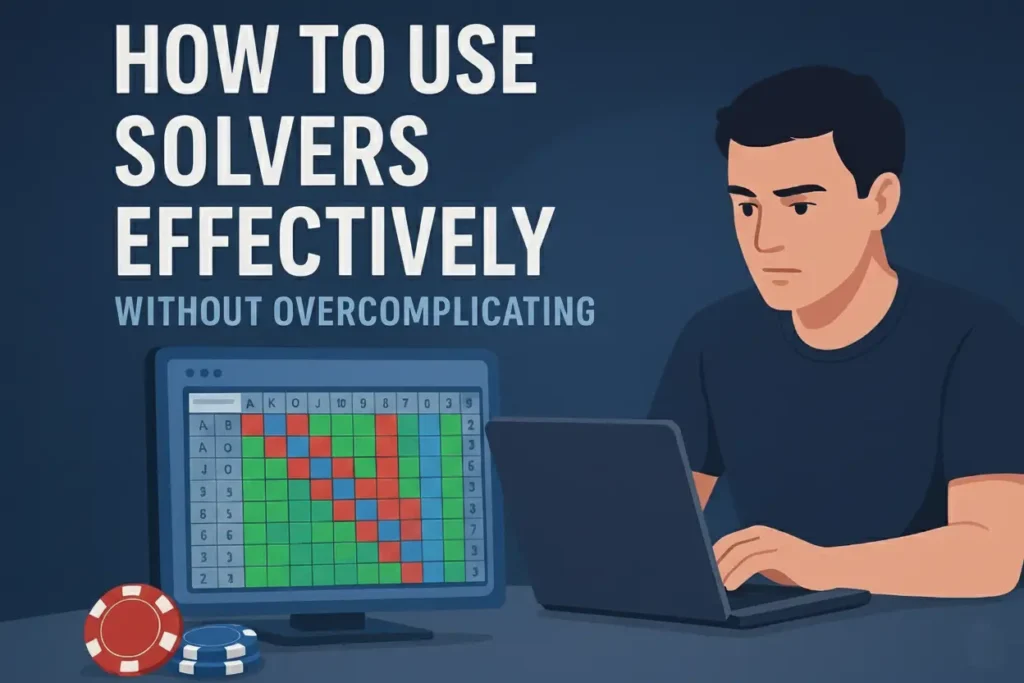
If you’ve ever opened a solver window and thought, “What in the world am I looking at?”, you’re definitely not alone. For many players, diving into Poker solvers can feel like reading a foreign language made of charts, colors, and percentages.
But here’s the truth: solvers don’t have to be overwhelming. In fact, when used correctly, they can simplify your thought process, not complicate it.
This article will show you how to use solvers effectively without drowning in data. You’ll learn how to balance theory and practice, how to build a manageable poker study routine, and how to apply solver insights in real games. Whether you’re a beginner or a grinder looking to sharpen your edge, this guide will help you get the most out of Solver, minus the confusion.
Why Poker Solvers Changed the Game
Let’s rewind a bit. Before solvers became mainstream, most poker strategies came from intuition, discussion forums, and guesswork. Then came the rise of GTO poker strategy or “Game Theory Optimal play.”
GTO isn’t about magic formulas or memorized charts. It’s a framework, a way to play that can’t be easily exploited by your opponents. Solvers, like PioSOLVER or GTO Wizard, are simply tools that calculate those unexploitable strategies.
Think of it like this:
If traditional poker learning was about “what feels right,” solvers brought the math and structure behind why certain plays make sense.
However, the moment people discovered solvers, things got… complicated. Many players started chasing perfection, trying to memorize endless frequencies and combos. That’s where most go wrong.
The Trap: Overcomplicating Your Study
Using solvers effectively isn’t about mastering every little detail; it’s about extracting the useful bits.
Here’s where players usually trip up:
- They try to learn everything at once.
Solvers can simulate millions of possibilities. If you try to study them all, you’ll end up learning none.
- They mistake precision for understanding.
Just because you know a spot is 32% call and 68% fold doesn’t mean you know why.
- They ignore real-world conditions.
GTO assumes opponents play perfectly, but humans? Not even close.
When studying solvers, the goal isn’t to become a robot. It’s to understand the logic behind decisions so you can apply that knowledge against imperfect opponents.
How to Use Poker Solvers Without Losing Your Mind
Start Small, One Spot at a Time
If you’re new to solver-based poker training, don’t load up massive simulations right away. Start with one situation, say, “Button vs. Big Blind on a dry flop.”
By narrowing your focus, you’ll actually absorb information. Ask simple questions like:
- What range does the solver suggest for c-betting?
- Which hands mix between betting and checking, and why?
- How does bet size change the strategy?
Mastering one spot at a time builds a mental foundation you can use later.
Simplifying GTO Study: Focus on Patterns, Not Numbers
Forget about memorizing frequencies. Instead, learn patterns and principles.
For example:
- Solvers tend to check more on connected flops (since the board hits both players).
- They bet more often on dry boards (where the pre-flop raiser has the advantage).
- They mix strategies, but the “why” matters more than the “how often.”
The idea of simplifying GTO study is to translate solver data into mental shortcuts. That way, when you’re playing, you don’t think “Solver says 67% bet frequency.” You just know this is a board that hits your range.
Build a Consistent Poker Study Routine
Here’s the secret sauce: it’s not about studying harder; it’s about studying smarter.
Try this 5-step study routine:
- Pick a theme. For example, “Playing turns after c-betting flop.”
- Run small sims. Focus on just a few boards, not hundreds.
- Take notes manually. Writing helps your brain retain key insights.
- Summarize lessons. “On paired flops, I should check more often.”
- Review and apply. Test these ideas in your next session.
You’ll be amazed at how much faster your understanding grows when your study process is intentional.
Learn Through Comparison
Let’s say the solver says to check Ace-King on a certain board, but your instinct says to bet. That’s a great opportunity for learning.
Compare the expected value (EV) difference between the two plays. Often, you’ll find that the “wrong” move isn’t a massive mistake, just slightly less optimal.
Here’s a mini example:
| Scenario | Solver Preferred Move | EV Difference |
| C-bet on dry flop | Bet small | -0.02 |
| C-bet on wet flop | Check | -0.01 |
| Bluff River missed a draw | Mix bet/check | -0.03 |
By studying these gaps, you’ll realize that poker isn’t about perfection; it’s about minimizing costly mistakes.
Balance GTO and Exploitative Play
This is where art meets science.
Understanding opponent ranges in poker is all about finding the right balance between GTO (Game Theory Optimal) and exploitative play. Solvers teach you the “unexploitable” baseline, but in real games, your opponents rarely play perfectly.
For instance:
- If someone folds too much to continue bets, go ahead, bet more often.
- If a player calls down too light, tighten your bluffing range.
The key is balance. Use GTO as your anchor, but don’t be afraid to adjust based on reads. That’s how great players blend theory and practice seamlessly.
Common Solver Mistakes to Avoid
Even the best players misuse solvers sometimes. Here are the most common pitfalls to steer clear of:
- Treating solver outputs as gospel: Solvers provide guidelines, not absolute truths.
- Skipping post-analysis: Running the sim is only half the job; understanding the “why” is the real work.
- Ignoring stack depth: Strategies change dramatically with deeper stacks; always account for it.
- Not adjusting bet sizes: Just copying solver sizes without understanding their function can backfire.
- Neglecting population tendencies: If your opponents fold 80% to 3-bets, GTO balance isn’t the priority; exploitation is.
Create Your Own Solver Notes
You don’t need to be a data scientist to make solver notes that actually help.
Try breaking them down into 3 parts:
- Situation: “BTN vs. BB, flop 9♥ 5♦ 2♣.”
- Solver logic: “Small bet range, high frequency.”
- Application: “Use small bets on dry boards where we have range advantage.”
Over time, your notes become a personalized GTO guide, one that matches your game, not just solver theory.
Visual Learning: Graphs and Color Codes
Solvers often present results in complex heatmaps and charts. Don’t let those visuals intimidate you; they’re gold mines of information when simplified.
Color-code your observations:
- Green: Strong hands that almost always bet.
- Yellow: Mixed strategy hands.
- Red: Weak hands that usually check or fold.
By visualizing your strategy this way, you’ll start to see recurring patterns and your in-game instincts will sharpen naturally.
Beginner Poker Solvers Guide: Keep It Real
If you’re just starting out, here’s the truth: you don’t need fancy computers or massive datasets.
All you need is:
- A basic solver tool (like GTO Wizard or Simple GTO Trainer).
- A clear learning goal (“I want to improve my flop play”).
- A consistent routine (20–30 minutes a day).
The biggest mistake new players make? Thinking they need to understand everything.
Instead, focus on understanding something one small concept at a time.
Before long, the fog will lift, and solver outputs will start to make sense.
Practical GTO Adjustments in Real Time
How do you actually apply solver logic while playing? Let’s break it down.
Imagine this: You’re on the button with K♠ J♠, and the big blind calls you open. The flop comes A♦ 7♠ 4♠.
Solver might say:
- Bet small often (since you have range advantage and backdoor draws).
- Mix in checks with medium hands to protect the checking range.
In practice, if you know your opponent folds too much to c-bets, you can lean into betting more often as a practical GTO adjustment.
You’re not playing perfectly balanced poker; you’re playing smart poker. And that’s what matters.
Balancing Theory and Practice
Poker is half science, half intuition.
Solvers give you the science and the logic behind unexploitable play. But the magic happens when you blend that logic with your feel for the game.
When you study, be analytical.
When you play, be instinctive.
That’s how you bridge the gap between solver efficiency and real-world performance.
Conclusion
At the end of the day, using Poker solvers effectively is all about balance.
Don’t drown in the data; learn to swim with it. Focus on one spot at a time, connect solver logic to human behavior, and simplify your learning routine.
Solvers aren’t meant to make poker robotic; they’re designed to make you think deeper and play smarter. Mastering GTO poker strategy doesn’t mean memorizing every chart; it’s about understanding the “why” behind each decision. Once you get that, you’ll not only stop overcomplicating things… you’ll start enjoying the process again.
Ready to play?
Find your next poker club in seconds at BluffingMonkeys.com/club-list. Our live-chat crew is on standby 24/7 to walk you through a blazing-fast signup.
See you at the tables.
Visit BluffingMonkeys.com and follow all our social media accounts for exclusive bonuses, promotions, club announcements, blogs, strategy breakdowns, free poker tools, and much more.
FAQs
Q1. How long should I study with solvers each week?
Aim for 3–4 focused sessions a week. Even 30 minutes a day is better than one long, unstructured session.
Q2. Are solvers only for advanced players?
Not at all. Beginners can use solvers to understand basic concepts like board texture and bet sizing.
Q3. How can I simplify my solver workflow?
Use pre-made solutions for common spots. Focus on interpreting results, not building every sim from scratch.
Q4. Should I trust my intuition over solver data?
In-game intuition matters especially when facing players who deviate from GTO. Solvers are your baseline, but your instincts keep you adaptable.
Q5. What’s the fastest way to improve with solvers?
Pick one recurring spot, run multiple simulations, take clear notes, and review your progress weekly.
At BluffingMonkeys, we do more than just share poker strategy, reviews, and guides. We help players stay connected to the best games, latest updates, and biggest opportunities. Be sure to follow all of our social media channels so you never miss important announcements, bonuses, promotions, special events, and new offers. Keep exploring our content, and when you’re ready to join the action, use our live chat button on the homepage to connect with us or message @bluffingmonkeys24_7 on the Telegram App.
 Hindi
Hindi Russian
 Spanish
 Brazilian Portuguese
 Simplified Chinese
 English