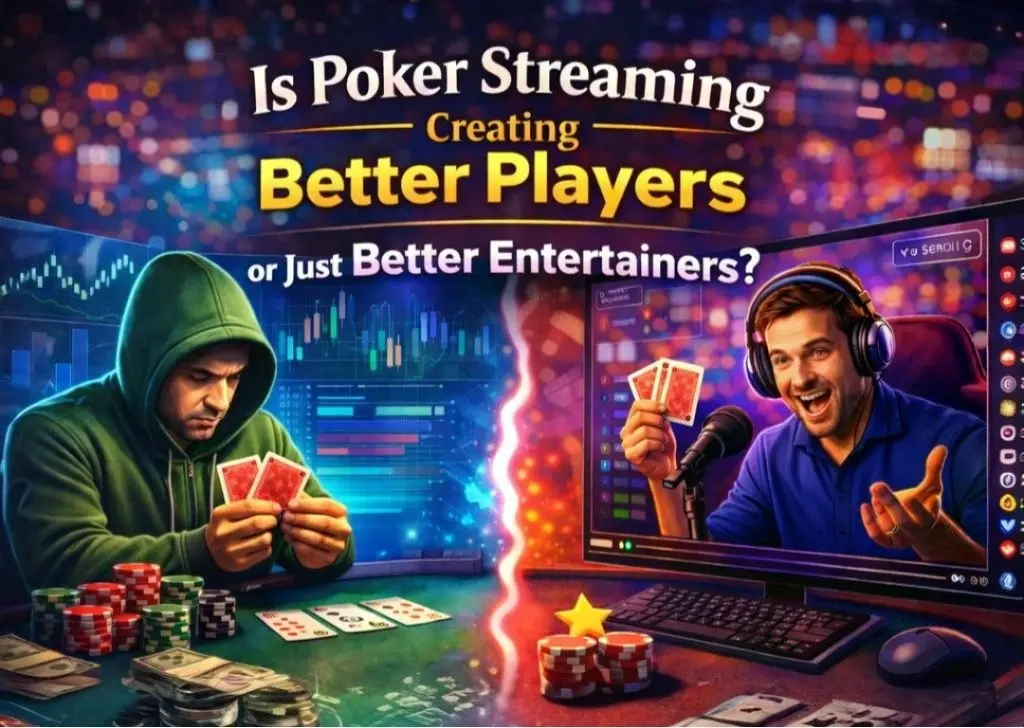
How Poker Streaming Changed the Way Players Learn
Poker has evolved faster in the last decade than at any point in its history. What was once a quiet, strategy-heavy game learned through books, forums, and trial-and-error is now played out live in front of thousands of viewers. Poker streaming on platforms like Twitch and YouTube has transformed h0w players consume poker content, learn strategy, and even define success in the game.
This shift raises a serious and often overlooked question: Is poker streaming actually creating better poker players, or is it mainly producing better poker entertainers?
The answer sits somewhere in the middle. Poker streaming has improved access to knowledge, accelerated learning for beginners, and brought transparency to high-level play. At the same time, it has blurred the line between educational poker content and pure entertainment. Understanding this difference is critical for anyone trying to improve their real-money results.
What Is Poker Streaming and Why Is It So Popular?
Poker streaming refers to players broadcasting their online poker sessions live, usually with commentary, hand analysis, and chat interaction. Viewers watch real-time decisions, emotional reactions, and long sessions unfold without edits or filters.
For many players, poker streams are now the primary learning resource. Instead of reading dense strategy books or solver outputs, players prefer watching how experienced grinders think through hands. This has made poker education more accessible, especially for beginners who struggle with theory-heavy material.
Key reasons poker streaming exploded:
- Free access to high-level gameplay.
- Real-time decision-making explanations.
- Interactive learning through chat.
- Entertainment blended with education.
Poker streaming didn’t just change how people watch poker; it changed how they learn poker strategy.
How Poker Streaming Helps Players Improve Their Game
When used correctly, poker streaming can genuinely improve poker skills.
One of the biggest advantages is visible decision-making. Viewers hear how streamers think about ranges, board textures, position, and opponent tendencies in real time. This bridges the gap between theory and execution in a way books often can’t.
Another benefit is range-based thinking. Instead of focusing on exact hands, viewers repeatedly hear discussions about possible hand combinations, which naturally improves strategic awareness.
Poker streams also provide rare insight into the mental game of poker. Viewers see how experienced players handle tilt, bad beats, downswings, and long sessions, lessons that are just as valuable as technical knowledge.
For disciplined learners, poker streaming works like an open classroom where theory meets real-world application.
Why Poker Streaming Does Not Automatically Create Better Players
Despite its advantages, poker streaming has serious limitations that many viewers overlook.
Most poker streams are built for viewer retention, not structured learning. Streamers often simplify explanations, skip deeper math, or avoid slowing down to analyze complex spots because long pauses hurt engagement. Important concepts like bet sizing theory, hand combinations, and exploitative adjustments are often mentioned briefly but not explored fully.
Another major issue is passive learning. Watching poker feels productive, but without active participation, such as pausing hands, taking notes, reviewing sessions, and applying concepts, improvement is limited. Many players mistake familiarity with understanding and assume watching strong players automatically upgrades their skill level.
Poker streaming can inform, but it does not replace deliberate practice.
Poker Streaming Rewards Entertainment More Than Precision
The poker streaming ecosystem favors personality over perfection.
Streamers who interact heavily with chat, tell stories, joke, and show emotion tend to grow faster than those who quietly analyze every decision. This pushes many content creators toward action-heavy styles, looser play, and exaggerated reactions, not because it’s optimal poker, but because it’s better entertainment.
This doesn’t mean poker streamers are bad players. It means their on-stream behavior is optimized for engagement, not long-term win rate. Viewers who blindly copy these styles without understanding the reasoning often struggle to replicate results.
Understanding this distinction is critical for anyone serious about improving at poker.
Learning Poker vs Watching Poker: The Key Difference
Watching poker and learning poker are not the same thing.
True poker improvement requires:
- Structured study.
- Post-session hand reviews.
- Mathematical reasoning.
- Long-term strategy planning.
Poker streams rarely provide this depth consistently. They are best used as supplementary learning tools, not primary education sources. Without active learning, viewers risk developing bad habits or overestimating their skill level.
Poker streaming should support your study, not replace it.
Are Poker Streamers Actually Strong Poker Players?
Yes, many poker streamers are genuinely strong and experienced players. However, what viewers see on stream is often a modified version of their real strategy.
On stream, players may:
- Play more hands to keep action flowing.
- Avoid long tanking decisions.
- Take higher-risk lines for excitement.
- Experiment more than usual.
Strong players know when they are deviating for content. Viewers often don’t. That gap in awareness is where misunderstandings begin.
Who Benefits Most From Poker Streaming?
Poker streaming is most valuable for beginners and intermediate players.
Beginners learn table flow, betting patterns, and common mistakes much faster through observation. Intermediate players benefit by comparing their own thought process with experienced streamers and refining decision-making.
Advanced players, however, often outgrow poker streams as a primary learning tool. At higher levels, improvement comes from solvers, databases, population analysis, and deep hand reviews, not entertainment-driven content.
How to Use Poker Streams to Actually Get Better
Poker streaming becomes powerful when used intentionally.
- Watch streams actively, not passively.
- Pause hands and make your own decisions before the streamer acts
- Focus on why decisions are made, not just outcomes.
- Combine streams with hand reviews, solvers, and structured study.
- Avoid copying styles without understanding the logic.
Used correctly, poker streaming sharpens intuition and decision-making. Used casually, it becomes background noise.
Is Poker Streaming Changing the Future of Poker?
Poker streaming has reshaped poker culture. It has made the game more social, transparent, and accessible. It has also shifted attention toward content creation, branding, and personality-driven success.
The future of poker will likely include both:
- Serious educational content
- Entertainment-first poker streams
Players who understand this balance and adjust how they consume content will have a clear edge over those who don’t.
Frequently Asked Questions
Does watching poker streams make you a better player?
Yes, but only when combined with active learning, practice, and review.
Are poker streamers always playing optimally on stream?
No. Many decisions are influenced by entertainment value and viewer engagement.
Is poker streaming better than poker courses?
Poker streams are easier to access, but structured courses are far more effective for long-term improvement.
Should beginners rely on poker streaming to learn poker?
Streams are a great starting point, but they should not be the only learning method.
Final Verdict: Better Players or Better Entertainers?
Poker streaming is creating better entertainers and more informed players, but not automatically better poker professionals. It excels at exposure, motivation, and showing real gameplay, yet falls short as a complete learning system.
At BluffingMonkeys, we do more than just share poker strategy, reviews, and guides. We help players stay connected to the best games, latest updates, and biggest opportunities. Be sure to follow all of our social media channels so you never miss important announcements, bonuses, promotions, special events, and new offers. Keep exploring our content, and when you’re ready to join the action, use our live chat button on the homepage to connect with us or message @bluffingmonkeys24_7 on the Telegram App.
 Hindi
Hindi Russian
 Spanish
 Brazilian Portuguese
 Simplified Chinese
 English