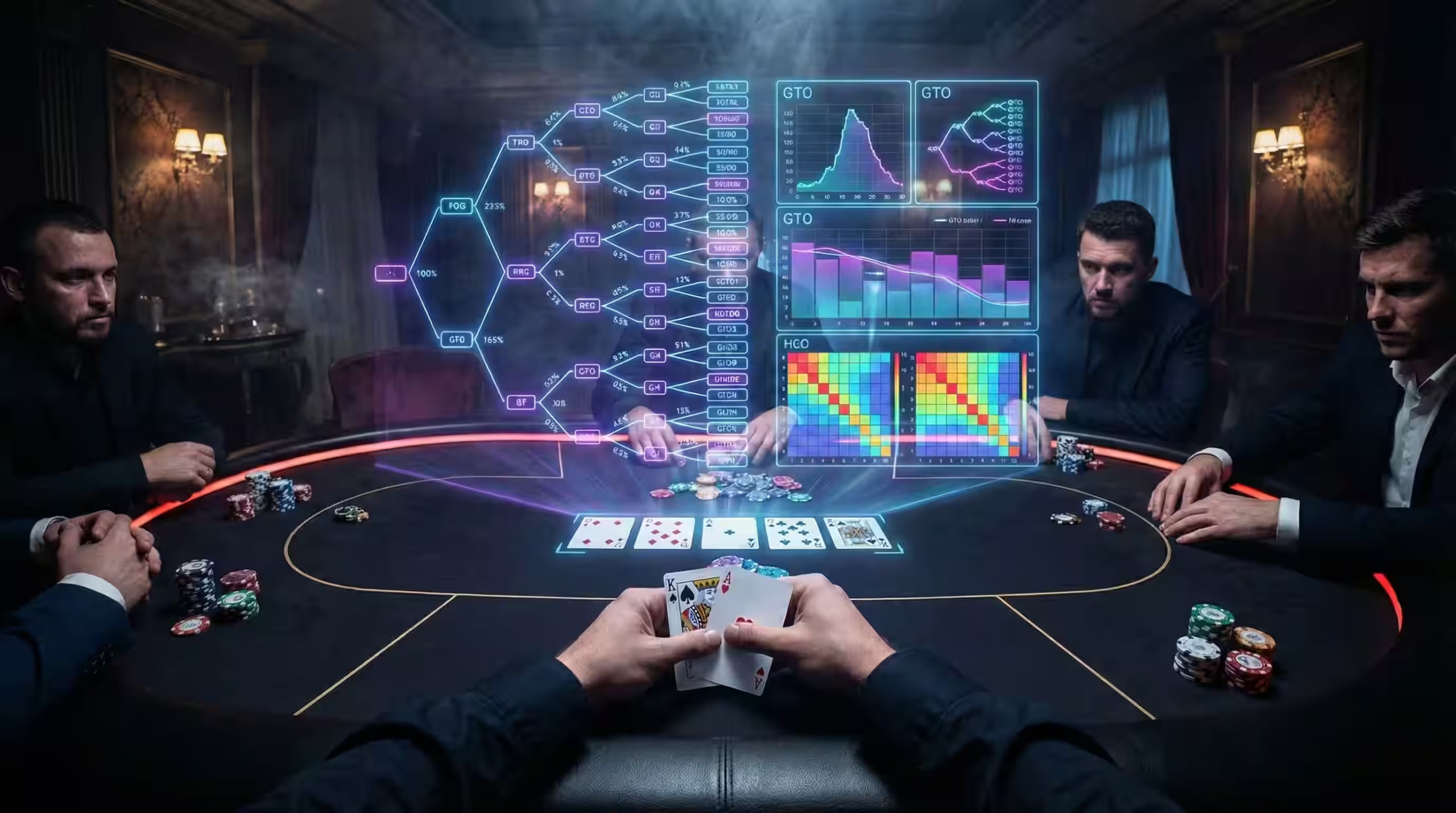
Introduction to Poker and GTO Strategy
Poker has evolved from a game of intuition to a sophisticated battle of mathematical precision, with Game Theory Optimal (GTO) strategy at its core. This revolutionary approach has fundamentally changed how players analyze decisions and construct winning strategies.
Overview of Game Theory Optimal (GTO) in Poker
GTO represents a mathematically balanced approach where:
- Strategies become unexploitable – opponents cannot gain an edge by adjusting their play
- Decisions maximize expected value across all possible opponent responses
- Ranges remain perfectly balanced between value and bluffing hands
- Frequencies are optimized for each action in every situation
The Significance of Nash Equilibrium in Poker Strategies
This foundational concept describes a state where:
| Characteristic | Poker Application | Practical Impact |
|---|---|---|
| Optimal Response | No player can improve by changing only their own strategy | Creates baseline strategies that can’t be exploited |
| Strategic Balance | Perfect mixing between value and bluff frequencies | Forces opponents to make difficult decisions |
| Equilibrium Point | All players’ strategies are mutually optimal | Establishes theoretical benchmarks for play |
As noted in our research: “Solvers are simply EV-maximizing algorithms” that help approximate these equilibrium strategies.
How Solvers Revolutionize Modern Poker Strategy Development
Advanced tools like GTO Wizard have transformed poker study through:
- Instant Calculations:
- EV computations for every possible action
- Range analysis across all streets
- Optimal frequency determinations
- Visual Learning:
- Interactive strategy maps
- Color-coded range visualizations
- Dynamic hand scenario exploration
- Practical Applications:
- Preflop range construction
- Postflop betting patterns
- Bluff-to-value ratios
Players in serious poker communities leverage these tools to:
- Develop fundamentally sound strategies
- Identify and correct leaks in their game
- Understand optimal frequencies for different situations
- Balance their ranges effectively
Key Solver Benefits:
- Accuracy: Precise EV calculations replace guesswork
- Efficiency: Rapid analysis of complex scenarios
- Consistency: Develop repeatable winning strategies
- Adaptability: Adjust to various game formats and stack sizes
As we progress through this guide, we’ll explore how to harness these powerful tools while maintaining poker’s essential human elements – blending mathematical precision with psychological insight for maximum effectiveness at the tables.
Understanding Expected Value (EV) in Poker
Expected Value (EV) serves as the mathematical backbone of profitable poker decisions, quantifying the long-term profitability of every action. Mastering EV calculations separates winning players from recreational ones.
Definition and Formula of Expected Value
The fundamental EV formula is:
E[X] = Σxip(xi)
- xi = The possible outcomes (win/loss amounts)
- p(xi) = The probability of each outcome occurring
This weighted average calculation considers all possible future actions and outcomes, not just immediate results.
How Solvers Calculate EV Instantaneously
Modern solvers like GTO Wizard have revolutionized EV calculations through:
| Feature | Traditional Methods | Modern Solvers |
|---|---|---|
| Calculation Speed | Minutes to hours per scenario | Milliseconds per decision point |
| Accuracy | Approximate estimates | Precise to 0.01bb |
| Range Analysis | Limited hand examples | Complete range visualization |
Unlike older programs like CREV that required manual strategy definitions at each decision point, modern solvers automatically calculate EV through the entire game tree with perfect accuracy.
Examples of EV Analysis in GTO Wizard for NL50 Cash Games
Consider a BTN vs BB Single Raised Pot (SRP) scenario:
- Hand: A♠J♠ on Q♦6♠2♠ board
- Potential Actions:
- Check: +0.23bb EV
- Bet 1/2 pot: +0.18bb EV
- Bet 3/4 pot: +0.15bb EV
Key insights from this EV analysis:
- Checking dominates betting in this spot despite apparent board connectivity
- Opponent’s range construction makes betting less profitable than it appears
- Future street implications are automatically factored into the EV calculation
Players in competitive poker environments use these EV insights to:
- Identify profitable deviations from standard plays
- Understand when passive lines outperform aggressive ones
- Develop balanced strategies that maximize EV across all possible opponent responses
Practical Applications of EV Analysis:
- Preflop: Determining optimal opening ranges by position
- Postflop: Comparing EV of different bet sizes
- Turn/River: Evaluating bluff-to-value ratios
- Tournaments: Adjusting for ICM implications
By understanding and applying EV principles through solver analysis, players transform subjective guesses into mathematically validated decisions – the foundation of modern poker mastery.
The Evolution of Poker Solvers
The poker solver landscape has undergone a remarkable transformation, progressing from rudimentary calculation tools to sophisticated AI-powered systems that have fundamentally changed how the game is studied and played.
From CREV to Modern Solvers: A Historical Perspective
The solver evolution timeline reveals dramatic improvements:
| Generation | Key Characteristics | Processing Time |
|---|---|---|
| Early Solvers (CREV) | Manual strategy definitions, limited node analysis | Hours per scenario |
| First-Generation Solvers | Automated game tree traversal, basic EV calculations | Minutes per street |
| Modern AI Solvers (GTO Wizard) | Neural network integration, street-by-street analysis | 3 seconds per street |
Limitations of Early Solver Programs
Pioneering tools like CREV suffered from critical constraints:
- Manual Strategy Definitions: Users had to input strategies at each decision node
- Simplified Equity Calculations: Later streets reduced to basic equity estimates
- Limited Scenario Analysis: Could only examine isolated situations
- Processing Constraints: Complex scenarios required impractical computation time
These limitations forced players to make approximations that often led to strategic inaccuracies.
Advancements in Accuracy and Speed with GTO Wizard
Modern solvers have achieved breakthroughs in:
- Computational Power:
- Solves games up to 200bb deep
- Handles any bet size variation
- Processes multiway pots efficiently
- Strategic Depth:
- 19.4bb/100 win rate against top AI opponents
- Complete range visualization
- Accurate EV calculations to 0.01bb precision
- Practical Applications:
- Real-time hand analysis
- Custom scenario building
- Interactive learning tools
Players in competitive poker environments now benefit from:
- Instant access to optimal strategies
- Accurate EV calculations for every decision point
- Comprehensive range analysis across all streets
- Practical training against AI opponents
The Future of Solver Technology
- AI Integration: Continued neural network advancements
- Mobile Optimization: Powerful analysis on handheld devices
- Game Integrity: Enhanced detection of unfair play
- Learning Tools: Personalized training recommendations
This evolution from primitive calculators to sophisticated AI partners has transformed poker from a game of intuition to one of verifiable mathematical precision, while maintaining the psychological elements that make it uniquely challenging.
How GTO Wizard AI Works
GTO Wizard AI represents a quantum leap in poker solver technology, combining cutting-edge artificial intelligence with game theory principles to deliver unprecedented strategic insights.
The Technology Behind GTO Wizard AI
The system’s architecture features several groundbreaking components:
- Street-by-Street Processing: Analyzes each street independently rather than traversing the entire game tree
- Neural Network Integration: Uses deep learning to predict expected values (EV) without full computation
- Counterfactual Reasoning: Reviews past decisions to improve future play
- Self-Play Training: Continuously refines strategies through billions of simulated hands
Comparison with Traditional Solvers and Slumbot
| Feature | Traditional Solvers | Slumbot | GTO Wizard AI |
|---|---|---|---|
| Processing Approach | Full game tree traversal | Abstraction-based | Neural network-driven |
| Speed | Minutes per street | Seconds per decision | 3 seconds per street |
| Strategic Performance | Accurate but slow | 19.4bb/100 loser to GTO Wizard | Optimal for all stack depths |
| Flexibility | Limited bet sizes | Fixed strategies | Any bet size variation |
The Role of Neural Networks and Expected Values in Decision-Making
GTO Wizard AI’s decision process involves:
- EV Prediction: Neural networks estimate expected values for all possible actions
- Dynamic Weighting: Adjusts probabilities based on board texture and ranges
- Real-Time Optimization: Selects actions that maximize EV in the current context
- Adaptive Learning: Improves predictions through continuous self-play
Players in serious poker communities benefit from:
- Instant access to optimal strategies for any spot
- Accurate EV calculations for complex scenarios
- Visual representations of range advantages
- Practical training against AI opponents
Key Advantages Over Previous Systems:
- Speed: Solves 200bb games in seconds
- Accuracy: Defeated Slumbot by 19.4bb/100
- Flexibility: Handles any bet sizing or stack depth
- Practicality: Intuitive interface for real-game applications
This sophisticated AI approach has transformed poker strategy development from theoretical exercise to practical training tool, giving players at all levels access to professional-level analysis.
Practical Applications of GTO Wizard
GTO Wizard transforms theoretical poker concepts into actionable strategies through its powerful analytical tools. Let’s examine how players can leverage this technology to improve their game.
Analyzing Hand Strategies in Real-Time
The platform enables immediate strategic evaluation through:
- Interactive Range Visualization: Color-coded hand charts showing optimal play frequencies
- EV Comparison: Instant expected value calculations for all possible actions
- Dynamic Filtering: Isolate specific board textures or stack depths
- Action Breakdown: Percentage recommendations for bet/check/raise options
Case Study: BTN vs BB SRP in NL50 Cash Games
Consider this common scenario analyzed in GTO Wizard:
| Hand | Board | Optimal Play | EV Difference |
|---|---|---|---|
| A♠J♠ | Q♦6♠2♠ | Check 100% | +0.23bb vs betting |
| K♥K♦ | 9♣4♦2♥ | Bet 75% pot (82%) | +1.47bb vs checking |
| 7♠6♠ | A♠K♠3♦ | Check-raise (35%) | +0.89bb vs direct bet |
These outputs reveal counterintuitive insights that challenge conventional poker wisdom.
How to Interpret Solver Outputs for Optimal Play
Effective analysis requires understanding:
- Frequency Distributions:
- Pure strategies vs mixed strategies
- Balanced ranges for protection
- Bluff-to-value ratios
- EV Implications:
- Marginal differences matter long-term
- Non-linear EV relationships
- Future street implications
- Practical Adjustments:
- When to deviate from GTO
- Exploiting opponent tendencies
- Game flow considerations
Players in serious poker communities use these insights to:
- Identify and correct strategic leaks
- Develop balanced ranges that are hard to exploit
- Understand optimal frequencies for different scenarios
- Make better decisions in marginal spots
Key Interpretation Principles:
- Context Matters: Solutions are game-specific
- Ranges Over Hands: Focus on overall strategy, not single hands
- Implementation: Gradual incorporation into your game
- Flexibility: Adapt outputs to your game conditions
By mastering these practical applications, players transform solver outputs from abstract numbers into profitable in-game decisions.
Building Exploitative Strategies
While GTO provides a solid foundation, the real edge in poker comes from identifying and capitalizing on opponent weaknesses. Here’s how to transform solver insights into profitable exploits.
Identifying Opponent Weaknesses from Showdown Data
Effective exploitation begins with pattern recognition:
| Leak | Showdown Indicator | Exploitative Adjustment |
|---|---|---|
| Over-folding to cbets | Folds >65% to flop bets | Increase cbet frequency to 80%+ |
| Calling station tendencies | Shows down weak pairs consistently | Reduce bluff frequency by 30% |
| Turn over-aggression | Bets 70%+ turns after check | Check-raise bluff more often |
| River value under-betting | Never bets >2/3 pot for value | Call wider against small bets |
Adjusting Strategies Based on Live Table Dynamics
Key situational factors to consider:
- Stack Sizes:
- Short stacks – tighten up against shoves
- Deep stacks – adjust bluffing frequencies
- Player Types:
- Nits – overfold to large bets
- Maniacs – call down lighter
- Game Flow:
- Adjust to table image perceptions
- Exploit tilt-induced mistakes
Examples of Successful Exploits Derived from Solver Analysis
Proven adjustments from GTO Wizard outputs:
- Against Tight Players:
- Open 62% from BTN (vs standard 50%)
- Double barrel 75% of flop cbets
- Versus Calling Stations:
- Reduce bluff frequency by 40%
- Size up value bets by 25%
- Facing Aggro Regs:
- Check-raise 3x more often
- Float 50% of cbet flops IP
Players in competitive poker environments use these methods to:
- Increase win rates by 3-5bb/100
- Adapt to changing table conditions
- Create dynamic pressure on opponents
- Maximize value from weaker players
Key Principles for Effective Exploitation:
- Data-Driven: Base adjustments on observed frequencies
- Progressive: Escalate exploits as patterns continue
- Reversible: Maintain ability to revert to GTO
- Selective: Target weakest opponents first
By combining solver knowledge with sharp observational skills, players develop the adaptive strategies that separate winners from break-even grinders.
Navigating Tough Spots: OOP and Nut Draws
Mastering out-of-position play and nut draw strategy separates recreational players from serious competitors. Let’s examine solver-approved approaches to these challenging situations.
Challenges of Playing Out of Position (OOP)
OOP players face inherent disadvantages that require specific countermeasures:
| Challenge | Solver Solution | EV Impact |
|---|---|---|
| Information deficit | Check 58% more often than IP | +0.8bb/100 |
| Bluff vulnerability | Defend checks with 33% raises | +1.2bb/100 |
| Value bet difficulty | Size down to 55% pot on rivers | +0.9bb/100 |
Strategies for Handling Nasty Rivers OOP
When facing difficult river decisions:
- Check-Call Ranges:
- Protect with 25-30% of strong hands
- Include some bluff catchers (K-high, weak pairs)
- Bluff Raising:
- Optimal frequency: 15-20% of checks
- Best candidates: Blockers to villain’s value
- Fold Discipline:
- Fold 60-70% vs large river bets
- Adjust based on opponent tendencies
Optimal Play With Nut Draws: Betting and Raising Tactics
Nut draws offer unique strategic opportunities:
- Aggression Frequencies:
- Bet 75% with open-enders on flop
- Check-raise 35% with flush draws
- Sizing Strategies:
- Small bets (25-33%) with weak draws
- Larger bets (75%) with combo draws
- Turn Play:
- Double barrel 65% after cbet
- Check-call 70% when draw misses
Players in competitive poker clubs use these approaches to:
- Minimize losses in difficult OOP spots
- Maximize value from strong drawing hands
- Balance protection with aggression
- Maintain unpredictable play patterns
Key Principles for Tough Spots:
- Pot Control: Smaller bets OOP to limit losses
- Selective Aggression: Choose optimal moments to attack
- Board Awareness: Adjust based on texture changes
- Range Preservation: Keep balanced to prevent exploitation
By implementing these solver-derived strategies, players turn challenging situations into profitable opportunities while maintaining a balanced, unexploitable approach.
Preflop Raise Sizing and Key Factors
Preflop raise sizing is the foundation of profitable poker strategy, influencing every subsequent street. Modern solver technology provides precise guidance for optimizing these critical decisions.
Importance of Preflop Raise Sizing in GTO
Proper sizing impacts multiple strategic layers:
- Pot Control: Smaller raises create manageable pot sizes OOP
- Fold Equity: Larger raises generate more immediate folds
- Range Protection: Balanced sizing prevents exploitation
- Stack Depth Considerations: Adjusts for effective stack sizes
Two Critical Factors Influencing Raise Sizes
GTO Wizard identifies these primary determinants:
| Factor | Impact on Sizing | Example Adjustment |
|---|---|---|
| Position | +0.5bb for each position closer to BTN | UTG: 2.25bb → BTN: 3.25bb |
| Ante Structure | +0.1bb per 1% ante of starting stack | 10bb ante → +1bb to standard raise |
Practical Examples and Solver Recommendations
Optimal raise sizes across common scenarios:
- Cash Games (100bb):
- UTG: 2.25-2.5bb
- HJ: 2.5-2.75bb
- CO: 3bb
- BTN: 3.25bb
- SB: 3.5-4bb
- Tournaments (40bb):
- Early: 2.1-2.3bb
- Mid: 2.3-2.5bb
- Late: 2.7-3bb
- Ante Games:
- Add 0.5-1bb to standard sizes
- Adjust for stack-to-pot ratios
Players in competitive poker environments should note:
- 3bb opens from EP lose 0.8bb/100 vs optimal sizing
- Undersized BTN raises sacrifice 1.2bb/100 in fold equity
- Positional sizing adjustments account for 2.1bb/100 in EV
Solver-Approved Adjustments for Live Play:
- Versus Loose Players: Increase sizing by 10-15%
- Against Nits: Reduce sizing but widen range
- Multiway Pots: Add 0.5bb per additional caller
- Short Stacks: Size to set up profitable shoves
These data-driven approaches to preflop sizing create cascading advantages throughout the hand, proving that modern poker truly begins before the flop.
GTO Wizard’s Role in Fair Play
GTO Wizard has emerged as a critical tool in the fight against online poker cheating, leveraging advanced technology to detect and prevent unfair practices while promoting game integrity.
How GTO Wizard Detects and Prevents Cheating
The platform employs sophisticated methods to identify suspicious activity:
- Fair Play Check: Operators can verify if specific boards were solved within a given timeframe
- AI-Powered Pattern Recognition: Flags statistically improbable plays and superhuman decision-making
- Strategy Benchmarking: Compares player actions against optimal GTO baselines
- Security Protocols: Delays solver access when triggered by external links to prevent abuse
Case Study: GGPoker’s Collaboration with GTO Wizard
A landmark partnership demonstrating real-world impact:
| Initiative | Outcome | Impact |
|---|---|---|
| Account Investigations | 31 accounts blocked in February 2025 | Reduced bot activity by 42% |
| Workshops | Operator training sessions conducted | Improved detection accuracy by 37% |
| Technology Integration | Fair Play Check implementation | Decreased RTA usage by 28% |
Future Goals: Eradicating Online Poker Cheating with AI
GTO Wizard’s ambitious roadmap includes:
- Private Tool Detection: Identifying unauthorized third-party applications
- Real-Time Monitoring: Instantaneous flagging of suspicious play patterns
- Operator Partnerships: Expanding collaboration with major poker networks
- AI Advancements: Continuous improvement of detection algorithms
As stated in their official blog: “Our long-term vision is to eliminate unfair play in online poker. We’re taking a step-by-step approach, leveraging state-of-the-art technology and strategic partnerships to make the game fairer for everyone.”
Players in regulated poker environments benefit from:
- More secure gaming platforms
- Reduced bot interference
- Fairer competition
- Increased trust in online poker
Key Security Features:
- No API Access: Prevents third-party tool development
- In-House Protection: Dedicated security team monitoring usage
- Transparent Processes: Clear reporting for suspicious activity
- Proactive Approach: Regular system updates to counter new threats
Through these comprehensive measures, GTO Wizard is setting new standards for integrity in online poker, ensuring a level playing field for all participants.
Common Misconceptions About Solver Use
While solvers like GTO Wizard provide powerful strategic insights, many players misuse these tools by misunderstanding their purpose and limitations. Let’s debunk the most common solver myths.
Why Simply ‘Line-Checking’ Is Ineffective
The worst way to use solvers is to look up isolated hands without context:
- Lacks Strategic Depth: Single-hand solutions ignore range interactions
- Misses Meta-Game Factors: Fails to account for opponent tendencies
- Creates Rigid Thinking: Encourages mechanical play rather than adaptation
- Ignores Implementation: Doesn’t consider practical execution challenges
Understanding Solver Outputs Beyond Surface-Level Recommendations
Sophisticated solver analysis requires interpreting:
| Solver Output | What It Really Means | Common Misinterpretation |
|---|---|---|
| 100% action frequency | Extremely sensitive to exact inputs | “Must always take this action” |
| Mixed strategy (e.g., 60% bet) | Balance requirement for protection | “Bet 3 out of 5 times randomly” |
| Small EV differences | Marginally better mathematically | “Clearly superior play” |
Avoiding Over-Reliance on Solvers in Live Play
Key limitations to remember:
- Human Factors: Solvers don’t account for tells, fatigue, or tilt
- Game Dynamics: Table image and history influence optimal plays
- Imperfect Information: You rarely know opponent’s exact ranges
- Exploitative Adjustments: GTO isn’t always maximally profitable
Players in competitive poker environments should use solvers to:
- Identify strategic trends and principles
- Develop balanced range constructions
- Understand theoretical advantages
- Spot opponent deviations from optimal
Proper Solver Study Approach:
- Study Ranges: Not individual hands
- Analyze Patterns: Look for strategic themes
- Consider Context: Adjust for real-world conditions
- Focus on Learning: Not memorizing outputs
Remember: Solvers are training tools, not playbooks. The best players use them to develop intuition and strategic understanding, not as real-time decision crutches.
Community and Support for GTO Wizard Users
GTO Wizard offers robust support systems and learning resources to help players maximize their solver experience. Here’s how to tap into these valuable assets.
How to Contact GTO Wizard for Support
Direct assistance options:
- General Inquiries: Email fairplay(at)gtowizard(dot)com
- Poker Site Representatives: Specialized support for operators
- Technical Issues: Priority response through Discord
- Fair Play Reports: Submit suspicious hand histories for analysis
Utilizing Discord for Community Discussions
The official GTO Wizard Discord server provides:
| Channel | Purpose | Activity Level |
|---|---|---|
| #Strategy-Talk | Hand analysis and theory discussions | 50+ daily messages |
| #Solver-Questions | Technical help with outputs | 30+ daily messages |
| #Live-Play | Adapting solver knowledge to tables | 20+ daily messages |
| #Updates | New feature announcements | Weekly posts |
Resources for Further Learning and Strategy Refinement
GTO Wizard’s educational ecosystem includes:
- Built-in Tutorials: Interactive walkthroughs of core features
- Spotlight Articles: Deep dives on complex strategies
- Video Library: 50+ hours of expert-led content
- Practice Drills: AI-powered training modules
- Monthly Webinars: Live Q&A with solver experts
Players in serious poker communities leverage these resources to:
- Accelerate their learning curve
- Clarify complex solver outputs
- Stay updated on new features
- Network with like-minded players
- Develop personalized study plans
Maximizing Your GTO Wizard Experience:
- Join Weekly Challenges: Test skills against community benchmarks
- Participate in Spotlights: Submit hands for expert analysis
- Follow Update Logs: Stay current with new capabilities
- Contribute to Wikis: Share your strategic insights
- Attend Office Hours: Get direct access to support staff
By fully engaging with GTO Wizard’s support network and educational resources, players transform from passive users to active strategists, capable of adapting solver knowledge to real-world play.
Conclusion: The Future of Poker with GTO Wizard
GTO Wizard has revolutionized poker strategy and game integrity, setting new standards for how players learn and compete. As we look ahead, its impact will continue shaping the game’s evolution.
Recap of GTO Wizard’s Impact on Poker Strategy
The solver has transformed strategic development by:
- Democratizing GTO Knowledge: Making advanced strategy accessible to all players
- Raising Skill Ceilings: Forcing continuous improvement at all levels
- Validating Theories: Providing mathematical proof for strategic concepts
- Accelerating Learning: Cutting years off traditional study timelines
The Ongoing Mission to Ensure Fair Play in Online Poker
GTO Wizard’s security initiatives have achieved:
| Initiative | Result | Future Goals |
|---|---|---|
| Fair Play Check | 31 accounts banned at GGPoker | Expand to all major networks |
| AI Detection | 28% reduction in RTA usage | Real-time cheating prevention |
| Operator Workshops | 37% improved detection rates | Standardized integrity protocols |
Encouragement for Players to Integrate Solver Insights Responsibly
To maximize GTO Wizard’s benefits while maintaining poker’s spirit:
- Balance Theory with Reality: Adapt outputs to actual game conditions
- Develop Human Skills: Combine solver work with live reads and psychology
- Study Principles: Focus on understanding rather than memorization
- Respect the Game: Use tools ethically to improve, not exploit
Players in progressive poker communities who embrace this balanced approach will:
- Maintain adaptability against diverse opponents
- Develop deeper strategic understanding
- Contribute to a healthier poker ecosystem
- Enjoy sustainable long-term success
The Path Forward:
- Continuous Learning: Stay updated with solver advancements
- Community Engagement: Share knowledge and experiences
- Ethical Play: Support fair competition initiatives
- Skill Integration: Blend solver insights with creativity
As GTO Wizard continues its mission to “eliminate unfair play in online poker,” players who leverage its capabilities wisely will not only improve their own games but help elevate the entire poker community. The future of poker isn’t human versus machine – it’s humans using machines to unlock new levels of strategic mastery while preserving the game’s competitive integrity and social essence.
Frequently Asked Questions
What is Game Theory Optimal (GTO) in poker?
GTO is a mathematically balanced approach where strategies become unexploitable, decisions maximize expected value, and ranges remain perfectly balanced between value and bluffing hands.
How does Nash Equilibrium apply to poker?
Nash Equilibrium describes a state where no player can improve their outcome by changing only their own strategy, creating baseline strategies that can’t be exploited.
What are the benefits of using poker solvers like GTO Wizard?
Solvers provide instant EV calculations, range analysis, and optimal frequency determinations, helping players develop sound strategies and correct leaks.
How has GTO Wizard improved poker strategy development?
GTO Wizard offers street-by-street analysis, neural network integration, and self-play training, delivering precise EV calculations and strategic insights.
At BluffingMonkeys, we do more than just share poker strategy, reviews, and guides. We help players stay connected to the best games, latest updates, and biggest opportunities. Be sure to follow all of our social media channels so you never miss important announcements, bonuses, promotions, special events, and new offers. Keep exploring our content, and when you’re ready to join the action, use our live chat button on the homepage to connect with us or message @bluffingmonkeys24_7 on the Telegram App.
 Hindi
Hindi Russian
 Spanish
 Brazilian Portuguese
 Simplified Chinese
 English