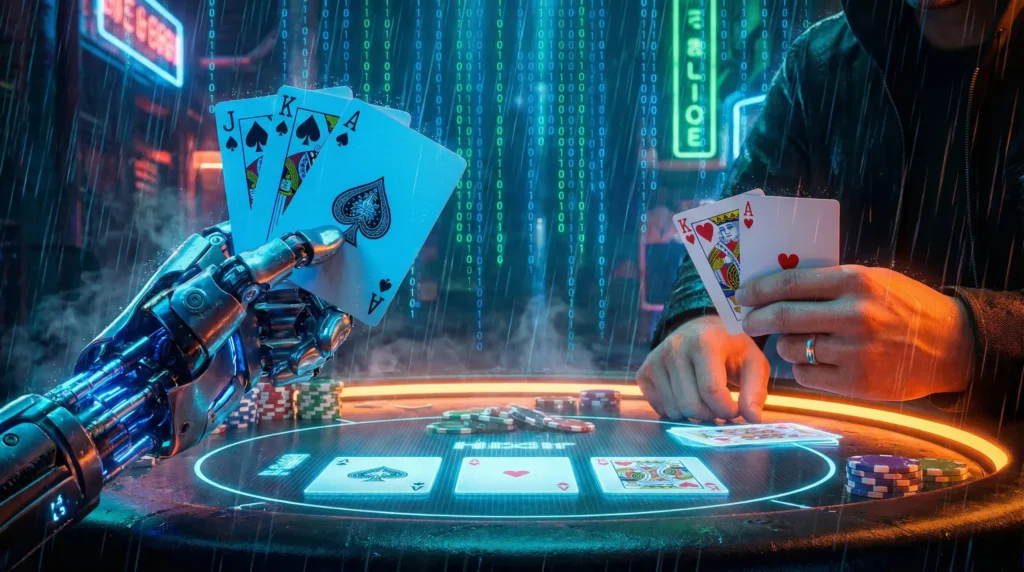
Imagine logging into a tournament and sitting at a virtual table where some opponents are humans, blinking, thinking, maybe a bit nervous, and others are cold, relentless bots running perfect logic. That’s the reality now with AI vs human players in online poker, and it’s stirring up the scene in ways few imagined a handful of years ago. As “Poker AI online” evolves, and “Poker Bots in Online Tournaments” become more common, the balance between human unpredictability and robotic precision is shifting fast.
In this story, we peel back the layers, showing you how bots perform, why some human players still shine, and how the entire ecosystem is adapting. We’ll explore changes in competitive dynamics, strategies, and what might be ahead if bots and humans keep going head-to-head.
AI vs Human Players in Online Poker: What’s Evolving on the Virtual Felt
Not long ago, online poker felt like a human space, full of quirks, tells, mistakes, and emotional swings. But now, with bots operating side by side, the landscape is morphing: predictable decisions, relentless consistency, and algorithmic accuracy are rewriting what it means to compete online. Human players still bring creativity and unpredictability, but bots raise the bar for baseline performance.
Let’s drill down into what each side offers, where advantages lie, and how things might unfold as technology advances.
Poker AI Online: What Bots Do Better
Mathematical Precision and Unflagging Consistency
- Bots crunch probabilities and evaluate moves with lightning‑fast accuracy. They examine hand possibilities, opponent patterns, and optimal action choices in a split second, far faster than any human ever could.
- They don’t get tired, bored, or frustrated. Whether it’s session number three or session number thirty, their focus stays razor-sharp and decisions remain unchanged.
- They log every detail, past hands, opponent behaviors, outcomes, and use that history flawlessly. Humans, in contrast, can misremember, drift, or misinterpret after a long session.
This combination of speed, memory, and stamina gives bots a baseline edge that’s hard to match, especially in long tournaments or high-pressure situations.
Strategy Grounded in Game Theory and Adaptive Logic
Modern bots often rely on strategies grounded in game theory, aiming for balanced, hard-to-exploit play rather than aggressive swings or unpredictable bluffs. Once coded properly and given sufficient data, bots adjust their lines dynamically, adapting to opponent tendencies and avoiding predictable errors.
Over time, that kind of play becomes tough to exploit, and many human players find themselves needing deeper insight and sharper instincts just to keep pace.
The Human Factor: What Humans Still Bring to the Table (For Now)
Humans contribute creativity, intuition, and adaptive thinking that machines cannot fully replicate, keeping the game unpredictable and dynamic.
Creativity, Intuition & Unorthodox Play
Humans have something bots don’t: gut feelings, unpredictability, and a flair for unorthodox decisions. Experienced players often step away from purely logic‑driven strategy when they sense a pattern, suspect a “read,” or just want to throw a curve ball. That unpredictability can disrupt a bot’s computed expectations, especially in multi-opponent scenarios or chaotic hands.
Humans can bluff in unusual ways, make unconventional calls, or change rhythm and timing, things bots might not handle as flexibly. That creative edge keeps human play alive and unpredictable.
Psychological Pressure, Social Dynamics & Adaptive Reads
Even online, human players react to subtle cues: timing, behavior patterns, emotional swings, or shifts in momentum. Bots tend to play “clean” and perfect, but that very perfection can become predictable. Humans can exploit that, using irregular moves, varied timing, or sudden shifts to throw off robotic consistency.
In short: when games get messy, unpredictable, or emotionally charged, humans may actually “win” simply by being human.
How Bots Are Changing Tournament Pools and Online Game Dynamics
Bots are raising the baseline skill level, reducing mistakes, and shifting competition dynamics, making games more strategic and challenging for human players.
Rising Baseline Skill – Mistakes Are Less Common
With bots in the mix, the overall level of play in many pools is rising. Mistakes that humans used to make, missing odds, misreading hand strength, tilting, become less frequent. As a result, variance drops, casual advantages shrink, and games get tougher overall. What was once a mild competition becomes far more strategic and intense.
Frustration, Disillusionment & Pressure on Player Engagement
For many players, facing bots can feel frustrating: games can become colder, more mechanical, and less social. If the illusion of “human unpredictability” fades, some players might lose interest or abandon tournaments altogether. Over time, this could shift how many people choose to participate, especially those who joined for fun, surprise, or human instincts rather than pure optimization.
The entry of bots challenges not just individual matches, but the entire community’s motivation and emotional engagement.
The Back-and-Forth: Detection, Adaptation & an Evolving Arms Race
As bots get sharper, systems to detect and manage them are evolving too. Many platforms deploy behavior‑analysis tools, pattern detection, and session‑consistency monitors to flag bot-like activity. That includes extremely consistent timing, perfect play over long sessions, or suspiciously balanced moves across many rounds.
- Bots trying to evade detection now sometimes “shake things up”, injecting randomness, varying timing, even simulating small human-like mistakes.
- At the same time, honest players use AI-based training tools to refine strategy: practicing hand histories, studying optimal play, reviewing sessions, spotting leaks, and improving long-term decision-making.
In a way, AI becomes both the challenger and the coach, pushing standards up for everyone involved.
The Human‑AI Hybrid Edge: Where Creative Humans Meet Smart Machines
As pure bots push consistency and performance, a new breed of human players is emerging, those who mix strategic thinking with unpredictability and psychological insight. These hybrid players don’t rely solely on textbook logic or solver lines; instead they adapt, read rhythms, and use creativity to stay unpredictable.
They:
- Study patterns and data, but don’t always follow the “optimal” path strictly.
- Introduce unconventional moves, timing variations, strange plays, especially in multi-player games or unpredictable situations.
- Use adaptive thinking, swapping strategies, mixing aggressive and passive styles, keeping opponents (human or bot) guessing.
These hybrid strategies keep the game alive, varied, and dynamic, preserving the human spirit in a world steadily leaning toward mechanical perfection.
Looking Ahead: What’s Next in the Bot-vs‑Human Poker Landscape
The future might see bots that don’t just follow rigid strategies, but learn on the fly, adapting to multi-player dynamics, unexpected moves, and unconventional human behavior. That could mean even more challenging competition for human players.
But at the same time, human players who embrace adaptability, creativity, and hybrid strategy may carve out new niches: meta‑play, unpredictable lines, unpredictable timing, aspects bots might struggle to mimic convincingly. The contest might shift from pure logic to a blend of logic, intuition, and human unpredictability.
In the end, poker may evolve into a new art form, one where human flair and algorithmic precision collide, pushing each other to higher levels.
FAQs
Q: Can bots truly outperform most human players nowadays?
Yes, especially in consistency, long‑term decision accuracy, and error reduction. However, humans still hold advantages in unpredictability, bluff‑like moves, timing strategies, and psychological depth that bots struggle to replicate.
Q: Do bots make the game feel less human?
For many players, yes. When matches become mechanical, emotionless, and perfectly balanced, the social and unpredictable charm of poker can fade, turning it into a cold logic puzzle instead of a human showdown.
Q: Is there still room for human-style creativity in bot‑heavy environments?
Absolutely. Players who adapt with hybrid strategies, balancing logic with unpredictability, can disrupt even the smartest bots. Creative timing, unconventional moves, and psychological pressure remain potent tools.
Q: What can honest players do to stay competitive?
Focus on flexibility: learn from data, but don’t become mechanical. Vary your styles, mix up timing and actions, and stay unpredictable, treat each session as a fresh challenge rather than a formula to solve.
Conclusion
The clash between bots and humans in online poker is no longer hypothetical, it’s happening now. Bots bring precision, memory, and unshakable discipline, steadily raising the bar for competitive play. But humans bring heart, unpredictability, creativity, and psychological nuance, qualities bots haven’t learned to master.
As the playing field shifts, the best players might not be those strictly following optimal logic, but those who blend it with human flair. If you love poker for its surprises, its chaos, and its human drama, there’s still hope. Even in a world of algorithms and cold calculations, there’s room for human spirit, cunning reads, and unpredictable moves.
The future of online poker might not belong solely to bots. It may belong to those who use their minds, and their guts in equal measure.
At BluffingMonkeys, we do more than just share poker strategy, reviews, and guides. We help players stay connected to the best games, latest updates, and biggest opportunities. Be sure to follow all of our social media channels so you never miss important announcements, bonuses, promotions, special events, and new offers. Keep exploring our content, and when you’re ready to join the action, use our live chat button on the homepage to connect with us or message @bluffingmonkeys24_7 on the Telegram App.
 Hindi
Hindi Russian
 Spanish
 Brazilian Portuguese
 Simplified Chinese
 English