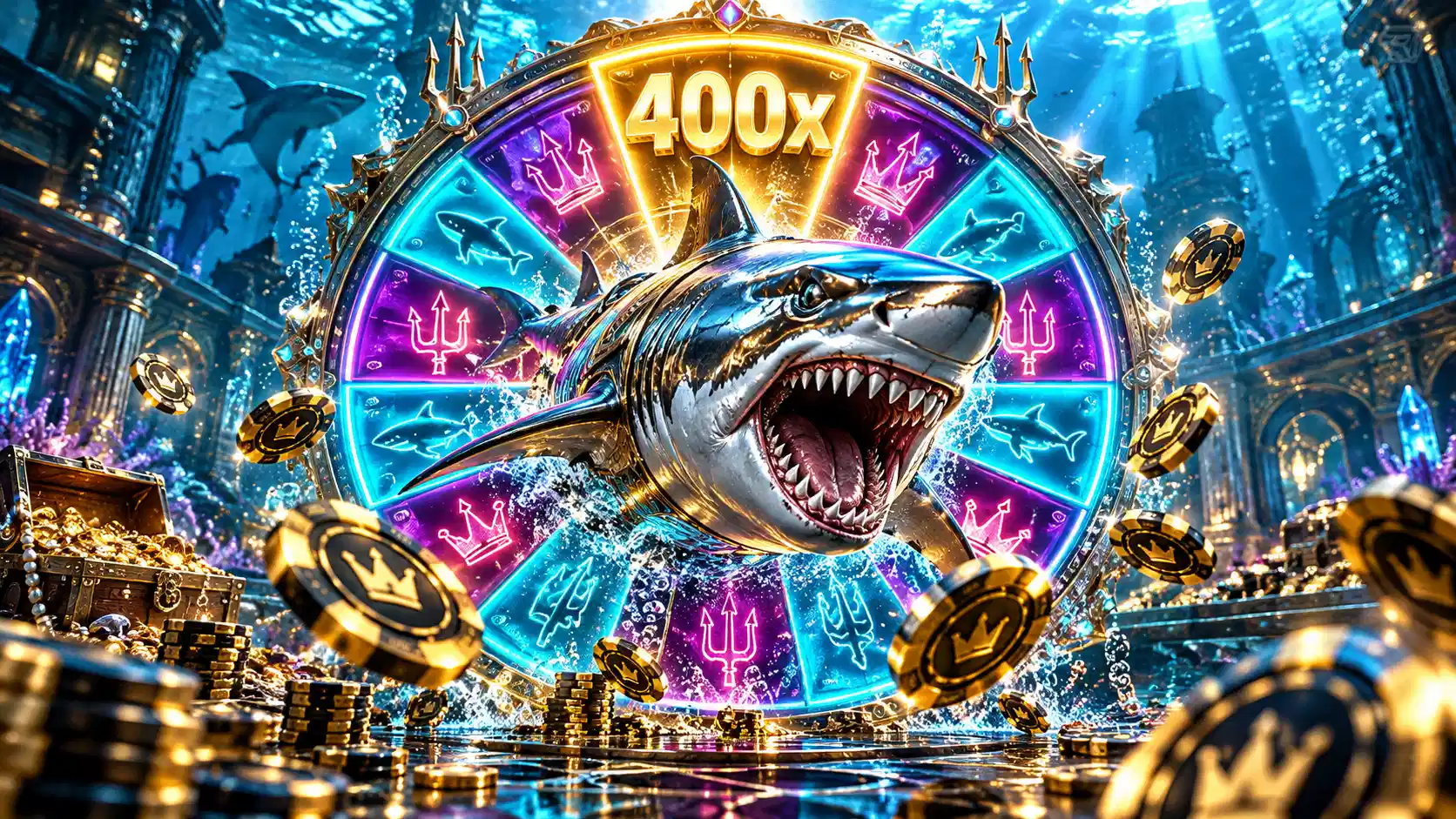
GGPoker Ocean KO takes the familiar Progressive Knockout tournament and adds something completely different: a random jackpot multiplier every time you eliminate another player.
The new format can multiply a standard bounty by as much as 400x. Meanwhile, players move through 14 ocean-themed bounty levels as their value increases.
At the very top sits the Legendary Shark.
Its bounty starts at $1 million, and a single knockout can generate a bounty prize worth as much as $1.5 million.
However, Ocean KO is not simply a giant bounty lottery.
The format still uses the core structure of Progressive Knockout poker. Half of a collected bounty prize is generally paid directly as cash, while the other half increases the winner’s own bounty.
That means one lucky multiplier can completely change a tournament.
You might knock out an ordinary player and suddenly become one of the most valuable targets at the table.
Therefore, Ocean KO combines three major poker concepts in one format:
- Progressive Knockout tournaments;
- jackpot-style random multipliers;
- and an evolving bounty ladder.
GGPoker introduced the format in October 2026, and its Help Center says Ocean KO will remain available as a permanent tournament offering.
Here is exactly how GGPoker Ocean KO works, what the 400x multiplier actually means and why players should not confuse jackpot potential with guaranteed profit.
GGPoker Ocean KO: Quick Facts
| Feature | Ocean KO |
|---|---|
| Platform | GGPoker |
| Format | Jackpot-style Progressive Knockout |
| Introduced | October 2026 |
| Standard Multiplier Range | 0.4x to 400x |
| Total Bounty Levels | 14 |
| Starting Level | Egg |
| Highest Level | Legendary Shark |
| Legendary Shark Bounty | $1,000,000 |
| Maximum Legendary Shark Multiplier | 1.5x |
| Maximum Bounty Prize | $1,500,000 |
| Normal Bounty Split | 50% cash / 50% added to your bounty |
| 400x Probability on Standard Pay Table | 0.002%, approximately 1 in 50,000 |
| Permanent Format? | Yes, according to GGPoker |
What Is GGPoker Ocean KO?
Ocean KO is essentially a Progressive Knockout tournament with a jackpot mechanic added to every elimination.
In a normal PKO, you know approximately what happens when you eliminate an opponent.
Part of their bounty becomes immediate cash. The other part increases your own bounty.
Ocean KO adds another step.
When you eliminate somebody, GGPoker spins a random bounty multiplier.
That multiplier is applied to the eliminated player’s current bounty value.
As a result, the actual bounty prize can be smaller than the displayed bounty, close to the same value or dramatically larger.
In standard Ocean KO levels, the multiplier can range from 0.4x all the way to 400x.
How a Normal Progressive Knockout Works
Understanding a standard PKO makes Ocean KO much easier to understand.
Suppose a tournament has a $100 buy-in and $50 of that amount forms the starting bounty.
If you eliminate a player with a $50 bounty in a traditional PKO, part of that bounty is normally paid directly to you.
The remaining portion increases your own bounty.
For example, under a 50/50 bounty split, you receive $25 immediately and another $25 gets added to the bounty on your head.
Therefore, each elimination makes you more valuable to your opponents.
That is why the format is called Progressive Knockout.
Our Progressive Knockout Poker Strategy guide explains how those growing bounties affect calling ranges and tournament decisions.
Ocean KO Adds a Random Multiplier to Every Knockout
This is where the new format changes the equation.
Instead of automatically receiving the standard fixed bounty result, the knockout triggers a wheel.
The game takes the eliminated player’s bounty and multiplies it by the random result.
For standard levels, possible multipliers run from 0.4x to 400x.
Therefore, two players with identical displayed bounties can produce completely different rewards.
One knockout might hit 0.5x.
Another could land 10x.
A very rare spin could reach 400x.
That introduces far more short-term variance than a standard PKO.
How the Ocean KO 50/50 Bounty Split Works
A common source of confusion is the number shown by the bounty animation.
The full amount shown is the bounty prize.
Normally, you do not receive the entire amount directly in your wallet.
Instead, GGPoker splits the result equally.
- 50% direct cash: immediately credited to your cash balance.
- 50% progressive bounty: added to the bounty on your own head.
For example, suppose you eliminate a player with a $5 bounty and the wheel lands on 10x.
The total bounty prize becomes:
$5 × 10 = $50
You receive $25 directly.
Another $25 gets added to your own bounty.
Therefore, the $50 graphic does not mean $50 of immediate cash goes into your wallet.
Ocean KO 400x Example
Now consider the headline multiplier.
Imagine a $10 tournament where the starting bounty is $5.
You eliminate an Egg-level opponent.
The bounty wheel lands on 400x.
The calculation becomes:
$5 × 400 = $2,000 bounty prize
Under the normal 50/50 split:
| Result | Amount |
|---|---|
| Total Bounty Prize | $2,000 |
| Immediate Cash | $1,000 |
| Added to Your Bounty | $1,000 |
So a player in a relatively small tournament could suddenly have a bounty worth more than $1,000 on their head.
That changes how everyone else at the table should evaluate an all-in against them.
What Are the Odds of Hitting 400x?
The maximum multiplier sounds enormous because it is extremely rare.
The published standard Ocean KO pay table gives the 400x multiplier a probability of approximately:
0.002%
That is roughly:
1 in 50,000 bounty spins
Therefore, players should not build a tournament strategy around hitting 400x.
The giant reward is possible, but most knockouts will produce much smaller multipliers.
Ocean KO Multiplier Odds
The standard pay table for Levels 1 through 10 has been published with the following distribution:
| Multiplier | Probability | Approximate Frequency |
|---|---|---|
| 400x | 0.002% | 1 in 50,000 |
| 100x | 0.080% | 1 in 1,250 |
| 10x | 2.400% | About 1 in 42 |
| 2x | 2.500% | 1 in 40 |
| 1.5x | 2.700% | About 1 in 37 |
| 1x | 20.000% | 1 in 5 |
| 0.7x | 22.000% | About 1 in 5 |
| 0.5x | 26.228% | About 1 in 4 |
| 0.4x | 24.090% | About 1 in 4 |
One number immediately stands out.
Approximately 72.3% of standard bounty spins land below 1x.
At first, that sounds bad.
However, rare 10x, 100x and 400x results carry much of the missing value.
Across the full published distribution, the average multiplier works out to approximately 1x.
In other words, Ocean KO changes how bounty value is distributed rather than simply making every elimination worth more.
Ocean KO Is Much More Volatile Than a Normal PKO
That average is important.
Suppose a standard bounty is worth $5.
In a normal PKO, its value is predictable.
Ocean KO makes the individual result unpredictable, even though the long-run multiplier distribution averages around the face value.
As a result, two players can collect the same number of knockouts and earn very different bounty results.
One may repeatedly hit sub-1x multipliers.
Another might hit a 10x early and suddenly create a huge bounty.
That extra randomness makes short tournament samples much more volatile.
Our Poker Variance and Downswings guide explains why short-term outcomes can differ dramatically from long-run expected value.
Ocean KO Has 14 Evolution Levels
The jackpot wheel is only half of the new format.
GGPoker also created a 14-level bounty progression system.
Everyone normally begins as an Egg.
As your bounty grows, your ocean character evolves.
The first ten levels scale with the tournament buy-in.
| Level | Name | Bounty Threshold |
|---|---|---|
| 1 | Egg | 0.5x buy-in |
| 2 | Fry | 0.6x buy-in |
| 3 | Fish | 0.75x buy-in |
| 4 | Shrimp | 1x buy-in |
| 5 | Crab | 1.5x buy-in |
| 6 | Turtle | 2.5x buy-in |
| 7 | Octopus | 5x buy-in |
| 8 | Dolphin | 10x buy-in |
| 9 | Whale | 20x buy-in |
| 10 | Shark | 50x buy-in |
Your level is based on bounty value.
It is not based on how many tournament chips you have.
Your Chip Stack Does Not Determine Your Ocean KO Level
This can create unusual situations.
A player might have a small tournament stack but an enormous bounty because they previously hit a large multiplier.
Meanwhile, the chip leader may have eliminated very few players and still carry a relatively small bounty.
Therefore, players need to track two separate forms of value:
- tournament chips;
- and bounty value.
Those two numbers can point in completely different directions.
You Can Skip Ocean KO Levels
Players do not always move from Egg to Fry, then Fish, then Shrimp one step at a time.
A large bounty spin can push your bounty past several thresholds immediately.
For example, a 100x or 400x multiplier can dramatically increase the progressive portion added to your bounty.
As a result, a player can skip several ocean levels after one knockout.
That makes the table dynamic.
One spin can suddenly create a major target.
The Four Legendary Ocean KO Levels
Once bounty values become extremely large, GGPoker moves away from normal buy-in-scaled levels.
The final four levels use fixed dollar thresholds.
| Level | Tier | Bounty Threshold |
|---|---|---|
| 11 | Legendary Octopus | $10,000 |
| 12 | Legendary Dolphin | $50,000 |
| 13 | Legendary Whale | $250,000 |
| 14 | Legendary Shark | $1,000,000 |
These levels use narrower multiplier ranges because the bounty amounts are already enormous.
In particular, the Legendary Shark can produce a multiplier as high as 1.5x.
How Can an Ocean KO Bounty Reach $1.5 Million?
The calculation is straightforward.
A Legendary Shark begins with a bounty value of at least:
$1,000,000
The maximum published multiplier for that tier is:
1.5x
Therefore:
$1,000,000 × 1.5 = $1,500,000 bounty prize
However, there is an important detail.
A normal knockout prize is split 50/50.
So a $1.5 million bounty prize would ordinarily mean:
- $750,000 paid immediately as cash;
- $750,000 added to the winner’s own bounty.
Therefore, the headline “$1.5 million bounty” should not automatically be interpreted as $1.5 million instantly deposited into a player’s cash balance.
The Tournament Champion Gets a Final Bounty Spin
Ocean KO also changes what happens when the tournament ends.
The champion can receive two separate bounty spins at the finish.
First, eliminating the runner-up triggers the normal knockout spin.
That prize uses the usual 50/50 structure.
Next, the winner receives a Final Bounty Spin based on their updated personal bounty.
This final spin is different.
GGPoker says the resulting Final Bounty Prize is paid 100% in cash.
As a result, winning the tournament can generate a major additional payout beyond the normal first-place prize.
Ocean KO vs Standard PKO
| Feature | Standard PKO | Ocean KO |
|---|---|---|
| Bounty Active From Start | Yes | Yes |
| Progressive Bounty | Yes | Yes |
| Random Multiplier | No | Yes |
| Maximum Standard Multiplier | Fixed structure | 400x |
| Bounty Levels | No Ocean ladder | 14 |
| Jackpot-Style Variance | Low | High |
| Final Champion Bounty Spin | Standard PKO treatment | Yes |
The underlying poker remains No-Limit Hold’em tournament poker.
However, Ocean KO changes the value attached to eliminating opponents.
Ocean KO vs Mystery Bounty
Ocean KO may initially sound like a Mystery Bounty tournament.
The formats are not the same.
In a Mystery Bounty tournament, players usually enter a specific bounty phase.
When they eliminate someone, they draw from a pool of mystery prizes.
A huge bounty is often available as a fixed envelope or top prize.
Ocean KO works differently.
The bounty remains progressive throughout the tournament.
Every elimination can trigger a multiplier, and part of the result increases the bounty on the winner’s own head.
Therefore, large rewards can create even larger future targets.
Ocean KO vs Jackpot Sit & Go
The random multiplier concept will feel familiar to players who know jackpot Sit & Gos.
Formats such as Spin & Gold use a multiplier to determine the prize pool before or during a short tournament.
Ocean KO moves that jackpot concept into individual knockouts.
Instead of spinning once for the whole event, the multiplier mechanic can appear repeatedly as players eliminate each other.
Our Jackpot Sit & Go Poker guide explains how random-multiplier poker became a major online format.
Why Ocean KO Could Become a Major GGPoker Format
The format combines two mechanics that already generate strong engagement.
Players enjoy bounties because eliminating an opponent creates an immediate reward.
Meanwhile, jackpot multipliers create suspense because the final payout is unknown until the wheel lands.
Ocean KO combines both moments.
First, you need to win the poker hand.
Then you get a second moment of uncertainty from the bounty spin.
That makes the format naturally suited to streaming, clips and social media.
The 400x Multiplier Creates Viral Poker Moments
Consider a creator streaming a $10 tournament.
A normal knockout might not generate much attention.
Now imagine the wheel lands on 400x.
Suddenly, a relatively small buy-in produces a $2,000 bounty prize from one elimination.
That moment can easily become a short-form video, social post or highlight clip.
GGPoker has already built several formats around visually dramatic moments, and Ocean KO fits that strategy.
Do Not Chase the 400x Multiplier With Bad Calls
This is the biggest strategic trap.
The wheel spins only after you actually eliminate the opponent.
Therefore, players may become tempted to call too widely because they imagine hitting 100x or 400x.
However, the expected value of the bounty still matters more than the maximum possible outcome.
A 400x result is exceptionally rare.
You should not treat every $5 bounty as if it were worth $2,000.
Instead, evaluate the expected bounty value together with your hand equity, pot odds and tournament situation.
The Average Multiplier Is More Important Than the Maximum
The published standard pay table averages approximately 1x.
That means the randomization redistributes bounty value rather than making every knockout massively more valuable.
Most individual spins actually land below 1x.
Rare large multipliers compensate for those smaller results.
Therefore, a player who overcalls every bounty because of the jackpot possibility can still burn chips quickly.
Ocean KO Strategy Still Starts With Poker Math
Suppose an opponent moves all in.
You need to estimate your equity against their range.
Next, evaluate the pot odds.
Then add the expected value of the bounty.
Finally, consider tournament factors such as ICM and your own stack.
The jackpot animation comes after those strategic questions.
Our Pot Odds in Poker guide explains the basic math behind deciding whether a call is profitable.
Big Bounties Can Change Calling Ranges
Although you should not chase the jackpot blindly, a genuinely large progressive bounty absolutely changes strategy.
Imagine two opponents have identical chip stacks.
One has a $10 bounty.
The other has a $1,000 bounty.
You should not necessarily use the same calling range against both players.
The larger bounty creates additional monetary value when you eliminate that opponent.
As a result, some calls that would lose chip EV in a normal tournament can become profitable once bounty value is included.
Ocean KO Can Create Extreme Table Targets
A 10x, 100x or 400x result does more than reward the player who got the knockout.
Half of that prize normally increases their own bounty.
Therefore, everybody else at the table now has a larger incentive to eliminate them.
This can change table dynamics immediately.
Players may isolate the high-bounty stack more aggressively.
Short stacks may take wider chances.
Meanwhile, the bounty holder needs to recognize that opponents now have extra incentive to call.
Your Range Should Adjust When Your Own Bounty Becomes Huge
Players often focus only on the bounties they can win.
However, your own bounty affects opponent behavior.
If you become a Shark or Legendary tier, other players have more financial incentive to eliminate you.
Therefore, bluff frequencies and shove ranges may need adjustment.
An opponent who normally folds may call because your bounty changes the price.
Thinking in ranges rather than individual hands becomes especially important.
Our Poker Ranges Explained 2026 guide covers how position, stack depth and incentives shape reasonable hand distributions.
Chip Leader Does Not Mean Biggest Bounty
This distinction could become one of the most interesting parts of Ocean KO strategy.
A chip leader may have won many small pots without eliminating anybody.
Another player could hold fewer chips but have an enormous bounty after hitting a jackpot multiplier.
Consequently, table priority may not follow the normal chip leaderboard.
Players must constantly evaluate both values.
Ocean KO Adds Another Layer to ICM
Final-table decisions already become complicated because chips have changing monetary value.
Bounties add another layer.
Randomized progressive bounties make the environment even more dynamic.
A player may face a decision involving:
- chip EV;
- payout ladder pressure;
- the opponent’s bounty;
- their own future bounty value;
- and tournament survival.
Therefore, copying a normal MTT chart without considering bounty economics can produce major mistakes.
Why Ocean KO Could Be Extremely Swingy
Most standard spins pay below the displayed bounty value.
Meanwhile, rare spins pay many times more.
This creates a wide distribution of short-term outcomes.
One player may run below expectation for dozens of knockouts.
Another could hit 100x in a small sample.
Neither result automatically proves that one player is better.
The format adds another source of variance on top of cards, tournament fields and all-in outcomes.
Bankroll Management Matters Even More
Jackpot mechanics can create dangerous thinking.
A player sees that a $10 Ocean KO can theoretically produce a four-figure knockout and decides to increase volume dramatically.
However, rare multipliers do not remove tournament variance.
They increase it.
Most sessions will not contain a 400x result.
Therefore, choose stakes based on your bankroll, not the largest bounty displayed in an advertisement.
Our Poker Bankroll Management guide explains why tournament players need enough buy-ins to survive long losing stretches.
Why GGPoker Is Launching New Formats
Online poker networks compete heavily for player liquidity.
A new tournament format gives players a reason to open the client even after a major series ends.
Ocean KO arrived immediately after the international WSOP Online festival finished on GGPoker.
That timing helps the platform transition players from bracelet events into its October bounty schedule.
Our Online Poker Boom 2026 report examines why traffic and liquidity have become such important competitive advantages.
Ocean KO and the Bounty Hunters Series
The format also fits naturally with GGPoker’s Bounty Hunters ecosystem.
October’s bounty schedule gives the company an obvious environment for introducing players to the new mechanic.
However, Ocean KO is not supposed to disappear when one promotional series ends.
GGPoker’s Help Center describes it as a permanent tournament offering.
That makes the format much more interesting from a long-term perspective.
Is Ocean KO Available in the United States?
GGPoker availability depends on jurisdiction.
The international GGPoker platform does not simply accept players from every country.
If a jurisdiction is unsupported, players should not use a VPN or location-spoofing tool to bypass platform restrictions.
Always confirm eligibility directly through the current GGPoker registration and location rules before playing.
Can Ocean KO Levels Carry Into Another Tournament?
No.
Your ocean level exists only inside the tournament you are currently playing.
If you reach Whale, Shark or a Legendary level and then start a new Ocean KO, your previous progress does not transfer.
Each event begins with its own bounty structure.
Can a Player Stay at the Same Level After a Knockout?
Yes.
Eliminating somebody does not automatically guarantee a level increase.
Your bounty must actually reach the next threshold.
For example, a small sub-1x spin may add too little value to move you into the next tier.
Therefore, evolution follows bounty value rather than raw knockout count.
Can One Knockout Skip Multiple Levels?
Yes.
A large multiplier can increase your bounty enough to pass several thresholds at once.
This is especially possible with 10x, 100x or 400x outcomes.
As a result, the same player can transform from a low-level target into a high-value opponent after one hand.
What Happens in a Split Pot?
If multiple players eliminate the same opponent in a split pot, GGPoker says the generated bounty prize is divided among the winning players.
Each player’s share then follows the usual structure.
Half is paid as cash, while half increases that player’s progressive bounty.
What Happens if You Disconnect During the Spin?
The bounty result does not depend on the animation completing on your screen.
GGPoker says the outcome is determined server-side as soon as the knockout occurs.
Therefore, disconnecting or closing the client does not cancel the bounty prize.
The system still credits the result and updates the player’s bounty.
Are Ocean KO Bounty Results Public?
Yes.
The bounty prize from a knockout is displayed to players at the table.
This is strategically useful because opponents can see how the progressive bounty changes.
Players can also identify ocean tiers through the icons displayed beside each seat.
Why the Prize Pool Is Listed as Estimated
Ocean KO contains another unusual detail.
The random multipliers mean the bounty payouts in one specific tournament do not have to equal the collected bounty pool perfectly.
A tournament could run hot and generate more bounty value.
Another could run below expectation.
GGPoker says the multiplier distribution is designed so that the totals should align closely over time.
However, an exact match is not guaranteed in each individual event.
Is Ocean KO Better Than a Standard PKO?
That depends on what you want from the game.
A standard PKO gives players more predictable bounty outcomes.
Ocean KO adds much more variance and entertainment value.
If you enjoy jackpot mechanics, large bounty swings and changing table targets, Ocean KO may feel more exciting.
If you prefer predictable bounty values, a traditional PKO may be easier to model mentally.
Neither structure automatically makes a player more profitable.
Is Ocean KO Better Than Mystery Bounty?
Again, the formats reward different preferences.
Mystery Bounty creates suspense around fixed mystery prizes.
Ocean KO creates repeated suspense because every knockout can generate a multiplier.
In addition, the prize changes the collector’s own progressive bounty.
That means one random result can influence later strategy rather than ending when the reward is collected.
Could Ocean KO Become the Next Major Poker Format?
It is too early to know.
However, jackpot PKO formats have already appeared in European markets, and GGPoker is now bringing its version to a much larger international audience.
That matters because network size can accelerate adoption.
If players generate strong traffic, Ocean KO could become a standard part of tournament schedules rather than an October novelty.
Fast-fold poker and traditional PKOs both started as innovations before becoming normal online poker categories.
Ocean KO now has a similar opportunity.
What Regular Players Should Remember
The biggest number is 400x.
However, the most important number may actually be 1x.
Across the published standard multiplier distribution, expected bounty value averages around the displayed bounty amount.
Therefore, the correct strategy is not to chase every knockout hoping for a jackpot.
Instead, understand the expected bounty value and let poker math determine the decision.
The giant multiplier should be the reward for a profitable knockout, not the reason for an unprofitable call.
GGPoker Ocean KO FAQ
What is GGPoker Ocean KO?
Ocean KO is a jackpot-style Progressive Knockout tournament format where each elimination triggers a random bounty multiplier.
What is the maximum Ocean KO multiplier?
The standard Ocean KO levels can produce a multiplier of up to 400x.
What is the minimum standard multiplier?
The published standard range begins at 0.4x.
What are the odds of hitting 400x?
The standard published pay table lists 400x at approximately 0.002%, or about one bounty spin in 50,000.
What are the odds of hitting 100x?
The published probability is approximately 0.08%, or about one in 1,250 bounty spins.
How often does a multiplier land below 1x?
Approximately 72.3% of spins in the standard published distribution are below 1x.
Does that mean Ocean KO has worse bounty value?
Not necessarily. Large multipliers compensate for many smaller outcomes, and the standard published multiplier distribution averages approximately 1x over the long run.
How many Ocean KO levels are there?
There are 14 levels, beginning with Egg and ending with Legendary Shark.
What is the Legendary Shark bounty?
The Legendary Shark threshold is $1 million.
Can a bounty really be worth $1.5 million?
Yes. A $1 million Legendary Shark bounty multiplied by the maximum 1.5x result creates a $1.5 million bounty prize.
Do I receive the full $1.5 million immediately?
Not in a normal knockout. Standard Ocean KO bounty prizes are split 50/50 between direct cash and an increase to the winner’s progressive bounty.
What happens to the champion’s bounty?
The winner receives a final bounty spin based on their updated bounty, and GGPoker says that final spin is paid 100% in cash.
Does every knockout increase my Ocean level?
No. Your bounty must cross the required value threshold for the next level.
Can I skip levels?
Yes. A large multiplier can increase your bounty enough to pass several thresholds at once.
Does chip stack determine Ocean KO level?
No. Ocean levels depend on bounty value rather than tournament chip count.
Do my levels carry into the next Ocean KO?
No. The progression resets for every tournament.
Is Ocean KO permanent?
GGPoker’s current Help Center says Ocean KO will remain as a permanent tournament offering.
Is Ocean KO the same as Mystery Bounty?
No. Mystery Bounty and Ocean KO both use randomized rewards, but Ocean KO maintains a progressive bounty that changes after each knockout.
Is Ocean KO the same as a normal PKO?
No. It keeps the core PKO system but adds random bounty multipliers and a 14-level progression system.
Final Thoughts: Ocean KO Turns Every Knockout Into a Second Sweat
GGPoker Ocean KO takes something players already understand and adds a new source of uncertainty.
You still need to win the poker hand first.
However, eliminating the opponent is no longer the end of the action.
Next comes the bounty wheel.
A small multiplier may reduce the immediate reward.
A 10x result can transform your bounty quickly.
A 100x hit can completely change the table.
And the extremely rare 400x multiplier can turn a modest bounty into a huge prize.
Meanwhile, every large result makes you a more valuable target because half of the normal bounty prize increases the amount on your own head.
That feedback loop is what makes Ocean KO different from a simple jackpot.
The random reward changes future poker decisions.
As players evolve from Egg through Fish, Dolphin, Whale and Shark, the tournament creates a second leaderboard based entirely on bounty value.
At the extreme end, the Legendary Shark starts at $1 million and can create a bounty prize worth as much as $1.5 million.
Still, players should remember the math behind the spectacle.
The 400x result is rare.
Most standard spins land below 1x.
Therefore, profitable bounty poker still requires discipline, ranges, pot odds and bankroll management.
Ocean KO does not replace poker strategy with a wheel.
It adds the wheel on top of poker strategy.
That distinction may determine whether the new format becomes another short-lived novelty or one of GGPoker’s next permanent tournament staples.