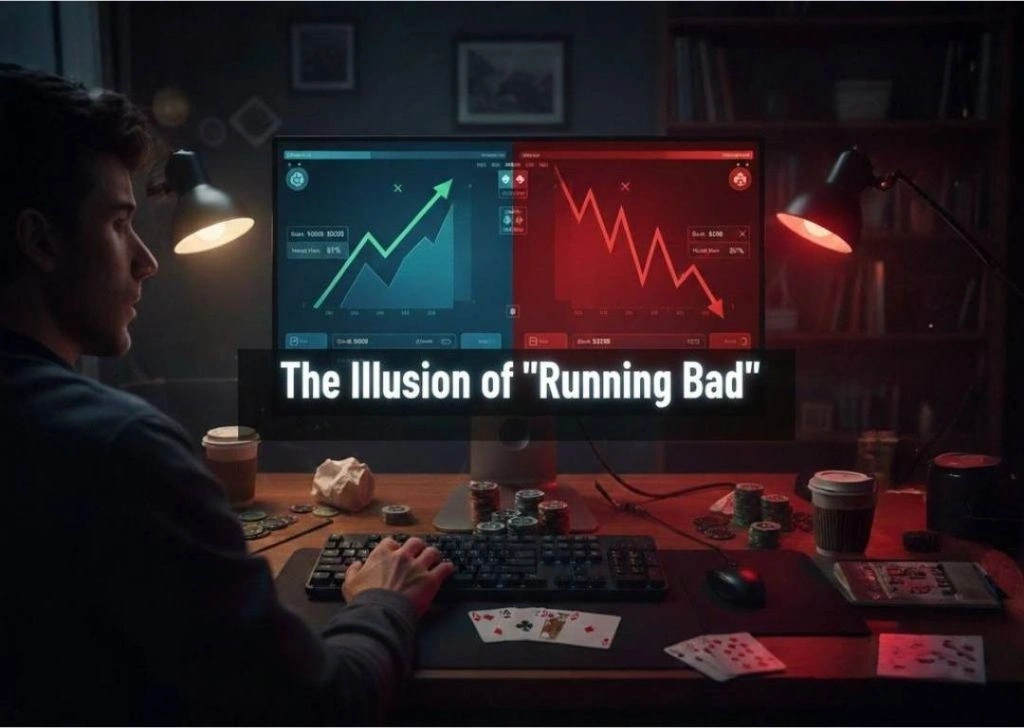
A poker downswing has a special way of sneaking up on you. One week, everything feels smooth, decisions flow naturally, and confidence is high. Then, bang, nothing seems to land. Strong hands lose value, bluffs get snapped, and that quiet thought starts whispering: “Am I doing something wrong, or am I just running bad?”
In online poker, this feeling hits harder and faster. High-volume play compresses time, stacking thousands of decisions into short sessions. What once felt like a mild rough patch now feels like a never-ending spiral. A poker downswing doesn’t just test your strategy it pokes at your patience, discipline, and emotional control.
The truth? Most players don’t fail because of bad cards. They fail because they misunderstand what’s happening during these stretches. This guide breaks down the illusion of “running bad,” explains why downswings are unavoidable in online play, and shows how to navigate them without losing confidence or control.
Understanding the Poker Downswing
A poker downswing isn’t about one unlucky day or a few frustrating sessions. It’s a sustained stretch where outcomes consistently fall short of expectations, even when your decisions remain solid. That gap between playing well and seeing results is what makes downswings so mentally draining.
Online poker amplifies this effect. Volume is relentless. You see more hands, face more marginal spots, and encounter tougher opponents at a faster pace. As a result, variance doesn’t just appear; it slams into you.
Many players mislabel normal variance as a personal failure. They assume skill has vanished overnight, when in reality they’re simply experiencing a natural statistical swing. Understanding this distinction is crucial. Without it, frustration turns into overcorrection, and overcorrection leads to real mistakes.
The Nature of Variance (Why It Happens)
Variance exists because poker outcomes aren’t immediate reflections of decision quality. You can make the right choice repeatedly and still see unfavorable results for long stretches.
Several factors influence how severe a downswing feels:
- Volume intensity: Online play accelerates swings by packing more decisions into less time
- Edge size: Smaller edges naturally produce wider and longer swings
- Game toughness: Stronger opposition increases volatility
- Mental fatigue: Reduced focus magnifies mistakes during bad runs
This is why players sometimes tell stories about the longest downswing poker stretches lasting months. It’s rarely about being “unlucky forever.” It’s about variance colliding with volume.
The smartest players don’t measure progress by days or emotions. They track performance over meaningful samples and focus on decision quality, not short-term outcomes. That perspective alone can remove a huge amount of unnecessary stress.
Surviving a Poker Downswing: Mindset and Strategy
Survival during a downswing isn’t about heroics. It’s about restraint.
This phase exposes how well you handle uncertainty. Confidence takes a hit, doubt creeps in, and suddenly every decision feels heavier than it should. Players start chasing validation from results instead of trusting their process.
The danger isn’t the downswing itself, it’s how players respond to it. Those who panic tighten up too much or start forcing action. Those who stay grounded maintain an edge while others unravel.
Key Mindset Shifts
- Separate confidence from outcomes
Confidence should come from preparation and discipline, not short-term results.
- Normalize discomfort
Feeling uneasy during a downswing doesn’t mean something is broken. It means variance is doing its job.
- Accept uncertainty without reacting to it
Poker rewards patience. The urge to “fix” a downswing immediately often causes more damage than the downswing itself.
- Focus on controllables
You can’t control outcomes, but you can control effort, focus, and decision-making consistency.
Players who master these mindset shifts don’t avoid downswings, they move through them with far less damage.
Practical Poker Downswing Tips
When results stall, structure becomes your anchor. These poker downswing tips help you stay sharp without overhauling your entire approach.
- Review with purpose
Look for patterns, not isolated hands. Ask whether decisions were sound, given the information available at the time.
- Protect mental energy
Long sessions during rough runs drain focus faster. Shorter, higher-quality sessions often outperform forced volume.
- Avoid emotional multitasking
Playing while distracted, tired, or frustrated compounds mistakes. Clarity beats quantity.
- Study proactively
A downswing is a perfect time to reinforce fundamentals, revisit strategy notes, and sharpen weak areas.
- Stabilize before scaling
If pressure builds, reduce intensity temporarily. Regaining rhythm matters more than pushing limits.
Knowing how to deal with poker downswing periods isn’t about playing scared, it’s about playing deliberately when emotions run high.
The “Good” Side of Downswings
As strange as it sounds, downswings play a vital role in poker’s ecosystem. Without them, weaker players wouldn’t stay engaged, and stronger players wouldn’t develop resilience.
Downswings force honesty. They reveal habits hidden during winning streaks, rushed decisions, emotional shortcuts, or subtle overconfidence. They also strengthen patience, a trait that separates long-term winners from short-term thinkers.
Many experienced players later realize their biggest improvements came right after their toughest stretches. Not because losing is enjoyable, but because adversity demands clarity.
FAQs
Q: What is a poker downswing online?
A: It’s a prolonged period of underperformance relative to expectations, often intensified by high-volume online play.
Q: How long can a downswing last?
A: There’s no fixed timeline. Duration depends on volume, edge size, and game conditions. Some end quickly; others test patience.
Q: How to deal with a poker downswing mentally?
A: Focus on process, maintain structure, and avoid reacting emotionally to short-term outcomes.
Q: Should I change my strategy during a downswing?
A: Minor adjustments after review are fine, but drastic changes driven by frustration usually backfire.
Q: Is self-doubt normal during a downswing?
A: Absolutely. The goal isn’t eliminating doubt, but preventing it from dictating decisions.
Conclusion
A poker downswing isn’t proof that you’ve lost your edge. It’s proof that you’re playing a game governed by variance. In high-volume online environments, the illusion of “running bad” feels intense, but it fades when viewed through a wider lens.
Players who last aren’t immune to rough stretches. They simply refuse to let them dictate behavior. Stay disciplined, trust your process, and keep decisions clean. When the swing turns and it will, you’ll still be standing.
Downswings don’t end careers. Poor reactions to them do.